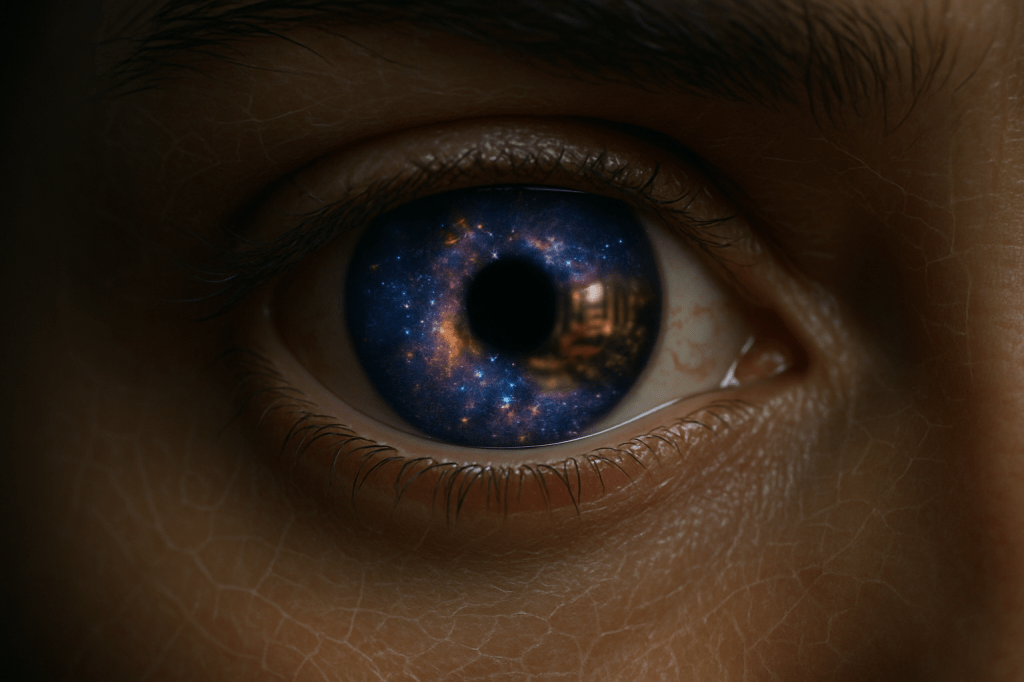
There’s this weird thing that happens when you sit still long enough. Not scrolling-waiting-at-the-dentist still. Actually still. Eyes closed, nowhere to go, nothing to do. After a few minutes, something shifts. The noise drops. The stories you’ve been telling yourself all day – the grocery list, the argument from last week, the thing your boss said – they thin out. And behind them, there’s a kind of open, buzzing quiet. Not empty. Full.
If you’ve meditated, you’ve felt this. If you’ve had a psychedelic experience, you’ve probably met it full-force. And if you’ve read the Corpus Hermeticum, you already know what it is.
The rest of us are just catching up.
The filter you didn’t know you had
Here’s what modern neuroscience has found in the last decade or so, and it’s the kind of finding that should be on every newspaper front page but mostly shows up in academic journals and Reddit threads about consciousness:
Your brain doesn’t generate your experience. It filters it.
This isn’t a metaphor. There’s a network of brain regions – neuroscientists call it the Default Mode Network, or DMN – that lights up when you’re doing nothing in particular. Daydreaming. Ruminating. Thinking about yourself. It’s the constant background hum of “me, me, me,” the narrative voice that constructs your sense of being a separate person moving through a world of separate things.
When the DMN quiets down – through meditation, through breathwork, through psilocybin, through flow states, through a dozen other methods – people report the same thing, every time, across cultures, across centuries. They feel like the boundary between themselves and everything else just… dissolved. They feel connected to something vast. They describe it as the most meaningful experience of their lives.
Marcus Aurelius would have recognized this. So would any student of Hermetic philosophy.
The Kybalion, that compact little text from 1908 that distills ancient Egyptian and Greek Hermetic thought, states the Principle of Mentalism right up front: “The All is Mind; the Universe is Mental.” The idea isn’t that the universe is made of thought the way a dream is made of thought. It’s that consciousness is the ground floor. Everything else – matter, energy, time – arises within it.
Your brain, in this model, isn’t the factory that manufactures your awareness. It’s more like a radio. It picks up a frequency, tunes it, focuses it into something local and usable. And when that radio’s default settings get disrupted – when the “tuning” loosens – you start hearing frequencies you didn’t know were there.
This is what the DMN research is actually showing us. The brain’s default activity, the self-referential chatter, isn’t consciousness. It’s a narrowing of consciousness. A useful narrowing, sure. You need a sense of self to navigate traffic and hold down a job. But it’s a reduction, not the whole picture.
The Hermetic texts knew this. They described the individual mind as a localized expression of universal Mind – a particularization, not a separate creation. “As above, so below.” The pattern of the whole is present in the part.
Neuroscience just gave us an fMRI to see it.
Sitting still as alchemy
Now here’s where it gets practical, because this isn’t just about tripping in the woods and feeling connected to trees – though there’s nothing wrong with that on a Saturday afternoon.
Judson Brewer, a psychiatrist and neuroscientist at Brown University, has spent years studying what happens in the brain during meditation. His work focuses on habit loops – that trigger-behavior-reward cycle that runs your life more than you’d like to admit. You feel anxious, you check your phone, you get a tiny dopamine hit, repeat. You feel lonely, you open the fridge, you chew something, repeat. The loop runs constantly, and most of the time you’re not even aware you’re in one.
Brewer’s research shows something interesting: when meditators practice simple awareness – noticing the urge without acting on it, watching the craving without feeding it – the brain changes. Not metaphorically. The neural pathways that support the habit loop weaken. The prefrontal cortex, the part of you that can step back and observe, gets stronger. The DMN, that default “me” network, loosens its grip.
This is the Hermetic practice of mental alchemy wearing a lab coat.
The Kybalion describes mental transmutation as the art of changing one mental state into another. Not suppressing it. Not fighting it. Changing the energy of the thing by observing it so clearly that it transforms on its own. Lead into gold, but inside your own head.
Brewer’s team found that experienced meditators literally have different brain connectivity patterns. The networks that support rigid, habitual thinking are weaker. The networks that support flexible, present-moment awareness are stronger. The brain has been reorganized – transmuted – through the simple, repeatable act of watching your own mind without grabbing onto what it offers you.
You don’t need to be a monk for this. You don’t need to sit in a cave for twelve years. You need about ten minutes and a chair. The practice is watching. When you feel the pull to react, you notice it. That’s it. The noticing is the alchemy.
One thing I keep coming back to: the Hermetic texts don’t present this as some mystical, rarefied achievement. They describe it as natural. As how the mind works when you stop interfering with it. Brewer’s data says the same thing – the brain already has the capacity for this flexible, open awareness. The habit loops are the interference. You’re not building something new. You’re stopping what’s in the way.
Accidental initiates
Here’s what cracks me up about the current psychedelic research renaissance. Johns Hopkins, NYU, Imperial College London – serious institutions are now publishing peer-reviewed studies showing that psilocybin reliably produces what they call “mystical-type experiences.” Participants rate them among the most meaningful events of their lives, on par with the birth of a child or the death of a parent.
Roland Griffiths and Matthew Johnson at Johns Hopkins have been at this for years now. Their work consistently shows that a single psilocybin session, done in a controlled, supportive setting, can produce lasting changes in well-being, openness, and sense of meaning. The participants describe dissolving into something larger. Feeling unconditional love. Encountering what they call “the sacred.”
Read the Corpus Hermeticum – specifically the Poimandres, the first book – and you’ll find an eerily similar account. Hermes describes an encounter with Nous, the Divine Mind, in which his individual consciousness expanded to encompass the totality of existence. He experienced the dissolution of boundaries between self and cosmos. He received knowledge directly, not through reasoning or sensory input, but through a kind of knowing that preceded both.
The Johns Hopkins participants aren’t reading Hermetic texts beforehand. Most of them have no exposure to this tradition at all. They come in stressed, depressed, or just curious, and they come out describing the same experience that an Egyptian-Greek mystic wrote down two thousand years ago.
That correspondence isn’t a coincidence. It’s not “woo.” It’s what happens when the brain’s filter loosens enough to let in more of the signal. The DMN quiets. The ego, that persistent construction of “I am this and not that,” thins out. And what’s underneath isn’t nothing. It’s something that every contemplative tradition has pointed at, using different vocabularies, across every culture that ever sat still long enough to look.
The Hermetic tradition called it Nous. The Buddhists call it rigpa or buddha-nature. The Advaita Vedantists call it Brahman. The mystics in every tradition have their word for it. The neuroscience just gives us a new language for the same territory: default mode suppression, mystical-type experience, ego dissolution.
Different maps. Same landscape.
What this means for your Tuesday afternoon
So what do you actually do with this? Because I’m not going to tell you to go take psilocybin, though the research is genuinely compelling. And I’m not going to tell you to sit in meditation for an hour a day, because most people won’t, and that’s fine.
Here’s what I keep coming back to, and what the research supports:
First, your mind is not a closed system. That’s the big reframe. You’ve been told, implicitly and explicitly, that your consciousness is a byproduct of your brain chemistry – a trick of neurons firing. The filter theory, backed by DMN research, says otherwise. Your awareness is being channeled, focused, narrowed by your brain, not produced by it. That’s a fundamentally different relationship with your own mind. It means the ceiling is higher than you thought.
Second, observation changes the thing observed. This is the core of Hermetic mental alchemy and it’s what Brewer’s meditation research keeps showing. You don’t have to fight your habits, your anxiety, your looping thoughts. You watch them. The watching itself does the work. The neural pathways shift when you stop feeding them with reactive energy. This isn’t mysticism. It’s neuroscience wearing a very old hat.
Third, you’ve probably already had a taste of this. Think about the last time you were completely absorbed in something – a conversation, a piece of music, a run, a moment in nature where you forgot yourself for a second. That was your DMN quieting down. That was the filter loosening. It happens more often than you think, in small ways, when you’re not trying. The practices – meditation, breathwork, whatever fits your life – just make it more intentional.
The Hermetic texts describe a universe that is mental at its core, alive, connected all the way through. They describe the individual mind as a window into something vast that it can never fully contain but can always learn to open wider.
The neuroscience, stripped of its clinical language, is saying the same thing.
You’re not a brain that happens to have experiences. You’re awareness that happens to have a brain. And that brain has settings you haven’t explored yet.
