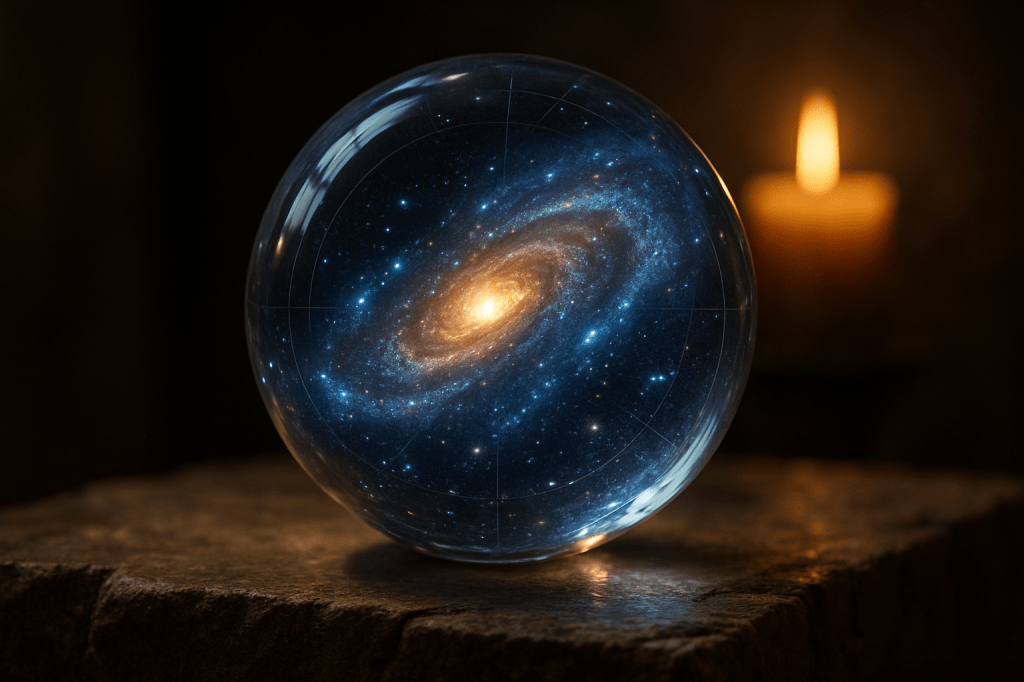
A few months back I was reading about black holes – as one does on a Tuesday night – and I hit a sentence that made me put my coffee down. A group of physicists had essentially proven that the information content of any volume of space can be fully described by the data encoded on its surface. Like a hologram on a credit card: looks three-dimensional, but all the data lives on a flat surface.
I sat with that for a minute.
Because if you’ve read the Kybalion – or even just the first page – you’ve already heard this idea. “The All is Mind; the Universe is Mental.” Reality isn’t built from little bits of matter bouncing around. It’s built from information. From mind. From something that looks an awful lot like a projection.
And here’s the thing that got me. The Kybalion was published in 1908. Maldacena published his paper in 1997. That’s eighty-nine years. Not “ancient mystics vaguely anticipated modern science.” Actual specific overlap, principle for principle, in ways I wasn’t expecting when I started pulling on this thread.
So let me walk you through what I found. Three connections that genuinely shook something loose in how I think about reality.
The holographic principle is “The All is Mind” in math
In 1997, Juan Maldacena – a theoretical physicist at the Institute for Advanced Study – published what’s become one of the most cited papers in physics. It’s called the AdS/CFT correspondence, and the core claim is this: a universe with gravity in it (our universe, basically) can be completely described by a quantum field theory living on the boundary of that universe.
One dimension lower. A flat surface.
Everything that happens inside – every star, every planet, every cup of coffee sitting on your desk – is encoded on the boundary. The inside isn’t less real, but it’s not fundamental either. The boundary is where the actual information lives.
Now hold that thought and flip open the Kybalion to Principle One. “The ALL IS MIND; The Universe is Mental.” The ancient Hermetic teachers said reality is a mental creation of THE ALL – that what we experience as the physical universe is more like a thought than a thing. Not a metaphor. A literal description of how existence works.
I don’t think the Hermetic writers were doing string theory in a cave somewhere. But I do think they were pointing at the same truth that Maldacena stumbled into through tensor calculus: that information is more fundamental than matter. That what we call “the physical world” is a rendering of something deeper.
The holographic principle, confirmed by decades of research since 1997, shows that the maximum amount of information in any region of space grows with the area of its boundary, not its volume. That’s not an engineering limitation. That’s the structure of reality telling you that surfaces matter more than interiors. That the map might be more fundamental than the territory.
“The Universe is Mental” isn’t mysticism. It’s topology.
Entanglement is “As above, so below” doing construction work
Here’s where it gets stranger.
You’ve probably heard of quantum entanglement. Two particles interact, and then no matter how far apart they drift – across a lab, across a galaxy – measuring one instantly determines the state of the other. Einstein hated it. Called it “spooky action at a distance.” He thought it proved quantum mechanics was broken.
It wasn’t broken. It was showing us something about how space works.
In 2013, Maldacena teamed up with Leonard Susskind and proposed something wild: the ER=EPR conjecture. The idea is that entangled particles are connected by tiny wormholes – Einstein-Rosen bridges. Entanglement isn’t just a weird correlation. It’s actual geometric structure. When two particles become entangled, they stitch a thread of spacetime between them.
Now think about what that means at scale. If every entangled pair of particles is creating a tiny wormhole, then the fabric of spacetime itself might be woven from entanglement. Space isn’t a stage that particles happen to live on. Space is what you get when enough particles become entangled with each other.
And the Hermetic principle of Correspondence – “As above, so below” – maps onto this almost too neatly. The principle says the same patterns repeat at every scale. What’s true for the small is true for the large. The microcosm mirrors the macrocosm.
Spacetime, it turns out, is exactly this kind of fractal construction. Entanglement between pairs of particles creates tiny bridges. Aggregate enough of those bridges and you get the geometry of the universe. The small-scale pattern becomes the large-scale structure.
“As above, so below” isn’t a poetic observation. It’s how reality gets built, one entangled pair at a time.
The measurement problem isn’t a problem
This one’s the one that kept me up.
In quantum mechanics, a particle exists as a wave of possibilities until someone measures it. Then it “collapses” into a definite state. Physicists have been arguing about why this happens for a hundred years. The Copenhagen interpretation says don’t worry about it, just do the math. Many-worlds says every possibility happens in a separate universe. Decoherence says the environment causes the collapse.
None of them fully resolve it. There’s always a gap. Always a moment where you have to ask: but why does observation do that?
The Hermetic tradition has an answer. It’s just not the kind of answer that fits in a physics equation, because it reframes the whole question.
Hermeticism says consciousness doesn’t emerge from matter. Matter emerges from consciousness. “The All is Mind” means that what we experience as physical reality is a mental phenomenon – a thought in the universal mind. Consciousness isn’t an accident that happened to evolve on one planet. It’s the ground floor.
If that’s true – and the holographic principle is nudging us in exactly this direction – then the measurement “problem” isn’t a problem. It’s a feature. Observation collapses the wave function because observation is what reality is made of. The universe doesn’t mysteriously respond to being watched. Watching is how the universe renders itself.
You could say the universe is still loading when nobody’s looking. And I half-believe that, except the Hermetic take is subtler. It’s not that consciousness causes reality. It’s that consciousness and reality are the same thing viewed from different angles. Like the inside and the holographic boundary. Two descriptions of one process.
So where does that leave us?
I’ll be honest. I don’t know what to do with all of this on a Wednesday morning. I’m not going to stop buying groceries because reality might be a holographic projection. My mortgage is still due.
But something has shifted in how I think about the relationship between my mind and the world I move through.
The Hermetic tradition isn’t asking you to believe anything. It’s asking you to notice. Notice that patterns repeat. Notice that your experience of reality is always mediated by your mind – by the stories, assumptions, and attention you bring to any moment. Notice that physics, after four centuries of trying to describe a mindless universe, is slowly arriving at the conclusion that information and observation might be more fundamental than particles and forces.
The Kybalion called this two thousand years ago. Not because the ancients had particle accelerators, but because they paid attention to something physics has been trying to avoid: the role of the observer.
If reality is informational – and the holographic principle says it is – then your mind isn’t a passenger in the universe. It’s part of the operating system. Not the whole thing. But not separate from it either.
There’s a quiet power in that. Not the kind that makes you rich or famous. The kind that changes what you think is possible when you sit with a problem, or look at a sunset, or wonder why things happen the way they do.
You’re not made of matter having a spiritual experience. You are information having a material one. And you’ve got a user manual that’s been sitting in plain sight for two millennia.
Maybe it’s time to crack it open.
