Thomas Young was twenty-seven years old when he did something that would haunt physics for two centuries.
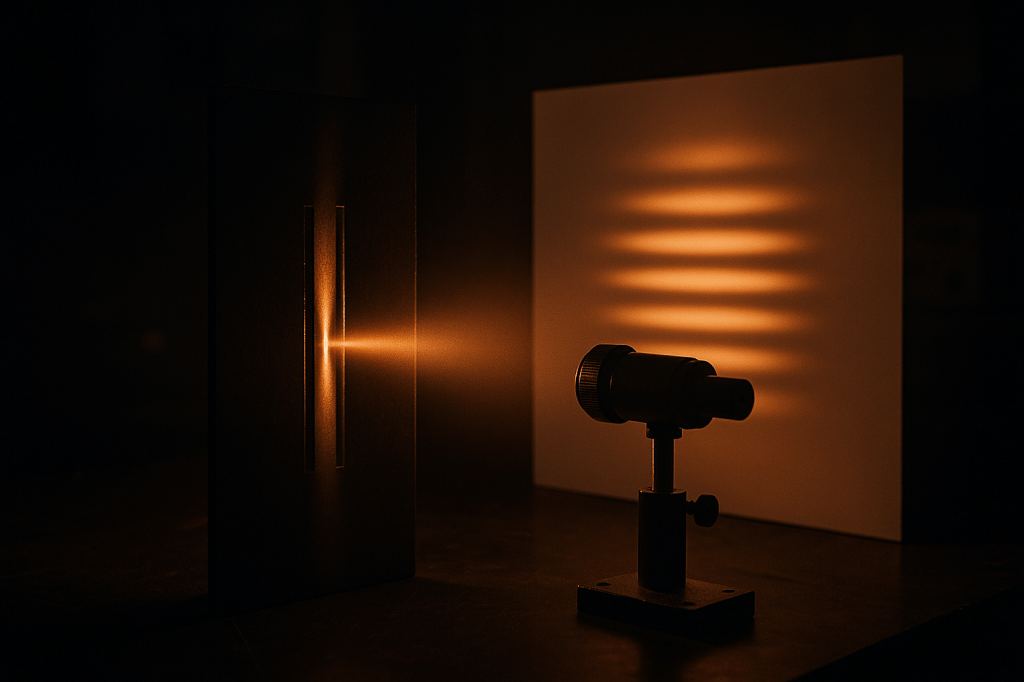
It was 1801. He cut two thin slits in a card, pointed a beam of light at them, and looked at what landed on the wall behind. He expected two bright lines – one for each slit, like light passing through two doorways.
Instead, he got a pattern of alternating bright and dark bands. Light and dark, light and dark, rippling across the wall like waves in a pond where two stones had been dropped.
That pattern meant only one thing. Light wasn’t a stream of tiny bullets traveling in straight lines. It was a wave. And where the peaks of two waves met, you got brightness. Where a peak met a trough, they cancelled out. Darkness.
Young published his findings. The physics establishment largely ignored him for decades. Newton’s particle theory of light was too entrenched. Young died in 1829 without seeing his work fully accepted.
Fast forward about a hundred years. Physics has gotten weird. Quantum mechanics is in full swing, and somebody – nobody’s quite sure who first – had the idea to repeat Young’s experiment with single photons. One photon at a time. Fire it through the slits. Wait. Fire another.
The results shouldn’t have made sense. Each photon landed at a single point on the detector, like a particle. But after thousands of individual photons had passed through, the pattern appeared. The same rippling bands Young saw in 1801. Each photon somehow “knew” where the other photons had landed and chose its spot accordingly.
A single photon interfering with itself. Passing through both slits at once, like a wave, even though it arrived as a particle.
That’s strange enough. But here’s where it gets really uncomfortable.
When you look, the pattern disappears
Physicists added a detector at the slits – something to watch which slit each photon actually went through. The moment they did that, the interference pattern vanished. Two bright lines. Just like Young would have expected in the first place.
Turn the detector off. The pattern comes back.
The photon doesn’t just behave differently when observed. It behaves as a completely different kind of thing. Wave when unwatched. Particle when watched. Same photon. Same experiment. Only difference: whether someone was paying attention.
This has been replicated hundreds of times since the 1920s. The double-slit experiment is not controversial. It’s not fringe. Every physics undergraduate does a version of it. The results are consistent and bizarre.
John Wheeler pushed it further in 1978 with his delayed-choice thought experiment – later confirmed experimentally by Alain Aspect’s team in 2007 and again by Jacques and colleagues in 2016. The idea: what if you wait until after the photon has passed through the slits before deciding whether to observe it? The result is the same. The observation made later still determines the behavior that already happened.
The universe seems to wait for the observer before deciding what occurred.
Now, if you’ve spent any time in spiritual or self-help circles, you’ve probably heard someone invoke quantum physics to justify manifesting your dream life. I want to be upfront: most of that is sloppy. “Your thoughts create reality” slapped onto quantum mechanics without understanding either one. That’s not what I’m doing here.
But there is something genuinely strange happening in these experiments. Something that maps onto an ancient framework in ways worth taking seriously – not as proof, but as a conversation between two ways of seeing that keep arriving at similar places.
The Hermetic version, written thousands of years before the photon
The Kybalion – a collection of Hermetic teachings published in 1908 but drawing on traditions much older – opens with a principle called Mentalism. It states it plainly: “The All is Mind; the Universe is Mental.”
That sounds mystical. Maybe even nonsensical. But sit with the double-slit results for a minute.
In the unobserved state, a photon has no definite position. It exists as a probability wave – a spread of possible locations, all equally real until something interacts with it. The mathematical description (the wavefunction) doesn’t say “the photon is here.” It says “the photon might be here, or here, or here,” and assigns a probability to each.
When you measure it, the wavefunction collapses. One definite position. One outcome. The act of looking turns possibility into actuality.
The Hermetic tradition says consciousness isn’t just a bystander watching the universe go by. It’s participatory. Mind isn’t separate from matter – mind is the substrate. Matter is what mind looks like from the inside.
I’m not claiming Thomas Young proved the Kybalion. I’m saying the double-slit experiment shows something the Hermeticists would have recognized immediately: the observer and the observed are not cleanly separable. Looking changes things. Participation isn’t optional.
The physicist Pascual Jordan, who worked with Heisenberg and Born on matrix mechanics, said it bluntly in the 1920s: “We ourselves produce the results of measurement.” He wasn’t being poetic. He was describing the math.
Two things at once, depending on how you ask
Here’s the second layer.
Light is a wave. Except when you look at it, and then it’s a particle. These aren’t two different kinds of light. It’s the same light, expressing differently depending on what you ask it.
The Hermetic Principle of Polarity says: “Everything is dual; everything has poles; everything has its pair of opposites; opposites are identical in nature, but different in degree.”
Hot and cold aren’t different substances. They’re the same thing – thermal energy – at different points on a spectrum. Same with love and hate, courage and fear, up and down. Polarity says you’re looking at one thing with two faces.
Wave and particle. Two faces. One photon.
The measurement you choose determines which face shows up. Point a detector at the slits and the photon says “particle.” Turn it off and the photon says “wave.” You didn’t change the photon. You changed the question.
This is what the Kybalion means by “different in degree, not in kind.” The photon doesn’t switch between two realities. It’s one reality that expresses as either pole depending on context.
And here’s the part that always gets me: this isn’t a metaphor. The math of quantum mechanics literally describes light as a superposition of wave and particle states. The formalism doesn’t commit to one or the other until measurement forces a choice. Physics has been describing polarity without calling it that for a century.
Entangled across any distance
The third piece.
In 1935, Einstein, Podolsky, and Rosen published a paper arguing that quantum mechanics must be incomplete. Their reasoning: if you create two particles that are linked (entangled) and send them in opposite directions, measuring one instantly determines the state of the other. That could be across a room. It could be across a galaxy. Instantly. No signal traveling between them.
Einstein called it “spooky action at a distance” and figured it proved something was wrong with the theory. He died believing that. But in 1964, physicist John Bell devised a test – Bell’s inequality – that could distinguish between Einstein’s preferred explanation (hidden variables, predetermined outcomes) and the quantum prediction (genuine non-local connection).
The experiments came in the 1970s and 1980s. Clauser in 1972. Aspect in 1982. Zeilinger in 1998. Every time, quantum mechanics won. Bell’s inequality was violated. The particles were genuinely connected in a way that doesn’t depend on distance or any signal traveling between them.
(Aspect, Clauser, and Zeilinger shared the 2022 Nobel Prize in Physics for this work. Decades of experiments, vindicated.)
The Hermetic Principle of Correspondence says: “As above, so below; as below, so above.”
That phrase gets used loosely – astrology, microcosm-macrocosm analogies, all sorts of things. But at its core, it’s saying the same thing entanglement demonstrates: reality is connected at a level deeper than spatial separation. What happens here reflects what happens there, not because of a message sent between them, but because the separation was never as complete as it looked.
Entangled particles aren’t two things that happen to be correlated. They’re one system described by a single wavefunction. Measuring one doesn’t send a signal to the other. It reveals something about the whole.
Correspondence, in its most literal sense. The pattern repeats. The part contains the whole. Distance is real at the surface but doesn’t reach the foundation.
So what does this actually mean for you?
I’m not going to tell you that quantum physics proves you can manifest a parking spot. That would be dishonest, and it cheapens both the science and the philosophy.
But here’s what I think is genuinely useful to sit with.
Your attention is not passive. The double-slit experiment shows that observation participates in creating outcomes. You don’t just receive reality – you’re part of how it takes shape. This doesn’t mean you control everything. It means the act of paying attention, of engaging, of choosing what to look at and how – that matters. It’s not nothing.
Opposites are closer than they look. Wave and particle. Success and failure. Love and loss. Polarity says these aren’t enemies. They’re the same energy on a spectrum. When you’re in one pole, the other isn’t gone – it’s the same thing at a different pitch. This can change how you hold difficult moments. You’re not stuck at one end. The spectrum is fluid.
Separation is partial. Entanglement suggests that at the deepest level, things aren’t as disconnected as they appear on the surface. Your mind and the world around you aren’t two sealed containers. Your relationships, your environment, your attention – these are entangled systems. What you put into one ripples into others in ways you can’t always trace.
None of this requires you to “believe in” quantum physics as a spiritual framework. The science stands on its own. The Hermetic principles stand on their own. What’s interesting is that they keep pointing in the same direction – toward a reality that’s more participatory, more interconnected, and more responsive to consciousness than the old mechanistic model suggested.
Thomas Young couldn’t have imagined any of this. He just shot some light through a card and noticed something odd. Two hundred and twenty-five years later, we’re still trying to figure out what it means.
Maybe the strangest part isn’t the physics. Maybe it’s that people figured out the philosophical implications thousands of years before the experiments existed.
Or maybe that’s exactly what Correspondence predicts.
