I want to do some math with you. Don’t worry, I can barely do long division and even I can handle this.
The average American kid spends roughly 1,000 hours a year in school. K through 12 is 13 years, so that’s 13,000 hours. Tack on college if you went, another 4,000 or so. Or if you went to a trade school or some sort of training in your life – that’s another 2,000 hours or so. Call the whole thing an average of 15,000 hours of structured education for the average American that graduated High School and received at least some additional education.
In that time you learned about mitochondria. The powerhouse of the cell, obviously. Treaty of Westphalia. Quadratic formula. The five-paragraph essay, which I’m still slightly bitter about because nobody in the real world has ever asked me for one. I remember dissecting a frog in tenth grade. Mine had a huge liver, which my lab partner and I thought was the funniest thing that had ever happened to us. We were fifteen. The bar was low.
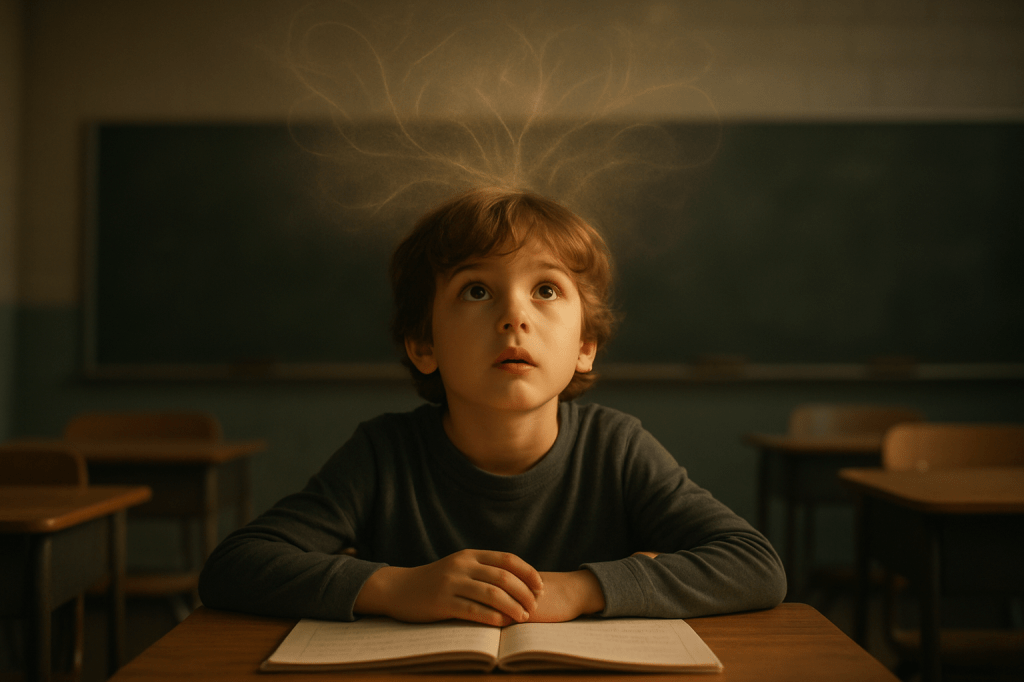
But what you didn’t learn, what not one of those 15,000 hours covered, was what your mind actually is.
The brain, sure. They did the brain. Neurons, synapses, prefrontal cortex, amygdala, all of it. But the mind itself? Consciousness? The thing reading this sentence right now and somehow understanding it?
Zero. Absolutely nothing.
The Assumption You Swallowed Whole
Here’s what happened instead, and it was subtle enough that most people never noticed it. School never said “here comes a philosophical position.” It just handed you a worldview and labeled it science.
The deal: your brain produces consciousness. You are your neurons. Brain dies, you die. Everything you experience, love, boredom, that specific ache of hearing a song you haven’t heard since middle school, all electrochemical noise in three pounds of tissue.
That’s physicalism. Serious philosophical position, serious defenders, not knocking it as a hypothesis. The problem is it was never framed as a hypothesis for you. It was just “this is how it is.”
Nobody mentioned that the hard problem of consciousness is wide open. We can map which brain regions fire when you see red. We have zero idea why you experience redness. None. The most basic fact of your existence, that it feels like something to be you, and we can’t explain it. Your biology textbook treated that like an optional chapter. It’s not optional. It might be the only question that actually matters.
Nobody brought up David Chalmers. Nobody pointed out that neuroscience works entirely on the correlation side of things. This brain state goes with that experience. Great. But correlation isn’t causation, and we’ve never crossed that bridge. “The brain produces consciousness” is an inference. Not a bad one. But unproven.
You got handed a conclusion and taught not to look at it too closely.
The Other Possibility
There’s a much older tradition. We’re talking thousands of years old. It comes at this from the completely opposite direction.
The Hermetic lineage runs through the Kybalion, the Corpus Hermeticum, the Emerald Tablet. Its core claim lands in one sentence: “The All is Mind; the Universe is Mental.”
What that means without the mystical trimmings: consciousness isn’t a byproduct of matter. It’s the foundation. Matter happens within it.
Whole thing flipped. Brain doesn’t create mind. Mind is fundamental and the brain works more like a receiver. A tuning device.
I like the radio metaphor. A radio doesn’t generate the broadcast. It picks up a signal and turns it into sound you can hear. Bang up the radio, the signal distorts. Smash the radio, the broadcast is still going somewhere. The radio was never the source.
Your brain is doing real work under this model. Shaping, filtering, focusing consciousness into something localized and specific. You whack your head and see stars. Something physical definitely happened that changed how consciousness is showing up for you. But that doesn’t prove consciousness is physical. A broken radio doesn’t prove music is made of transistors.
I’m not asking you to buy this wholesale. I’m pointing out that you never got presented with it as an option.
You grew up in a system with one framework taught as the only truth. Meanwhile, consciousness-as-fundamental has been explored by contemplative traditions on every continent for millennia. Your school didn’t mention that. Which is a pretty big omission if you think about it for more than thirty seconds.
Why This Actually Matters
I can hear the objection. “Cool philosophy, but I have rent due on Tuesday.”
Fair. Here’s the practical angle.
If consciousness is just neurons, then your thoughts are you. You literally are your anxiety. You are the 2 AM voice that won’t shut up. Other people are their brain chemistry too. Free will is probably fake. Death is lights-out. The universe is dead machinery that accidentally spawned observers. Fun times.
Flip the framework. If consciousness is fundamental, your thoughts are events within awareness. You aren’t your thoughts. You’re the space they happen in. Other people are also expressions of the same underlying consciousness. That’s not feel-good fluff, it’s a claim about the structure of reality. Death could be a mode change rather than an ending. The signal goes on; the receiver doesn’t.
These aren’t small differences. They rewire how you relate to your mind, to other people, to mortality. They shift what seems possible.
And you never got to choose between them because only one was on the menu.
Three Ways to Start Investigating This Yourself
I said “investigating” deliberately. This isn’t belief. The whole Hermetic thing is “here’s a hypothesis, go test it against your own direct experience.” Your consciousness is the lab.
1. Watch Without Identifying
Ten minutes. Quiet spot. Timer on so you’re not peeking at the clock.
Just watch. Thoughts drift in and out. Emotions rise, plateau, fall away. Sensations. Sounds. That itch on your nose that always shows up the second you try to be still.
Don’t interfere. Don’t curate. Just watch.
Something interesting will show up. There’s a gap between a thought and whatever is watching the thought. “I’m hungry” floats through and something else notices it float through. “This is dumb” appears and something watches that too.
That gap is worth paying attention to.
Pure brain activity wouldn’t have a witness. It’d just be thoughts from the inside, no distance at all. But there is distance. Something there that sees the mental activity without being identical to it.
Test it right now if you want. Pick a number. Any number. Done? Something just watched you pick it. What was that?
2. The “Who Is Watching?” Thing
Throughout your day, stop every so often and ask: who’s aware of this right now? Not in a panic-attack way. Just a check-in. Doing dishes, who feels the hot water? Walking outside, who notices the light?
Then go backwards. If “I” am watching my thoughts, who’s watching the “I” that’s watching? If I can observe my sense of self, the observer has to be something beyond that self.
Keep peeling. Every answer you find, ask who knows that answer.
You’ll run out of words. Hit something that resists description. That’s not failure. That’s the actual point. You’re touching raw awareness, before any content gets added.
Buddhists call it “original face.” Hermetics call it the universal Mind looking at itself through a particular window. Doesn’t matter what you call it. It’s there. No training needed, just a real question.
3. Correspondence
“As above, so below.” The old idea that patterns repeat at every scale.
Get a notebook. Or write yourself an email. When you get up, write what you feel. Do you feel anxious? Nervous? Happy? You don’t have to write a lot – just a sentence. Even a word. Then, before you go to bed, write what the world brought you that day. Something good? Something bad? A whole lot of nothing. Do this for a week or two.
When I did this, the mornings I woke up anxious, the day conspired. Bad traffic, cold coffee, someone cut me off, meeting went sideways. Mornings I felt clear, same city, same commute, same job, and somehow things just flowed. The world didn’t change. The filter did.
It works the other direction too. Things you think about consistently start appearing. Not in a “manifest a sports car” way. More like: you’ve been thinking about switching careers and suddenly every third person you meet has done it. You read about a weird historical event and then it comes up twice more that week.
The Hermetic take: that’s correspondence. Inner and outer reflecting each other because they’re both expressions of the same mental reality. Could be confirmation bias too. Could be both. Point is, start paying attention and see what pattern emerges.
Two weeks. Notebook. Morning mood, day’s events. Not scientific, but you’ll see something.
The Thing They Should Have Taught
We’re in a weird moment. AI writes essays, solves math, codes software, passes bar exams. Everything school trained you to do, a machine now does faster.
The one thing school skipped, understanding consciousness itself, turns out to be the one thing that can’t be outsourced. You can’t automate self-awareness. You can’t hand “what am I?” to a machine. An AI can describe consciousness. It can’t know what it feels like. (If it can, we’re in way more interesting territory, but that’s a different post entirely.)
So maybe 15,000 hours missed the most important subject. Or maybe the institution just wasn’t built for it. Schools are good at transmitting information. They’re not great at asking you to look at the thing that’s receiving the information.
Either way. You don’t need the institution. Ten minutes watching your thoughts. “Who is aware of this?” at a red light. Noticing the gap between you and the stuff moving through your head.
No permission required. No prerequisites either, which is more than I can say for most things worth doing.
Just look.
