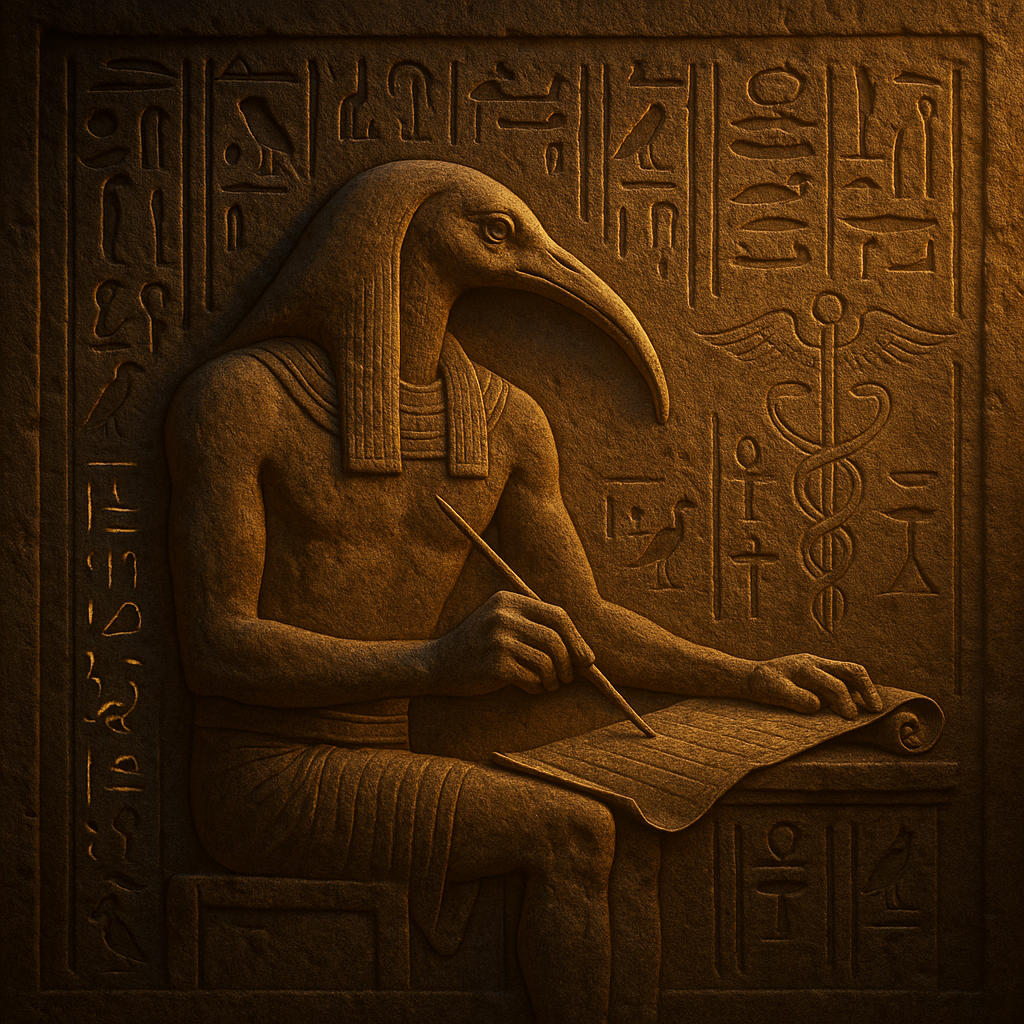
Before Hermes Trismegistus, there was Thoth. Not a sage. Not a philosopher. A god, standing in the hall of judgment, holding a reed pen over the cosmos, recording the weight of every soul that passed through the underworld. And here’s the part people tend to skip: the Egyptians didn’t think he was just writing things down after they happened. They believed his writing made them happen.
That distinction changes everything about how you understand the Hermetic tradition.
The scribe who spoke the world into being
Most people who’ve heard of Hermes Trismegistus have a vague sense that he was some ancient wise man who wrote mystical texts. A kind of proto-philosopher in a toga. But that’s like saying the ocean is “some water.” The figure we call Hermes Trismegistus has roots that go much deeper and much stranger than a Greek man in a toga.
Go back two thousand years before the Greeks got involved. In Egypt, Thoth was already ancient. The Egyptians called him Djehuty, and his portfolio was enormous. He was the god of writing, magic, wisdom, the moon, measurement, and time. He invented hieroglyphics. He authored the Book of the Dead. He served as the scribe of the gods and the arbiter of cosmic truth.
But here’s the part that matters: Thoth didn’t write things down the way a court stenographer writes down testimony. The Egyptian conception of Thoth’s writing was active. Generative. When Thoth spoke or wrote, reality shifted to match. His words weren’t descriptions of what was. They were instructions for what would become.
Think about that for a second. The oldest known version of the Hermetic tradition starts with the idea that language creates reality. Not metaphorically. Not poetically. Operationally. The god of wisdom understood that words shape the world, and the world bends to accommodate them.
Sound familiar? If you’ve read the Kybalion, it should. The First Principle of Mentalism says “The All is Mind; the Universe is Mental.” Consciousness is primary. The mental precedes the physical. Thought produces form. Thoth embodied this principle thousands of years before anyone put it in writing. He was Mentalism in divine form, a living demonstration that the mental fabric of reality can be worked with, shaped, and inscribed.
The Egyptians didn’t separate writing from magic. To write something down was to make it real. To speak a name was to invoke a being. To inscribe a spell on a tomb wall was to guarantee its effect in the afterlife. This wasn’t superstition. It was a technology of consciousness that the Hermetic tradition would eventually inherit and refine.
Where the roads meet
Now fast forward a few centuries. Alexander the Great conquers Egypt in 332 BCE, and suddenly Greek and Egyptian culture are in the same room, eyeing each other. The Greeks had their own god of communication: Hermes, the messenger, the trickster, the guide of souls between worlds. And when Greek scholars encountered Thoth, they did what Greeks always did with gods they liked. They adopted him.
But not directly. They didn’t just rename Thoth as Hermes. They merged the two. And that merger produced something neither tradition had on its own.
Thoth brought the creation framework. He was the cosmic scribe, the one who wrote reality into existence, the keeper of divine knowledge. His domain was the fundamental structure of things, how reality works at the deepest level.
Hermes brought the communication framework. He was the messenger between worlds, the translator of divine knowledge into human language, the one who carried information across boundaries. His domain was movement, exchange, connection.
Together, they produced a figure who could both understand how reality works AND explain it. Who could both receive divine knowledge and transmit it to mortals. Who was equally at home in the cosmic architecture and the human conversation.
That’s why the Hermetic texts have the quality they do. Read the Corpus Hermeticum and you’ll notice something strange: the texts oscillate between enormous, sweeping statements about the nature of the cosmos and surprisingly practical advice about how to live. One passage describes the structure of reality itself. The next gives you something you can actually do on a Tuesday afternoon. That oscillation isn’t a flaw. It’s the Thoth-Hermes merger working exactly as intended. Thoth provides the cosmic architecture. Hermes provides the practical transmission.
The Egyptian side says “here is how the universe is built.” The Greek side says “and here is how to tell someone about it.” Neither one works without the other. A god who understands creation but can’t communicate it is useless to humans. A messenger who can talk but has nothing worth saying is just noise.
Three times great
Which brings us to the title itself. “Trismegistus” means “thrice-great” or “three times great.” Why three?
The standard explanation you’ll find in most Hermetic introductions is that Hermes mastered three disciplines: alchemy, astrology, and theurgy. That’s the medieval interpretation, and it’s not wrong, exactly. But there’s an older, simpler, stranger explanation.
In Egyptian tradition, Thoth held a title that translates roughly as “the great, the great, the great.” Three times. The repetition wasn’t redundancy. It was emphasis of the highest order. Thoth was the greatest of the gods. The greatest of the scribes. The greatest of the magicians. Three domains, three supremacies, three times great.
And those three domains map directly onto what the Hermetic tradition considers the pillars of practice.
The first domain: understanding reality. Thoth was the greatest god because he grasped the fundamental nature of existence. He knew how the cosmos was structured, how thought produced matter, how the mental and physical related to each other. This is Mentalism in action. Before you can shape reality, you have to understand what it’s made of, and what it’s made of is consciousness.
The second domain: shaping reality. Thoth was the greatest scribe because his writing was active, creative, generative. He didn’t record the world. He authored it. This is the practical application of Hermetic principles: using your understanding of mental reality to actually change your experience. Not wishing. Not hoping. Working with the mental fabric of things the way Thoth worked with papyrus and ink.
The third domain: communicating reality. Thoth was the greatest magician because magic, in the Egyptian sense, was fundamentally about language. The right words, spoken in the right way, at the right time, could alter the fabric of existence. When the Greeks merged Thoth with Hermes, this third domain became even more prominent. Hermes was the god of communication. Teaching, translating, transmitting – making the cosmic accessible to the human.
Three greatnesses. Three domains. And if you practice any form of Hermeticism, you’ll recognize all three in your own work. You study to understand. You practice to shape. You share to transmit. That’s not a coincidence. It’s the original architecture.
Why the lineage matters
Here’s a question worth sitting with: why should any of this matter to someone reading a blog post in 2026?
Because most people encounter Hermes Trismegistus as a name without a body. A label on a text. A figure attached to seven principles that sound nice but feel unmoored. There’s no weight to it. No history. No depth.
But when you trace the lineage back to Thoth, something shifts. The principles stop being abstract ideas and start being descriptions of a technology that humans have been working with for thousands of years. Mentalism isn’t just “the All is Mind.” It’s the understanding that a god of wisdom embodied long before anyone wrote a book about it. The principle of creation isn’t a nice metaphor. It’s what Thoth did every time he put reed to papyrus and made something real.
The lineage also explains why Hermeticism feels different from other esoteric traditions. It’s not purely mystical. It has that Egyptian practicality baked in. Thoth didn’t sit around contemplating the nature of reality. He wrote it down. He made it real. He used language as a tool, not a prayer. And that practical, active quality runs through every Hermetic text from the Emerald Tablet to the Kybalion to whatever you’re reading right now.
When you pick up a Hermetic text, you’re not just reading words on a page. You’re engaging with a tradition that stretches back to a god who understood that words are the mechanism of creation. That reading is an act of participation in the structure of reality. That the pen and the cosmos have always been connected.
That understanding doesn’t just add historical context. It changes how you read. It changes how you practice. It changes what you think is possible when you sit down with a text and really pay attention to what it’s saying.
The god at the writing desk
There’s an image that stays with you once you’ve seen it. Not the ibis-headed figure standing in judgment in the Book of the Dead. Something quieter. A god, alone, at a writing desk. Reed pen in hand. Ink prepared. And in front of him, not papyrus, but the raw material of reality itself, waiting to be shaped.
The Egyptians understood something that the Hermetic tradition preserved and that modern physics is slowly, reluctantly arriving at: reality is not made of things. It’s made of information. Of structure. Of something that behaves more like language than like matter. And language, wielded with understanding, is the most powerful technology there is.
Thoth knew this. Hermes knew this. And now you know it too.
The next time you write something down – a journal entry, a plan, a letter, even a to-do list – remember what you’re participating in. You’re not just organizing your thoughts. You’re using the same technology that a god used to shape the cosmos. The reed pen is different. The ink is different. The principle is the same.
Write something real. Write it down like it matters. Because it does. It always has.