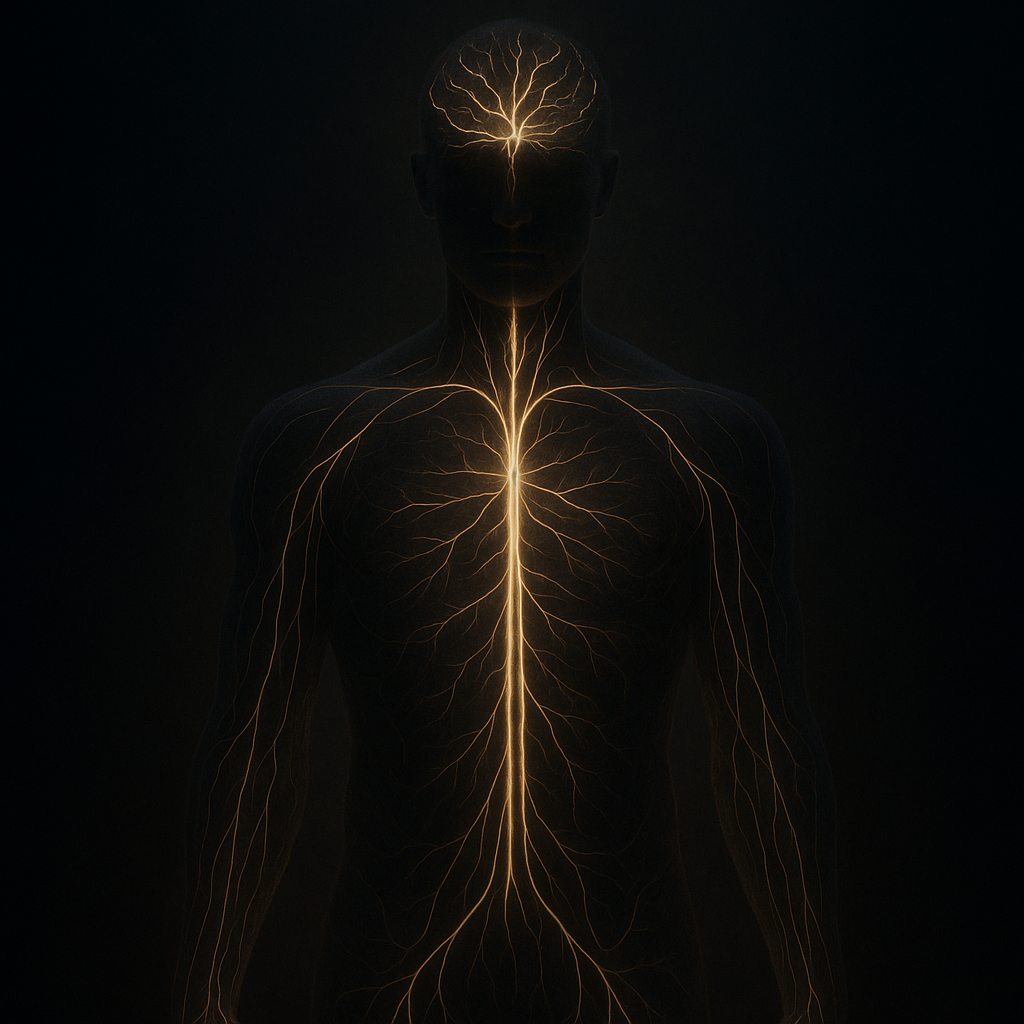
You have a headache. You go to the doctor. They run blood work, order a CT scan, maybe check your blood pressure twice. Everything comes back normal. They pat you on the shoulder and say it’s stress. You already knew that. What they didn’t tell you is that the stress isn’t just “life being hard” or “too much on your plate.” The stress is a conversation between your mind and your body, and your mind has been doing most of the talking.
You’ve had this happen. Maybe not the headache exactly, but something. The knot in your stomach before a meeting you’ve prepared for a hundred times. The tightness in your jaw that shows up around certain family members. The back pain that flares every time work gets overwhelming. Your doctor sends you home with ibuprofen and a suggestion to “relax more,” as if relaxation is a switch you forgot to flip.
But here’s what nobody explains: those physical symptoms aren’t malfunctions. They’re messages.
The Conversation You Didn’t Know You Were Having
The Hermetic tradition has a name for this. Actually, it has a phrase: “As above, so below.” It’s the Principle of Correspondence, and it says that patterns repeat at every level of reality. What happens on one plane echoes on every other plane. The mental and the physical aren’t separate kingdoms with a border between them. They’re the same territory at different resolutions.
Think of it like a pond. Drop a stone in and the ripples don’t stay on the surface. They reach the bottom. Your thoughts are the stone. Your body is the pond. And the ripples have been hitting bottom for years without you noticing.
The Kybalion puts it plainly: “As above, so below; as below, so above.” This isn’t poetry. It’s mechanics. Anxiety doesn’t just live in your head as a thought you can “think your way out of.” Anxiety produces cortisol. That cortisol courses through your blood, tightens your muscles, suppresses your immune response, and alters your digestion. Anger triggers adrenaline. That adrenaline raises your heart rate, tenses your shoulders, and diverts blood from your extremities toward your core. Joy generates endorphins. Those endorphins relax your blood vessels, ease inflammation, and make your whole system hum a little differently.
These aren’t side effects. They’re correspondences. The body is the physical expression of the mental state, every single time, without exception.
What the Lab Coat Confirms
Now, you might be thinking this sounds like something your yoga teacher would say while burning sage. Fair enough. But the science is hard to dismiss.
There’s an entire field of medicine called psychoneuroimmunology. It’s a mouthful. Most people have never heard of it. But it’s been around since the 1970s, and the research it’s produced is some of the most quietly revolutionary work in modern medicine.
What does it study? Exactly what the Hermetic tradition has been saying for millennia. How mental states affect the nervous system and the immune system. Not metaphorically. Chemically. Measurably.
Here’s what the researchers found. Chronic stress, the kind that comes from sustained negative thought patterns, ongoing worry, unresolved emotional tension, actually suppresses immune function. Not a little. Enough that wound healing slows down. Enough that you catch colds more often. Enough that inflammation markers rise and stay elevated in ways that contribute to heart disease, autoimmune conditions, and a dozen other things your doctor will treat as separate problems without ever asking what’s happening between your ears.
One landmark study showed that caregivers, people caring for a spouse with dementia, had immune systems that looked measurably worse than non-caregivers. Same age. Same diet. Same neighborhood. The difference was the mental load. The worry, the exhaustion, the emotional weight of watching someone you love decline. Their bodies were bearing the cost of their minds.
Another set of studies looked at wound healing speed in people under high psychological stress versus low stress. The high-stress group healed 24% slower. Same wound. Same treatment. Different minds. Different bodies.
And it works the other direction too. Positive mental states, genuine ones, not the forced smile kind, actually accelerate healing. Laughter increases natural killer cell activity. Meditation reduces inflammatory markers. Even the simple act of feeling supported by others measurably improves immune function.
The Hermetic tradition didn’t have lab equipment. They had centuries of observation. And they arrived at the same conclusion: the mind and body are not separate. They never were.
Where Your Body Stores Your Story
Here’s where it gets personal. And slightly strange.
Your body doesn’t just respond to your mental states in general terms. It seems to have patterns. Specific kinds of tension tend to show up in specific places, and those patterns are remarkably consistent across people.
Tension in the shoulders and neck. If you carry a lot of responsibility, if you’re the one everyone depends on, if you feel like you’re holding things together for other people, check your shoulders right now. Seriously. Roll them back. If they were up near your ears, you’re not alone. The shoulders are where people store the weight of obligation.
Stomach issues. Knots, nausea, that churning feeling that shows up before decisions, transitions, anything where the outcome is uncertain. The gut is deeply connected to the nervous system, more than most people realize. There are more neurons in your enteric nervous system, your gut brain, than in your spinal cord. When your mind is churning about the future, your gut churning isn’t a coincidence. It’s a correspondence.
Headaches and jaw tension. These often show up in people who overthink. People who run scenarios on repeat. Those who analyze every conversation after it happens and pre-analyze conversations that haven’t happened yet. The mind is grinding, and the body grinds with it. Clench your jaw right now. Notice how much effort that takes. Now imagine doing that unconsciously for eight hours.
Lower back pain. This one’s interesting. The lower back is structurally about support. It’s the foundation that holds you upright. When people feel unsupported, financially, emotionally, in their relationships, the lower back often speaks up. Not always. Bodies are complicated. But the correlation shows up enough that it’s worth paying attention to.
Chest tightness. Grief, heartbreak, emotional armor. People who’ve learned to protect themselves emotionally often carry that protection as physical tension across the chest. It’s as if the body took the metaphor literally. Guard your heart. So it does.
None of this means your back pain is “all in your head.” It’s the opposite. It’s all in your body. The body is doing exactly what it’s supposed to do. It’s reporting. And the report is about you.
Five Minutes That Might Change How You Listen
Here’s something you can try today. It takes five minutes. You don’t need an app, a cushion, or any special training. Just a quiet place to sit.
Close your eyes. Take three slow breaths. Not deep breaths, not belly breaths, not any particular technique. Just slow ones.
Now scan your body. Start at the top of your head and move downward, slowly, like you’re shining a flashlight down the front of your body. Your scalp. Your forehead. Your eyes, are they tense? Your jaw. Your neck. Your shoulders. Your chest. Your stomach. Your lower back. Your hips. Your legs. Your feet.
Don’t try to fix anything. Don’t stretch. Don’t adjust. Just notice.
Where do you feel something? Tension, tightness, pain, heat, numbness, anything. Wherever the flashlight finds something, pause there.
And ask one question: “What mental state might be producing this?”
Don’t force an answer. Don’t analyze it like a puzzle. Just let the question sit there, in that part of your body, and see what comes up. Sometimes you’ll get an immediate answer, a feeling, a memory, an insight about something that’s been weighing on you. Sometimes you’ll get nothing, and that’s fine too. The point isn’t to crack a code. It’s to start a conversation.
Because here’s the thing about conversations. They only work if both sides are listening. Your mind has been talking to your body for years, issuing commands, pouring stress hormones into the bloodstream, tightening muscles in response to threats that exist only as thoughts. Your body has been listening to every word. And it’s been trying to talk back.
The body scan is how you start listening.
The Correspondence Nobody Taught You
School teaches you that the mind and body are separate things. The mind is up here, doing the important work of thinking. The body is down there, a vehicle that carries the brain around and occasionally breaks down. Medicine reinforces this. You see a doctor for the body and a therapist for the mind, as if they’re servicing different machines.
The Hermetic tradition never made that split. For them, the mental plane and the physical plane were aspects of the same reality, like the inside and outside of a sphere. You can’t touch one without affecting the other. You never could.
And this is where it gets interesting for your everyday life. Because if your thoughts produce physical effects, and they do, then the reverse is also true. Changes in your physical state can shift your mental state. This is why exercise helps with depression, not because it “distracts” you, but because the body is sending new signals back to the mind. This is why deep breathing calms panic, not because it’s a trick, but because you’re altering the physical pattern and the mental pattern follows. As above, so below. As below, so above. The correspondence runs in both directions.
You don’t have to believe in anything mystical for this to work. You just have to notice what’s already happening. Your mind is shaping your body right now, in this moment, as you read this. The question is whether you’re shaping it on purpose or by default.
Most people are doing it by default. Their thoughts run wild, and their bodies bear the consequences. Worry becomes a clenched jaw. Resentment becomes a tight chest. Overwork becomes a wrecked lower back. And nobody told them there was another option.
There is. You start by listening.
One Small Shift
Try the body scan today. Five minutes. Head to toe. One question at each place of tension: “What mental state might be producing this?”
You might find that the headache isn’t about your sinuses. The stomach isn’t about the food you ate. The back pain isn’t about the mattress.
You might find that your body has been trying to tell you something for years, and you’ve been too busy, too distracted, too convinced that the body and mind are separate to hear it.
Your body is listening to every thought you have. Maybe it’s time you started listening back.