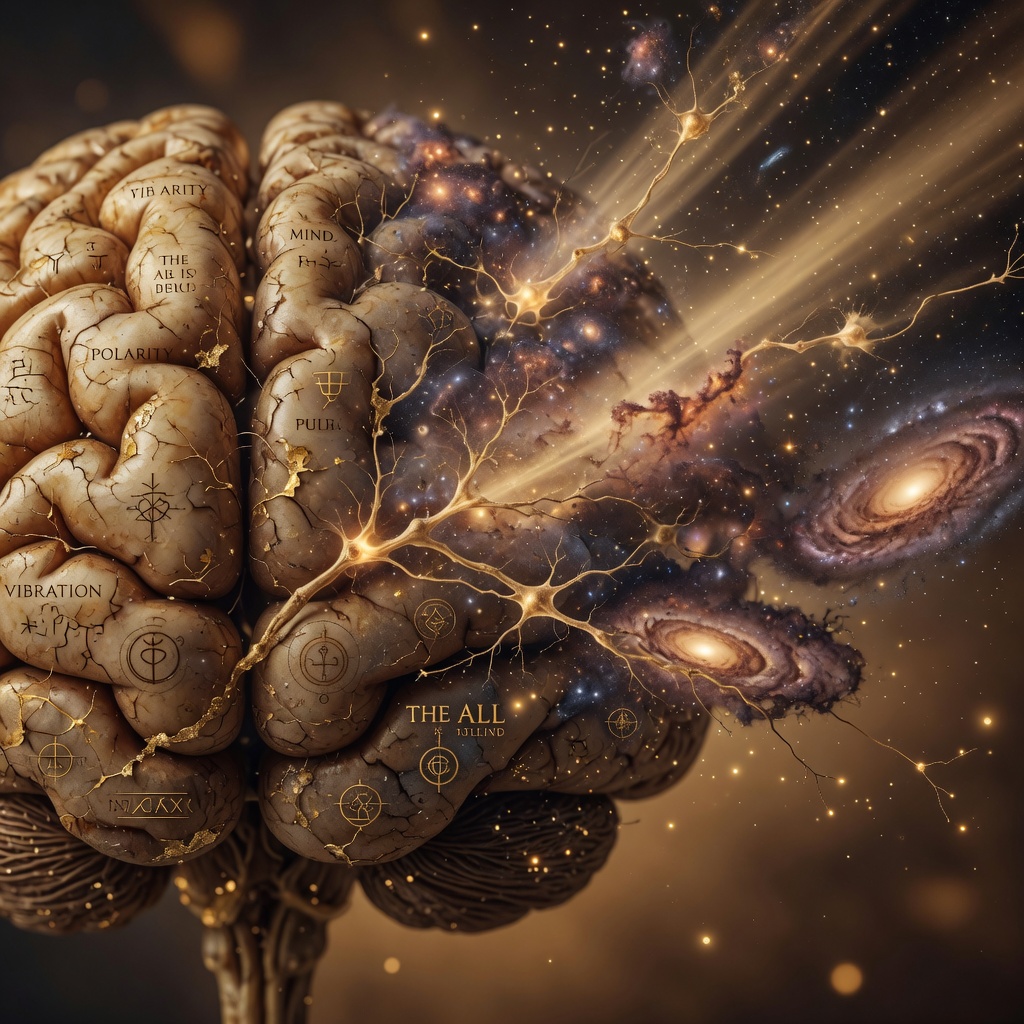
That weird moment when classified research sounds like a philosophy lecture
Scroll through your social media feed on any given Tuesday, and sandwiched between ads and memes, you might catch something that makes you stop mid-thumb-swipe. Something that doesn’t quite fit the usual news categories. Something that makes you wonder if you accidentally wandered into the wrong corner of the internet.
Maybe it was a headline like this one, from October 2024: DARPA – the Defense Advanced Research Projects Agency, the folks who helped bring you the internet and GPS – announced a new research program called INSPIRE. That’s short for Investigating how Neurological Systems Process Information in Reality.
Not “in the brain.” Not “in neural networks.” In reality.
And here’s the part that should make your ears perk up: the program specifically asks researchers to move beyond the traditional computer metaphor for how the brain works. It wants proposals that challenge the idea that neurons are just processing binary information like a laptop with better marketing. Instead, INSPIRE wants to understand how the brain actually constructs the reality you’re experiencing right now – these words, this screen, the ambient noise around you, that faint awareness of being a person sitting somewhere reading.
The military is funding research into how your mind builds the world you think you’re living in.
Let that settle for a second.
From psychic spies to reality construction
If you’ve been around the parapsychology block, you might remember another government program with a similar flavor. Back in 1972, the CIA and later the DIA started funding something that eventually became known as the Stargate Project. For over two decades, the U.S. government quietly trained and deployed “remote viewers” – people who claimed they could perceive distant locations and events using nothing but their minds.
The Stargate Project was declassified in 1995. The official conclusion was mixed: some statistical evidence suggested something real was happening, but it wasn’t reliable enough for intelligence work. The program was shut down. Most people filed it away as a Cold War curiosity, a weird footnote in government history.
But look at what’s happened since.
In the years following Stargate’s closure, government interest in consciousness didn’t disappear. It shifted. It evolved. Programs studying brain-machine interfaces proliferated. DARPA’s N3 program pushed into noninvasive neurotechnology. The NIH’s BRAIN Initiative launched in 2014 with hundreds of millions in funding.
And now, INSPIRE. Which isn’t asking “Can the mind do strange things?” It’s asking something much more fundamental: “What is the mind actually doing when it generates the experience we call reality?”
That’s not a small question. That’s the kind of question that makes philosophers nervous and mystics smile.
The Kybalion said it first
About two thousand years ago give or take, a tradition of wisdom attributed to Hermes Trismegistus crystallized into what we now call Hermetic philosophy. The texts survived through various channels – the Corpus Hermeticum, the Emerald Tablet, and eventually the Kybalion, published in 1908 by three anonymous students of the tradition.
The very first principle in the Kybalion is called Mentalism. Its central claim? “The All is Mind; the Universe is Mental.”
Read that again. The universe is mental.
Not “the universe contains minds” or “minds are important parts of the universe.” The universe itself – the whole show, the whole shebang – is a mental phenomenon. Consciousness isn’t something that happens inside a material world. Material experience is something that happens inside consciousness.
This isn’t presented as metaphor in the Hermetic tradition. It’s presented as the fundamental nature of existence. The physical world you navigate every day – your kitchen, your commute, your body – is a construction. A remarkably consistent, surprisingly reliable construction, but a construction nonetheless. Built by something. Experienced by something. But not, at its base, made of the stuff we usually call “matter.”
Sound familiar?
DARPA’s INSPIRE program is essentially asking neuroscientists to take seriously the possibility that the brain isn’t a passive receiver of external reality but an active constructor of experienced reality. That the world you perceive isn’t so much “out there” as it is “in here” – generated by neurological processes that may not work the way we’ve assumed for the last century.
The Hermetics would say: welcome to the party. We’ve been here for a while.
Why the computer metaphor is breaking down
For decades, the dominant framework in neuroscience has been computational. The brain is a computer. Neurons are processors. Synapses are switches. Your experience is the output of biological hardware running biological software.
It’s a neat model. It’s also showing cracks.
The problem isn’t that the computer metaphor is useless – it’s been incredibly productive. It gave us neural networks, machine learning, and a common language for talking about cognition. But it has limits that are becoming harder to ignore.
A computer processes information in a very specific way: input comes in, gets encoded in binary (ones and zeros), gets manipulated according to rules, and produces output. The computer doesn’t “experience” anything. It doesn’t have a felt sense of what the data means. It just runs operations.
Your brain doesn’t seem to work that way. You don’t experience the world as raw data being processed. You experience it as a seamless, immersive, emotionally textured movie that you happen to be starring in. The color red doesn’t arrive in your consciousness as a wavelength number. It arrives as redness – warm, vivid, immediate. The sound of rain isn’t a frequency analysis. It’s atmosphere, mood, memory.
Something is happening in your brain that’s generating not just information but experience. And that something might not be reducible to digital computation.
INSPIRE is explicitly asking researchers to explore what else might be going on. What are the other ways neural systems store and process information? What happens in the gap between neurons firing and a person experiencing a sunset? How does the brain construct a world that feels real, coherent, and meaningful?
These aren’t questions that fit neatly into the computer metaphor. They’re questions about the nature of consciousness itself.
The shift from “can it do tricks” to “how does it work”
Here’s what’s interesting about the evolution from Stargate to INSPIRE.
The Stargate Project was essentially asking: “Can the mind do things that shouldn’t be possible according to our current models?” That’s a valid question, and the evidence suggested the answer was at least “sometimes, kind of, in ways we don’t fully understand.”
But it’s a question focused on anomalies. On edge cases. On the strange exceptions to the normal rules.
INSPIRE is asking a different question entirely: “What are the normal rules?”
Not “can consciousness do unusual things” but “what is consciousness doing all the time?” Not “how does the brain sometimes break the rules of perception” but “how does the brain create perception in the first place?”
This is a much bigger question. It’s also, arguably, a much more useful one.
Because if you understand how the brain constructs reality – really understands it, not just metaphorically – you open doors to understanding everything from mental illness to meditation. From why trauma reshapes someone’s entire world to why certain practices can apparently expand awareness beyond ordinary limits.
The Hermetic tradition has always maintained that understanding the mind’s constructive relationship to reality is the master key. Not a curiosity. Not a side quest. The central project.
It’s notable that a defense research agency is now funding exploration of exactly this territory.
What this means for you, personally
Maybe you’re reading this and thinking: “Cool for DARPA, but what does this have to do with my life?”
Fair question. Here’s what.
If the Hermetic principle of Mentalism is even partially correct – if your experienced reality is genuinely a construction of consciousness rather than a passive reflection of an external world – then the implications for your daily life are enormous.
It means the reality you’re struggling with is not fixed. The narrative you’ve been living inside – the one about who you are, what’s possible for you, what the world is like – is a story your mind is telling. And stories can be revised.
This doesn’t mean you can wish your problems away or that material reality is an illusion you can just “think” your way past. The construction is robust. It has rules. It has inertia. But it is, at its root, a mental phenomenon. And that means your relationship to it is more dynamic than you might assume.
Consider how this plays out in small ways every day.
Two people can sit in the same traffic jam. One experiences frustration, rage, a sense of being trapped. The other experiences a few quiet minutes with a podcast, an unexpected pause in a busy day. Same external circumstances. Different constructions.
A task at work can feel like a crushing burden or an interesting puzzle depending on the mental frame you bring to it. A rainy Saturday can feel gloomy or cozy. A difficult conversation can feel threatening or clarifying.
You’re not choosing these constructions consciously – they happen below the threshold of deliberate thought. But they’re constructions nonetheless. And with practice, you can learn to become more aware of them. More deliberate about which constructions you reinforce.
This is what contemplative traditions have taught for millennia. And it’s what DARPA is now paying scientists to investigate.
The science is catching up to the mystics
There’s a pattern in the history of ideas that’s worth noticing.
Mystics and contemplatives report something about the nature of consciousness or reality. The scientific establishment dismisses it as unverifiable subjective experience. Then, gradually, research begins to suggest the mystics might have been onto something. Not in every detail, but in the general direction.
It happened with meditation. Once dismissed as navel-gazing, now backed by thousands of peer-reviewed studies showing measurable changes in brain structure and function.
It happened with the mind-body connection. Once dismissed as wishful thinking, now a central pillar of psychoneuroimmunology and health psychology.
And it’s happening now with the nature of consciousness and reality construction.
The Hermetic teaching that “The All is Mind” isn’t going to show up in a DARPA funding announcement. The language is different. The framing is different. But the territory being explored? The fundamental question of whether consciousness is primary and reality is constructed?
That’s the same territory.
The Kybalion puts it this way: “The Universe is Mental.” Modern neuroscience is beginning to put it another way: “The brain constructs experienced reality through processes we don’t yet fully understand.”
Different words. Strikingly similar insight.
The principle of correspondence in action
The second Hermetic principle, Correspondence, is often summarized as “As above, so below.” Patterns repeat across scales. What’s true at one level of reality tends to be true at other levels.
Watch how this plays out with INSPIRE.
At the cosmic level, some physicists are now exploring whether consciousness might be fundamental to the universe – not an emergent property of complex matter, but a basic feature of reality itself. (Google “panpsychism” or “integrated information theory” if you want to go down that rabbit hole.)
At the biological level, INSPIRE is asking how individual brains construct the experience of a coherent, meaningful world from fragmentary sensory data.
At the personal level, you’re doing this right now – constructing an experience of reading, understanding, and having reactions to ideas.
Same pattern. Different scales. The macrocosm reflecting the microcosm reflecting the macrocosm.
The Hermetics would look at all three levels and say: “Yes. Obviously. That’s how it works.”
Modern science is arriving at the same conclusion, one research program at a time.
What to do with all this
So the government is funding research into how the brain constructs reality, and an ancient wisdom tradition says reality is a mental construction. What now?
You could file this away as interesting trivia. Or you could take it as an invitation.
An invitation to pay more attention to your own reality construction process. Not to try to control it – consciousness doesn’t respond well to brute force – but to notice it. To get curious about it.
The next time you find yourself stuck in a strong emotional reaction – frustration, anxiety, boredom, irritation – try pausing for just a moment and asking: what is my mind constructing right now? What story is it telling about this situation? What assumptions is it making about what this means?
You don’t have to change anything. You don’t have to “think positive” or reframe the situation into something more pleasant. Just notice. Notice that the construction is happening. Notice that it feels absolutely real and inevitable while you’re inside it, but that there’s a tiny bit of space between you and the construction when you observe it.
That space is everything.
The Hermetic tradition calls it the observer position. Modern mindfulness calls it metacognition. Whatever you call it, it’s the beginning of recognizing that you’re not just living in reality – you’re participating in its construction.
DARPA is spending money to figure out how that works.
You can start exploring it right now, for free, by simply paying attention.
The long game
Here’s one more thing worth sitting with.
Government interest in consciousness and reality construction isn’t going away. INSPIRE is just the latest chapter in a story that’s been unfolding for decades. The Stargate Project asked if consciousness could transcend normal perceptual limits. INSPIRE asks how consciousness creates normal perception.
The trajectory is clear: from anomalies to fundamentals. From “can the mind do weird things” to “what is the mind, actually?”
This matters because when institutions start taking something seriously – really seriously, with funding and research programs and institutional backing – it changes the conversation. It shifts what’s considered legitimate to investigate. It opens doors that were previously sealed shut.
Twenty years ago, suggesting that consciousness might be fundamental to reality – not a byproduct of brain chemistry but a primary feature of existence – would get you laughed out of most academic departments. Today, DARPA is funding research that, while carefully framed in conventional scientific language, is exploring the same neighborhood.
The mystics aren’t surprised. They’ve been saying this for thousands of years. But they might be pleased.
Not because they need validation. Because when more people start taking seriously the idea that reality is a construction of consciousness, more people start paying attention to how they’re constructing their own reality. And that attention – that awareness – is where real change begins.
The Kybalion offers one more observation that feels relevant here: “The lips of wisdom are closed, except to the ears of understanding.”
Maybe more ears are opening now. Maybe a few more people are ready to hear what the old teachings actually said. Not as mysticism versus science, but as complementary descriptions of the same mysterious process: consciousness generating the experience of a world.
DARPA is listening. You can too.