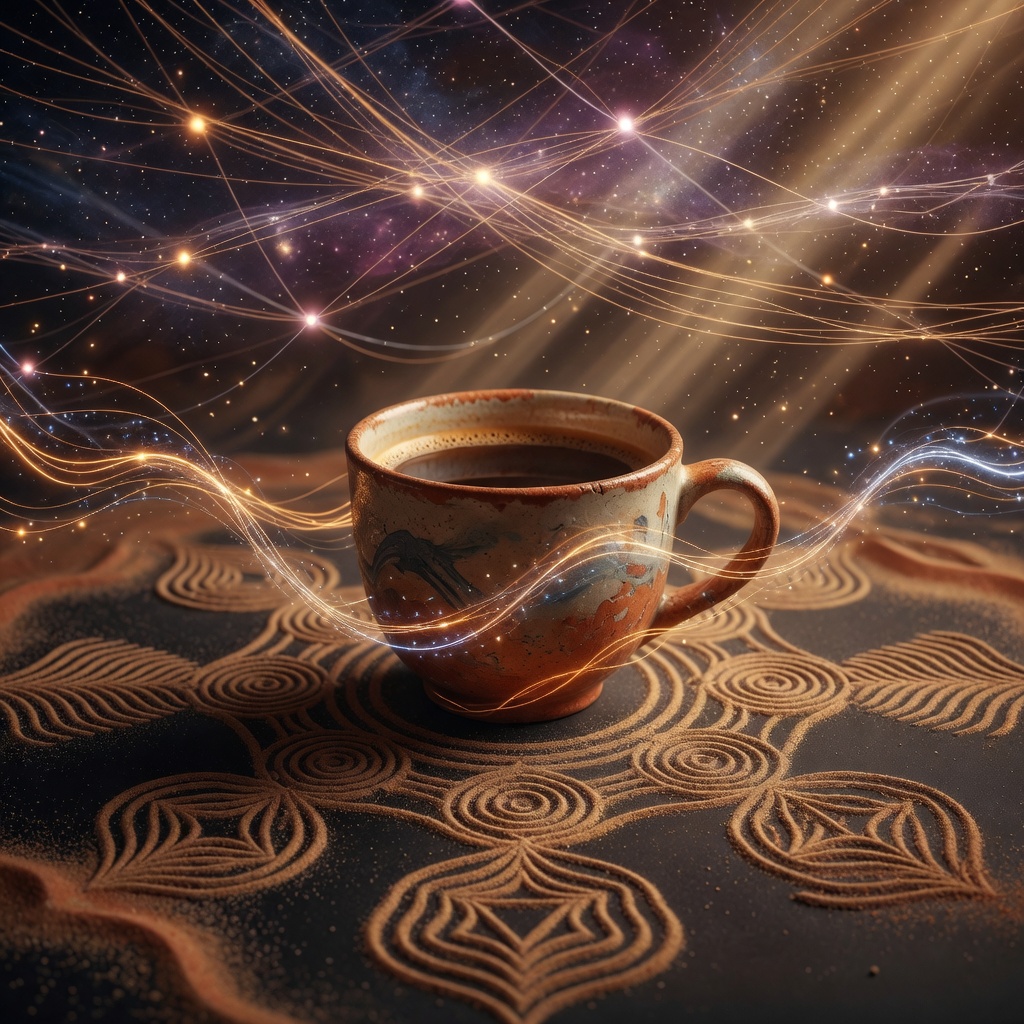
When Your Coffee Cup Lied to You
Pick up your coffee mug. Feel its weight, its solidity. It seems utterly still, completely at rest.
It’s lying to you.
Every atom in that ceramic is vibrating. The electrons orbiting each nucleus are buzzing at incomprehensible speeds. The quarks inside the protons are oscillating. Even the “empty” space between particles hums with quantum fluctuations. That mug is a symphony of vibration pretending to be stillness.
This isn’t poetry. It’s physics. And it’s exactly what a group of anonymous initiates wrote down over a century ago in a strange little book called The Kybalion, claiming to preserve the wisdom of ancient Egypt.
“Nothing rests; everything moves; everything vibrates.”
The Third Hermetic Principle. Stated as dogma in 1908. Now being confirmed, almost reluctantly, by physicists working at the cutting edge of string theory.
The Universe Is Not Made of Tiny Billiard Balls
For most of modern physics, we imagined fundamental particles as tiny dots. Points. The smallest possible chunks of matter, like minuscule billiard balls bouncing around.
String theory changed that picture entirely.
In string theory, the most basic building blocks of nature aren’t points at all. They’re one – dimensional vibrating strings – unimaginably small loops or snippets of energy. And here’s the part that should make any Hermetic student sit up straight: the way these strings vibrate determines what kind of particle they become.
A string vibrating one way becomes an electron. Another vibration pattern produces a quark. A different oscillation manifests as a photon. Change the frequency, change the particle. Change the particle, change the nature of matter itself.
Sound familiar?
The Kybalion put it this way: “The differences between different manifestations of Matter, Energy, Mind, and even Spirit, result largely from varying rates of Vibration.”
Modern physics arrived at the same conclusion through mathematics and particle accelerators. The Hermetics arrived there through contemplation and initiation. Different paths. Same mountain.
A Breakthrough That Should Have Made Headlines
In December 2024, physicists Clifford Cheung, Grant Remmen, and collaborators at Caltech and NYU published a paper in Physical Review Letters that sent quiet shockwaves through the theoretical physics community.
They asked a deceptively simple question: “What is the math question to which string theory is the only answer?”
Using a method called the bootstrap – an approach where you derive results from consistency requirements alone, without adding external assumptions – they showed that string theory’s predictions aren’t just one possibility among many. Under certain basic conditions about how particles scatter and interact, the Veneziano amplitude (string theory’s core mathematical formula) is the unique solution.
Read that again. Unique. Not one option among several. The only answer.
This doesn’t mean string theory is “proven” in the way a laboratory experiment proves something. But it means that if you start with very basic physical assumptions and demand mathematical consistency, you arrive at vibrating strings whether you intended to or not.
The universe doesn’t just happen to work this way. Under certain conditions, it must work this way.
A year later, in May 2026, the same team published follow-up work showing that string theory can be uniquely derived from even more basic assumptions – essentially “almost nothing.” The framework emerges naturally from the structure of reality itself.
The Hermetic masters might have smiled at this. They always insisted the Principle of Vibration wasn’t a metaphor. It was the operating system of the cosmos.
When Sound Becomes Shape
Still skeptical? Let’s leave quantum physics for a moment and look at something you can see with your own eyes.
Cymatics is the study of visible sound and vibration. The term comes from the Greek kuma (wave), and the field was formalized by Swiss physician Hans Jenny in the mid-20th century.
Here’s how it works: take a metal plate, sprinkle sand or powder on it, then run a violin bow along the edge or attach a speaker underneath. As sound vibrates through the plate, the particles arrange themselves into precise geometric patterns. Different frequencies produce different shapes. A low tone might create a simple circular pattern. Increase the frequency and you get a star. Push it higher and intricate mandalas emerge – patterns that look suspiciously like sacred geometry.
This isn’t random. It’s not artistic interpretation. It’s vibration literally shaping matter in real time.
Jenny’s experiments showed something the Hermetics would have called obvious: vibration organizes substance. Sound creates form. Frequency determines structure.
You can watch this happen. There are hundreds of videos online showing sand dancing into geometric perfection on vibrating plates. Water droplets suspended in mid – air, forming shapes that shift and transform as the frequency changes. It’s mesmerizing, and it’s undeniable.
Now scale that up. Way up. If sound vibrations can create geometric order in sand on a plate, what happens when you consider that every particle in the universe is itself a vibrating string? The implications get wild fast.
The Frozen Music Metaphor Gets Literal
Philosophers have long called the universe “frozen music” or “crystallized vibration.” It sounded beautiful but vague. Poetic license.
String theory suggests it might be literal.
If every electron is a string vibrating at a specific frequency, and every quark is a string with its own oscillation pattern, and every force – carrying particle is yet another vibrational mode – then matter itself is frozen vibration. Solid objects are standing waves. The chair you’re sitting on is a chord.
This isn’t metaphor anymore. This is the leading candidate for a theory of everything.
The Kybalion’s authors couldn’t have known about quantum chromodynamics or supersymmetry. They worked from a different knowledge base – Hermetic texts, initiatory traditions, contemplative practices. Yet they described the fundamental nature of reality in terms that modern physics is now independently confirming.
Coincidence? Maybe. Or maybe the Hermetic method of understanding reality – through direct perception, meditation, and the study of natural principles – actually works. Maybe it reveals truths that formal science takes centuries to catch up to.
What This Means for Your Wednesday Afternoon
Okay, so the universe vibrates. Interesting. But what does that have to do with your commute, your anxiety, your creative project that’s been sitting half – finished for weeks?
Everything, according to the Hermetic framework.
If the Principle of Vibration is real – if nothing rests and everything moves – then your thoughts, emotions, and mental states are also vibrational phenomena. The Kybalion is explicit about this. It says that the difference between Matter and Energy, between Mind and Spirit, is “largely a matter of varying rates of Vibration.”
This connects to the Principle of Mentalism (“The All is Mind; the Universe is Mental”) and the Principle of Correspondence (“As above, so below”). If the cosmos is mind, and if patterns repeat across scales, then the vibration of your inner states corresponds to – and participates in – the vibration of everything else.
You don’t have to take this on faith. You’ve experienced it.
Think about the last time you walked into a room where two people had just been arguing. You could feel it before anyone said a word. The air was thick. Something was off. You weren’t reading facial cues – you hadn’t even made eye contact yet. You were picking up on a vibrational state.
Or consider how your mood shifts when you hear a particular song. Not just the lyrics – the frequency, the rhythm, the resonance. Certain sounds make you feel expansive. Others contract you. This isn’t just emotional response. In a Hermetic framework, it’s vibrational resonance – your internal frequency responding to an external one.
The Practical Turn: Mental Transmutation
The Kybalion doesn’t just describe vibration. It teaches you how to work with it.
The practice is called Mental Transmutation – the art of changing your mental and emotional states by consciously altering their vibrational rate. Think of it like tuning an instrument. When a guitar string is too loose, it produces a dull, flat tone. Tighten it, and the pitch rises. The string didn’t change. The frequency did.
Your mind works similarly, according to Hermetic teaching.
Here’s the practical application: you can’t control external events. But you can learn to shift your internal frequency. You can recognize when you’re caught in a low – vibrational loop – chronic worry, resentment, self-pity – and consciously choose to raise the pitch.
This isn’t toxic positivity. It’s not slapping a happy face over genuine pain. It’s closer to what a musician does when they tune up before a performance. You’re not faking a note. You’re finding the right one.
Three Ways to Experiment with Vibration Today
The Hermetic path isn’t theoretical. It’s experimental. Here are three simple ways to test the Principle of Vibration in your own life.
Notice your default frequency. Spend a day paying attention to your baseline emotional state when nothing specific is happening. Not your reaction to events – your resting tone. Are you generally anxious? Calm? Restless? Content? This is your vibrational default. Awareness of it is the first step toward conscious adjustment.
Use sound deliberately. You already know certain music affects your state. Use this knowledge intentionally. If you need focus, try binaural beats or instrumental music tuned to specific frequencies. If you need calm, lower – frequency sounds like Tibetan singing bowls or deep ambient music can help shift your state. You’re not doing magic. You’re using physics.
Experiment with the pause. Between stimulus and response, there’s a gap. In that gap, you have a choice about what frequency you want to inhabit. When someone cuts you off in traffic, there’s a half-second before the anger surges. In that half-second, you can choose a different response. This isn’t easy. It takes practice. But it’s the core of mental transmutation – recognizing that you are not your automatic reactions. You are the one who can change the station.
The Ancient and the Modern Shake Hands
There’s something satisfying about watching two completely different knowledge systems arrive at the same conclusion.
On one side, modern physics – rigorous, mathematical, peer – reviewed, cautious about its claims. On the other, Hermetic philosophy – ancient, experiential, transmitted through initiatory chains, expressed in aphorisms and allegories.
String theory says reality is vibration. The Kybalion says the same. Cymatics proves vibration shapes matter. Hermetic practice says you can work with vibration to shape your experience.
Neither tradition owns the truth. But the convergence is hard to ignore.
Maybe the most interesting takeaway isn’t that the ancients were right and modern science finally caught up. Maybe it’s that reality is knowable through multiple paths. Mathematical formalism and contemplative practice both yield genuine insight. The universe doesn’t care about your methodology. It rewards anyone who pays close attention.
That coffee mug is still vibrating. So are you. The only question is whether you’re going to be intentional about your frequency or just let it drift.
What would it feel like to spend one hour today treating your emotional state as a frequency you can consciously adjust – not by forcing positivity, but by simply noticing and gently tuning?
Try it. See what happens.