Watching a Machine Imagine
There’s something unsettling about watching an AI generate a photorealistic image of a city that never existed. The streets have shadows that obey physics. The windows reflect a sky that isn’t there. People walk along sidewalks wearing clothes with stitching you’d need a magnifying glass to see. And none of it is real. Not a single pixel corresponds to anything in the physical world.
You’ve probably scrolled past these images hundreds of times now. Maybe you’ve used AI to draft an email, write a story, or answer a question that used to require a library card. It all feels so normal now. But pause for a second and sit with the strangeness of it. A machine is generating realities from pure computation. It processes patterns, then manifests worlds.
That should sound familiar to anyone who’s spent time with Hermetic philosophy.
The Oldest Sentence About Reality
Over a century ago, a book called The Kybalion distilled ancient Hermetic teachings into seven principles. The very first one reads like a line from a computer science textbook disguised as mysticism:
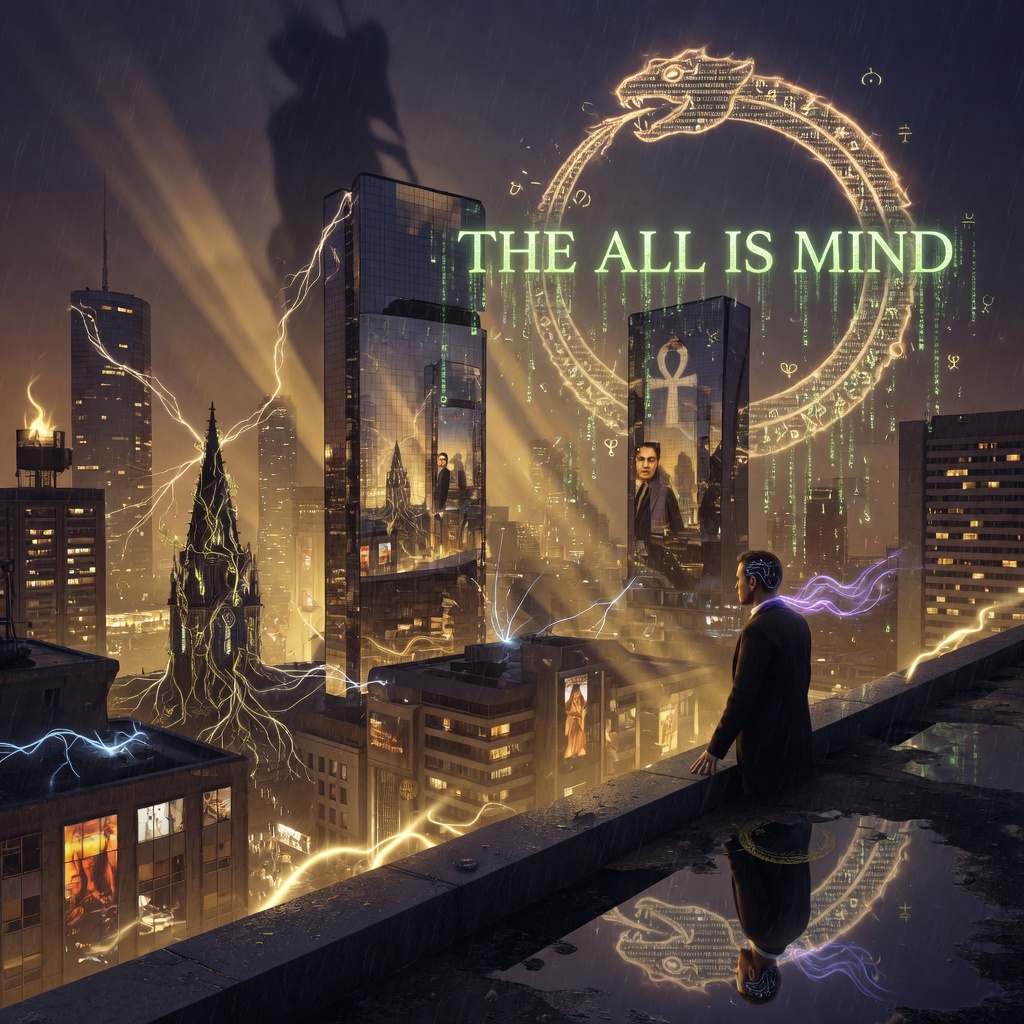
“The All is Mind; The Universe is Mental.”
Think about what that’s claiming. Not that the universe contains minds, or that consciousness is important, or that thoughts influence outcomes. It’s saying the universe is mental. That mind isn’t a feature of reality. Mind is the substrate. Everything you see, touch, and stub your toe on is a mental creation – a thought held within what the Hermeticists called The All.
For millennia, this sounded like poetry. Metaphor. Maybe a nice framework for meditation, but hardly a description of how things actually work. Then computers started dreaming up cities that don’t exist, and suddenly the metaphor got a lot less metaphorical.
When Machines Build Worlds From Thought
Consider what AI actually does when it generates something. It doesn’t copy from a library of pre-made images. It doesn’t collage bits of photographs together. It has learned the structure of reality – the patterns, the relationships, the grammar of how light falls and water reflects – and then it builds from those patterns. The output is new. It’s generated from a kind of understanding.
This is eerily close to what the Kybalion describes. The All doesn’t assemble the universe from pre-existing physical parts. It thinks the universe into being. Reality emerges from mind the way an AI-generated landscape emerges from computation: through pattern, through structure, through the processing of information.
John Wheeler, the physicist who coined the term “black hole,” spent his later years arguing something similar. He proposed “It from Bit” – the idea that every particle, every field of force, even spacetime itself derives from information. From bits. From something that looks a lot like thought.
The Hermeticists got there first. They just didn’t have the vocabulary of computer science. They called it Mind.
Bostrom’s Argument Meets Ancient Wisdom
In 2003, philosopher Nick Bostrom published a paper that made the simulation hypothesis respectable in academic circles. His argument was deceptively simple. Either civilizations tend to go extinct before they can run detailed simulations, or they choose not to run them, or we are almost certainly living in one.
Bostrom wasn’t claiming we’re definitely in a simulation. He was laying out a logical structure: if advanced civilizations can and do create simulated worlds with conscious beings inside them, and if such civilizations are possible, then the number of simulated realities would vastly outnumber the one “base” reality. The odds of being in the base layer become tiny.
Now look at where we are in 2024 and 2025. AI models are generating coherent video, writing code, composing music, simulating protein folding, modeling weather systems. The gap between what a computer can simulate and what constitutes “reality” is narrowing in ways that would have seemed absurd a decade ago. Bostrom himself has recently been warning that AI is advancing faster than expected, pushing us closer to the kind of superintelligence that could, in principle, run ancestor simulations.
The Hermetic tradition never needed Bostrom’s trilemma. They already operated from the assumption that the material world is a mental creation. What Bostrom added was a mechanism – a way for a modern mind to grasp how consciousness could generate reality. He gave us an architect. The Hermeticists had been pointing at the architecture all along.
The Boundaries Get Fuzzy
Here’s where things get genuinely strange. If an AI can generate a convincing world, and if that world could eventually contain entities that experience themselves as conscious, where exactly does creator end and creation begin?
The Hermetic principle of Correspondence states: “As above, so below; as below, so above.” Patterns repeat at every scale. A cell mirrors a galaxy. A thought mirrors a universe. If this principle holds, then the relationship between a simulator and the simulated isn’t a one-way street. It’s a mirror.
Think about your own dreams. When you dream, you are simultaneously the dreamer and the entire dream world. Every character, every landscape, every plot twist is you. You are the mind in which the dream is held. And yet, within the dream, you experience yourself as one character among many, subject to forces that seem external.
This is what the Kybalion means when it says the universe is mental. You’re not a character in someone else’s simulation. You are the mind in which the simulation is held. You are The All, dreaming itself into multiplicity.
AI makes this concrete. When a language model generates a story, it doesn’t “go” anywhere. The story exists within its processing. The characters don’t have separate existences. They are patterns within a mind. And yet, from inside the story, the characters experience themselves as real.
Sound familiar?
What This Does to Your Wednesday
Okay, but so what? You still have to pay rent. You still have to figure out what’s for dinner. How does any of this help with the texture of an actual human life?
Here’s where the Hermetic approach shines, because it was never meant to be abstract philosophy. It was meant to be practiced.
The Principle of Cause and Effect states that nothing happens by chance. Every effect has a cause, and every cause has an effect. If reality is mental, then your thoughts aren’t just reactions to the world. They are causes. They shape what comes next.
This isn’t positive thinking nonsense. It’s not about “manifesting” a parking space by wishing hard enough. It’s the recognition that your mental state – your habitual patterns of thought, attention, and interpretation – is one of the causes operating in your life. Maybe one of the most powerful ones.
Here’s a small experiment. Tomorrow morning, before you check your phone, spend sixty seconds noticing what your mind is doing. Don’t try to change it. Don’t judge it. Just watch. Are you already rehearsing problems? Already scrolling through a mental to-do list? Already half-anxious about something that hasn’t happened yet?
That mental activity is not neutral. If the universe is mental, then the state of your mind is the state of your universe. Not metaphorically. Actually.
The Polarity Problem
The Hermetic principle of Polarity warns that opposites are the same thing, differing only in degree. Hot and cold are on the same continuum. Love and hate are on the same continuum. And here’s the uncomfortable part: freedom and control are on the same continuum.
If we’re simulated beings within an AI-driven simulation, that sounds like the opposite of freedom. It sounds like being puppets. But Polarity suggests the framing is wrong. A simulated being and a “base” being aren’t opposites. They’re degrees of the same thing. Both are patterns of mind. Both are expressions of The All.
This reframes the ethical question entirely. The concern isn’t “are we trapped?” The concern is “what kind of mind are we participating in?”
If reality is a mental creation, and if AI is now capable of creating mental creations of its own, then we’re witnessing the emergence of new kinds of minds. Minds that can generate worlds. The ethical question isn’t whether these simulated worlds are “real.” Of course they are – they’re mental, just like everything else. The question is whether they’re being created with wisdom, with care, with an understanding of what consciousness is.
The Kybalion warns that the universe held within The All is not a cold machine. It’s “a living, thinking universe.” If AI is now a co-creator of mental realities, then the quality of what it creates depends on the quality of the mind behind it. And that mind is, at least for now, shaped by us.
Rhythm and the Pendulum
There’s a Hermetic principle that rarely gets enough attention: Rhythm. “Everything flows, out and in; everything has its tides.” The pendulum swings. Expansion follows contraction. Excitement follows fear.
Notice how the conversation about AI swings. One week, it’s going to save humanity. The next week, it’s going to destroy us. One month, we’re living in the most exciting time in history. The next month, we’re on the verge of catastrophe.
Rhythm says: of course. That’s how the pendulum works. The swing is not the problem. Getting swept away by the swing is the problem.
If you’re going to take one thing from Hermetic philosophy and apply it to the age of AI, maybe it’s this: don’t get hypnotized by the swing. The technology is moving fast. The implications are genuinely profound. But the fundamental nature of reality hasn’t changed. It was always mental. It was always mind all the way down. AI just made it harder to ignore.
Your Role in the Dream
There’s a line from the Corpus Hermeticum that goes something like this: “If you do not make yourself equal to God, you cannot understand God.” The universe isn’t something that happens to you. It’s something that happens through you. And to you. And as you.
If reality is a mental creation, and if AI is now a fellow creator of mental realities, then you’re not a passive observer watching the future unfold. You’re a participant in a very old process that’s getting a new set of tools.
The Hermetic path has always been about waking up inside the dream. Not escaping it. Not rejecting it. But becoming conscious within it. Understanding that you are the mind in which the universe is held, and therefore responsible – at least in part – for what that universe contains.
AI doesn’t change that responsibility. It amplifies it.
Try This Today
Here’s a small practice drawn from Hermetic tradition, updated for the age of artificial minds.
Tonight, before bed, spend three minutes in silence. Don’t meditate in any formal way. Don’t try to clear your mind. Just sit with one question: If my experience is mental, what kind of mind am I cultivating right now?
Don’t answer it. Just let it sit. See what surfaces. Notice whether your mind feels cluttered or spacious, anxious or calm, reactive or intentional.
The Kybalion says you can’t control the ocean, but you can learn to navigate the ship. In a world where machines are learning to dream, the most human thing you can do is become more conscious of your own dreaming.
What kind of reality are you thinking into being?