When Life Feels Like a Rollercoaster You Didn’t Choose
Scroll through your phone first thing in the morning. Notice how quickly your mood shifts. One headline makes you anxious, the next angers you, then something funny distracts you, then back to dread. By 9 AM, you’ve already ridden an emotional rollercoaster without leaving your bed.
That constant yo-yo feeling isn’t random. It’s engineered.
The ancient Hermetic philosophers understood something that modern neuroscience is only now catching up to: everything moves in cycles. The fifth principle from The Kybalion states it plainly: “Everything flows, out and in; everything has its tides; all things rise and fall; the pendulum-swing manifests in everything.”
This principle describes a natural law. Rivers flow to the sea and back through rain. Seasons turn. Your energy rises in the morning and falls at night. Emotions crest and recede like waves. Rhythm is woven into the fabric of existence.
But here’s where it gets interesting – and where your freedom lives. There’s a difference between natural rhythm and manufactured rhythm. One sustains life. The other keeps you off-balance, reactive, and easy to direct.
The Difference Between Nature’s Rhythm and the Machine’s
Think about how indigenous cultures organized their days. Wake with the sun. Work during light. Rest when darkness falls. Celebrate during harvest. Reflect during winter. These weren’t arbitrary choices – they were alignments with the actual rhythms of the earth and the body.
Now consider your average Tuesday. Alarm blares at 6 AM (regardless of when your body actually wants to wake). Coffee to override fatigue signals. Constant notifications pulling attention in seventeen directions. News cycles manufactured to trigger outrage every few hours. Social media designed to spike dopamine, then crash it. Artificial light keeping you wired past midnight. Then repeat.
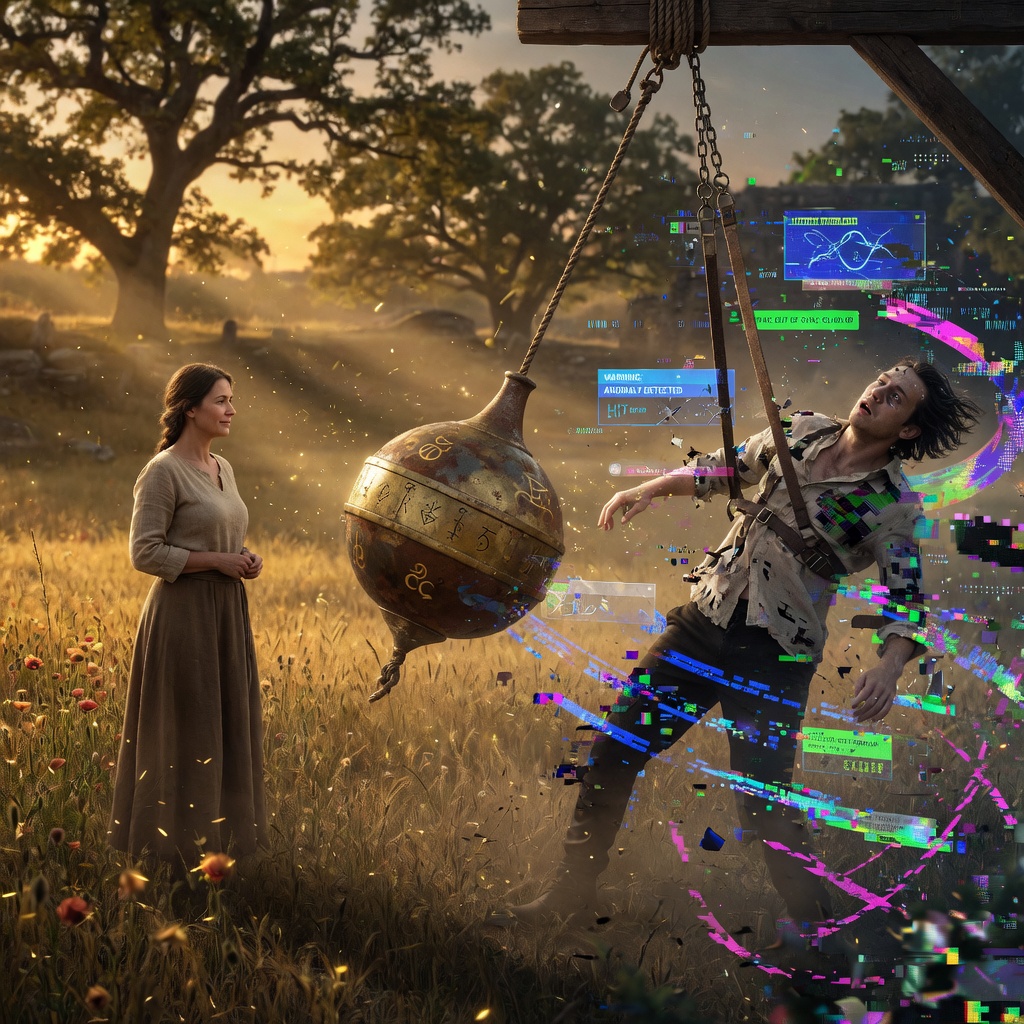
The Kybalion warns that most people “swing like a pendulum” between emotional poles – joy and sorrow, hope and fear, excitement and boredom. The Hermetic Masters observed this and developed techniques to rise above the swing. But the modern system has done something those ancient teachers never anticipated: it has weaponized the pendulum itself.
Every notification is a gentle push on your emotional swing. Every outrage cycle accelerates the oscillation. Every manufactured crisis jerks you from one pole to the other. The goal isn’t to keep you happy or sad – it’s to keep you swinging. Because a swinging pendulum is predictable. A swinging pendulum can be directed.
A still pendulum cannot.
Why Constant Stimulation Breaks Your Internal Clock
Your body runs on rhythms. Circadian rhythms govern sleep, hormone release, digestion, and cognitive function. Ultradian rhythms cycle every 90 minutes or so, affecting focus and rest. Even your cells have their own clocks.
When you align with these natural cycles, something remarkable happens. Sleep deepens. Energy stabilizes. Emotions become less volatile. Decision-making sharpens. It’s not magic – it’s biology.
But the matrix runs on artificial time. 24-hour news cycles. Always-on work expectations. Entertainment streams that never end. Food available at any hour. Light at any hour. Stimulation at any hour.
Research from NPR and multiple sleep studies confirms what Hermetic philosophy has taught for millennia: when you fight your natural rhythms, everything suffers. Your immune system weakens. Your mood destabilizes. Your ability to think clearly degrades. You become reactive instead of responsive.
And a reactive person is exactly what the system needs.
The Hermetic Art of Polarization
The Kybalion contains a teaching that sounds almost like a cheat code: the “Art of Polarization.” It’s the ability to choose which emotional pole you rest at, rather than being jerked between them.
Picture a pendulum swinging between fear and courage. Most people are strapped to that pendulum, feeling every swing. One news story pushes them toward fear. A motivational post swings them back toward courage. Then fear again. Back and forth, endlessly.
The Hermetic approach isn’t to stop the pendulum from existing. That’s impossible – rhythm is a law of nature. Instead, you learn to detach from the swing. You become the observer standing still while the pendulum moves around you.
This isn’t suppression. It’s not pretending you don’t feel things. It’s developing what the Kybalion calls a “higher plane of consciousness” where you can watch the swing without being controlled by it.
Here’s a concrete example: you read something that triggers anger. Old pattern – you react immediately, post something inflammatory, argue with strangers, stew for hours. New pattern – you notice the anger rising. You feel it in your chest. You acknowledge it. Then you pause. You ask yourself: is this my natural emotional tide, or did someone just push my pendulum?
That pause changes everything.
Practical Ways to Find Your Still Point
The Hermetic Masters didn’t just theorize about rhythm – they developed specific practices for mastering it. Here are some adapted for modern life:
Morning Sunlight Before Screens
Your circadian clock runs primarily on light signals. Morning sunlight tells your brain: “Day has begun. Start the cortisol rise. Prepare for alertness.” Screens blast artificial light that confuses these signals.
Try this: spend the first 15-30 minutes of your day in natural light. No phone. No news. Just light hitting your eyes and skin. This single practice recalibrates your internal clock more effectively than any productivity hack.
The Observer Practice
Several times throughout your day, pause and notice your emotional state without judgment. Don’t try to change it. Don’t label it good or bad. Just observe. “There is anxiety present.” “There is excitement present.” “There is boredom present.”
This practice builds the muscle of detachment. Over time, you’ll notice that emotions arise and pass on their own, like weather. You don’t have to chase the sunny ones or run from the storms.
Create Rhythm Where the System Removes It
The matrix hates rhythm because rhythm creates stability. Deliberately build cycles into your life:
Eat at roughly the same times each day. Your digestion and energy will thank you. Sleep and wake at consistent times, even on weekends. Schedule deep focus work in 90-minute blocks followed by genuine rest. Designate specific times for news and social media rather than grazing constantly. Create weekly rituals – a Sunday walk, a Wednesday phone-free evening, a Saturday morning for slow coffee and reading.
These aren’t restrictions. They’re anchors. When the world tries to jerk your pendulum, these rhythms keep you grounded.
The 24-Hour Rule
When something triggers a strong emotional reaction – especially from media or online content – wait 24 hours before engaging with it further. This isn’t avoidance. It’s allowing the manufactured urgency to fade so you can assess the situation from a place of clarity.
Most “crises” that feel urgent at 2 PM seem far less significant at 2 PM the next day. The system needs your immediate reaction. Deny it that.
Reconnect with Seasonal Time
Our ancestors lived by seasons, not fiscal quarters. There’s a natural rhythm to the year that most modern people have completely disconnected from. Spring for new beginnings and planting intentions. Summer for growth and outward energy. Autumn for harvesting results and letting go. Winter for rest, reflection, and going inward.
You don’t have to become a farmer. But noticing which season you’re in and adjusting your energy accordingly can restore a sense of natural timing that the artificial world strips away.
The Deeper Teaching: Rhythm Serves You When You Understand It
Here’s what the Kybalion actually teaches about mastering rhythm: once you understand the principle, you can use it rather than be used by it.
Natural rhythms are your ally. Sleep cycles restore you. Emotional waves process experience. Creative rhythms alternate between output and incubation. Even the rhythm of effort and rest makes you stronger – any athlete knows this.
The problem was never rhythm itself. The problem is artificial rhythm imposed on top of natural rhythm, creating dissonance. Like two songs playing at different tempos simultaneously, the result is chaos that feels like your fault.
When you strip away the artificial rhythms – the constant stimulation, the manufactured urgency, the always-on expectations – what remains is something ancient and wise. Your body knows when to rest. Your emotions know how to process. Your mind knows when to focus and when to wander.
The matrix didn’t break your rhythm. It buried it. The work of unplugging is largely the work of excavation – digging through layers of artificial time to find the natural cycles that were always there, waiting.
Standing Still While the World Swings
There’s a passage in the Corpus Hermeticum where Hermes describes the liberated mind as one that has “risen above the body” and can observe the play of forces without being pulled into them. This isn’t escapism. It’s mastery.
The pendulum will keep swinging. News cycles will keep churning. Algorithms will keep trying to push your emotional state from one extreme to the next. That’s the nature of the system.
But you can choose to stand at the center point. Not by fighting the swing – that just exhausts you. Not by pretending you don’t feel – that just creates numbness. But by developing the awareness that allows you to observe the swing while maintaining your own equilibrium.
This is what the ancient Hermetists called “refusing to swing.” They didn’t deny the existence of the pendulum. They simply stopped letting it move them.
The world needs people who can think clearly while others are caught in manufactured chaos. People who can feel deeply without being controlled by those feelings. People who operate on natural time while everyone else is running on artificial urgency.
That’s available to you. Not through some complex spiritual practice or expensive retreat. Through the simple, daily discipline of noticing the swing and choosing – again and again – to find your center.
What’s one artificial rhythm in your life that you could replace with a natural one this week? Maybe it’s as simple as watching a sunset instead of watching the news, or eating lunch without your phone, or going to bed when you’re actually tired instead of when the algorithm releases you. Start there. Notice how it feels. The rest will follow.