That Electric Hum You Can Almost Feel
Close your eyes for a moment. Not to meditate, not to visualize anything in particular – just close them and notice. There’s a faint buzzing behind your thoughts. A subtle thrum that rarely stops, even when you try to quiet down. It’s not anxiety. It’s not hunger. It’s something more fundamental.
Your brain is humming.
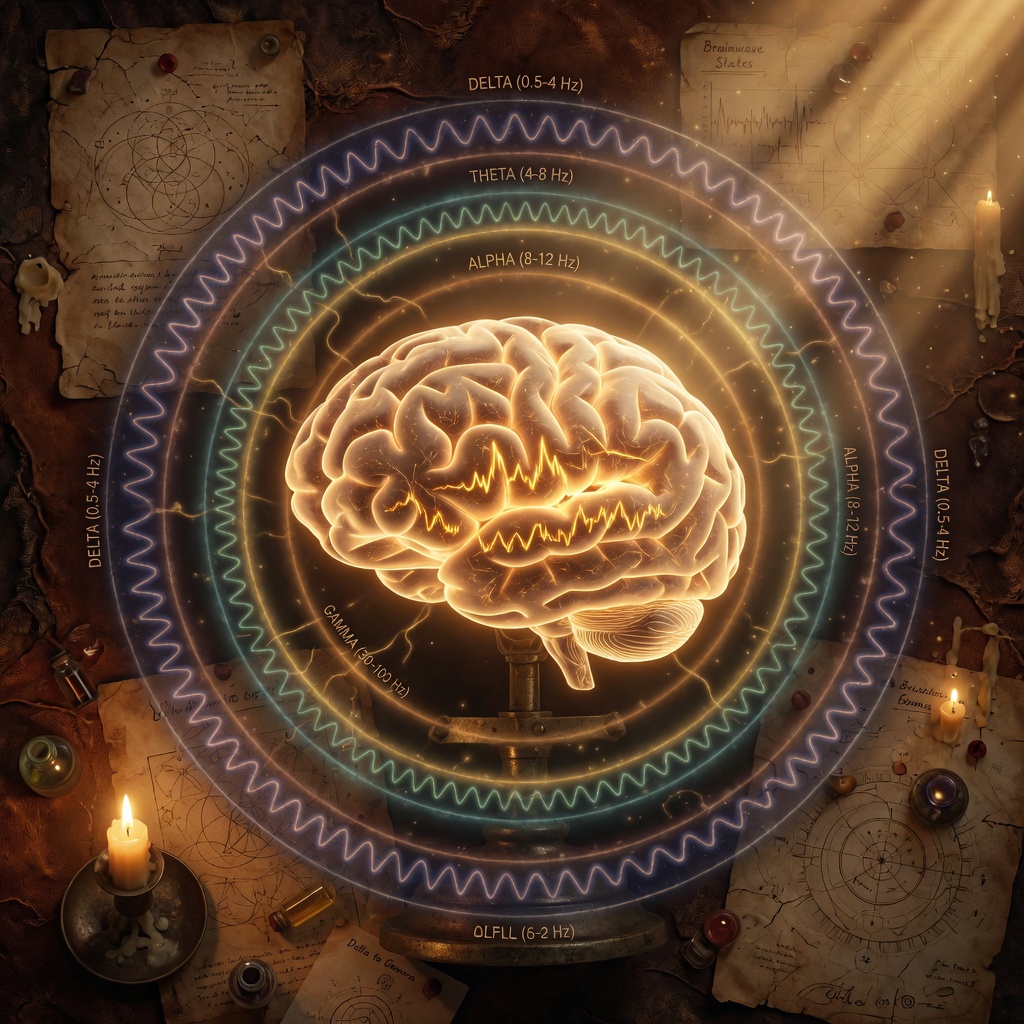
Right now, billions of neurons in your skull are firing in rhythmic patterns, creating oscillations that scientists can measure with electrodes pressed against your scalp. These oscillations – brainwaves, they’re called – aren’t random. They follow specific frequencies that correspond to different states of consciousness. Focus hard on a problem, and your brain sings one tune. Drift toward sleep, and it shifts to another entirely.
Three thousand years before anyone attached an EEG machine to a human head, Hermetic philosophers had already mapped this territory. They just used different language.
Nothing Rests: The Ancient Blueprint
The Kybalion, a text distilling Hermetic wisdom attributed to Hermes Trismegistus, lays out seven principles that govern how reality operates. The Third Principle – Vibration – states something deceptively simple: “Nothing rests; everything moves; everything vibrates.”
Read that again. Nothing rests. Not the chair you’re sitting in. Not the air around you. Not your thoughts, your emotions, or the electrical storms raging inside your skull right now.
The Hermetic teachers believed that the difference between matter and energy, between thought and physical reality, came down to one thing: frequency. A rock vibrates slowly. A flame vibrates faster. Thought vibrates fastest of all. Everything exists on a spectrum of vibration, and by learning to shift your own frequency – your own rate of vibration – you could transform your mental and emotional state at will.
They called this practice “mental transmutation,” and they considered it the art of arts.
Modern neuroscience has stumbled into the same conclusion from a completely different direction. It just took a few millennia.
What Your EEG Would Show Right Now
If you were hooked up to an electroencephalograph at this very moment, the machine would pick up electrical pulses produced by your brain’s neurons communicating with each other. These pulses generate wave patterns measured in hertz – cycles per second. And here’s where it gets interesting: different frequencies mean different things.
Delta waves (0.5 to 4 Hz) are the slowest. They dominate during deep, dreamless sleep – the kind where you lose all sense of time and self. Your brain is doing heavy restoration work here: repairing tissue, consolidating memories, clearing metabolic waste. Delta is the vibration of unconscious renewal.
Theta waves (4 to 8 Hz) show up during light sleep, deep meditation, and those hazy moments right before you drift off or just after waking. This is the realm of intuition, creativity, and vivid imagery. Ever had a brilliant idea in the shower? That was probably theta state – your conscious mind relaxed enough to let deeper patterns surface.
Alpha waves (8 to 13 Hz) appear when you’re awake but relaxed. Think of a lazy Sunday morning, a gentle walk through a park, the calm that follows a satisfying meal. Alpha is the bridge between your conscious thinking mind and your unconscious depths. Meditation practitioners know this state well – it’s the sweet spot where you’re alert but not trying.
Beta waves (13 to 30 Hz) kick in during normal waking consciousness. Conversations, problem-solving, focused work, navigating traffic – beta handles the mechanics of daily life. Lower beta frequencies are associated with relaxed focus. Higher beta can tip into anxiety, hypervigilance, and that awful feeling of being “wired but tired.”
Gamma waves (30 to 100+ Hz) are the fastest. They emerge during states of peak cognition, heightened perception, and moments of insight. Long-term meditators – particularly those practicing compassion meditation – show dramatically elevated gamma activity. It’s the vibration of your brain at its most integrated, with distant regions suddenly communicating in perfect synchrony.
Sound familiar? The Hermetics mapped vibration from dense to subtle. Modern science mapped brainwaves from slow to fast. Both arrived at the same conclusion: your state of consciousness is a frequency, and frequencies can be shifted.
The Pendulum Between Focus and Flow
Here’s something the Kybalion warns about that neuroscience has confirmed: the Principle of Rhythm. Everything swings. The pendulum that pushes you toward intense beta focus will eventually swing back toward scattered theta. The deep delta of sleep naturally rises into the alertness of morning alpha.
Most people fight this rhythm. They try to maintain high-beta focus for eight hours straight, then wonder why they crash by 3 PM. They resist the natural drift toward theta during boring meetings, then blame themselves for losing concentration.
But the Hermetic view – and increasingly, the neuroscience view – is that this oscillation isn’t a flaw. It’s a feature. Your brain cycles through different dominant frequencies roughly every 90 minutes, a pattern called the ultradian rhythm. Trying to stay locked in one gear is like trying to drive a car in third gear all the time. You can do it, but the engine won’t thank you.
The skilled mental alchemist doesn’t fight the pendulum. They learn to ride it. They notice which frequency they’re in and either accept it or consciously shift toward what the moment requires.
The Science of Shifting Gears
This is where the Hermetic concept of mental transmutation meets modern technology in a genuinely fascinating way.
Binaural beats are perhaps the most studied tool for deliberate brainwave shifting. The concept is straightforward: play a slightly different frequency into each ear – say, 200 Hz in the left and 210 Hz in the right – and your brain perceives a third tone at the difference between them. In this case, 10 Hz, which falls in the alpha range.
The theory is that your brain’s electrical activity then “entrains” to this perceived frequency, synchronizing with it the way a tuning fork makes a nearby string vibrate at the same pitch. A 2023 systematic review published in PLOS ONE examined the available research and found mixed but intriguing results. Some studies showed clear shifts in brainwave patterns during binaural beat exposure. Others showed more subtle effects or questioned whether the mechanism works exactly as advertised.
What’s clear is that many people report subjective benefits – reduced anxiety, improved focus, easier transitions into meditative states. The research on psychiatric applications is ongoing and promising, though not yet conclusive.
Is this mental transmutation through vibration? The Kybalion would say yes. The mechanism is different from what the ancient teachers imagined – they spoke of willpower and mental discipline, not headphones and hertz – but the underlying principle is identical. You’re using vibration to shift consciousness.
Meditation itself operates on the same principle without any technology at all. Brain imaging studies of experienced meditators show they can reliably shift their dominant brainwave patterns through practice alone. They move from the busy beta of ordinary thinking into alpha calm, or from there into the theta depths of contemplative absorption, and they do it intentionally.
A 2024 study on mindfulness meditation found significant changes in theta and alpha activity during practice. The meditators weren’t just relaxing – they were actively modulating the frequency of their neural oscillations. They were practicing mental transmutation, whether they used that term or not.
Polarity in Your Skull
The Fourth Hermetic Principle – Polarity – adds another layer here. “Everything is dual; everything has poles; everything has its pair of opposites,” the Kybalion teaches. “Like and unlike are the same; opposites are identical in nature, but different in degree.”
Apply this to brainwaves and something interesting emerges. Anxiety and excitement are both high-beta states. The difference isn’t in the frequency – it’s in how you relate to it. Deep sleep and deep meditation both involve the slowing of ordinary conscious thought, but one is unconscious and the other is hyper-aware.
This is why the same brainwave frequency can feel radically different depending on context. Theta during sleep is oblivion. Theta during meditation is insight. The vibration is similar; the consciousness experiencing it transforms the meaning entirely.
The Polarity principle suggests that you can learn to shift between apparently opposite states because they’re not actually opposite – they’re points on the same spectrum. Calm and anxiety aren’t different things vibrating at different frequencies. They’re the same vibration experienced at different intensities, with different relationships to conscious awareness.
This reframes the whole project of mental transmutation. You’re not trying to jump from one state to some completely different state. You’re learning to slide along a spectrum you already occupy. The anxious beta brain and the focused beta brain aren’t strangers. They’re neighbors.
Practical Alchemy: Three Experiments to Try
Theory is lovely, but the Hermetics were practical people. They wanted results. Here are three simple ways to start experimenting with conscious frequency shifting.
Morning Alpha Activation. Before you reach for your phone, before you even open your eyes fully, spend two minutes breathing slowly and paying attention to the space between your thoughts. Don’t force anything. Just notice the gentle drift of your mind in that hypnagogic borderland between sleep and wakefulness. You’re riding the natural delta-to-theta-to-alpha transition that your brain does every morning anyway. By staying aware through it, you’re practicing conscious navigation of the vibrational spectrum.
Midday Reset with Sound. When the 2 PM slump hits – when your beta-focused brain has burned through its fuel – try a five-minute listening break. Search for a 10 Hz alpha binaural beat track (many free options exist online). Put in headphones, close your eyes, and just listen. Don’t try to make anything happen. The frequency is doing work whether you notice it or not. Some people feel a shift immediately. For others, it takes a few sessions to notice anything. The point is to give your brain a vibrational nudge toward the alpha state that supports relaxed alertness.
Evening Theta Exploration. As you’re lying in bed, not quite asleep but letting go of the day, pay attention to the imagery that starts forming behind your closed eyelids. Random scenes. Faces. Colors. This is theta territory – the same frequency associated with creativity, memory consolidation, and intuitive insight. Instead of falling asleep immediately (which is fine too, some nights), try to hover in this state for a few minutes. You’re not doing anything mystical. You’re simply staying conscious while your brain shifts down a gear. The Hermetics would call this entering the temple. Modern neuroscience calls it the hypnagogic state. Both recognize it as a doorway.
The Vibration You Choose
Here’s what strikes me about all of this: the ancient Hermetics and the modern neuroscientists are telling the same story in different languages. Your consciousness is not fixed. It’s not even particularly stable. It’s a living, oscillating process – a vibration – that responds to intention, environment, and practice.
The Principle of Vibration isn’t some abstract metaphysical claim. You can verify it with electrodes. You can feel it when you shift from panic to calm, from scattered to focused, from waking to dreaming. Every state of mind you’ve ever experienced was a particular frequency of neural oscillation, and every frequency can, with practice, be consciously approached.
That’s not to say it’s easy. The Hermetics called mental transmutation the “art of arts” for a reason. It takes patience. It takes the willingness to observe yourself without judgment, to notice which frequency you’re in before trying to change it. But the basic principle is available to anyone with a brain – and that includes you.
Nothing rests. Everything moves. Everything vibrates.
Including the thoughts reading these words right now.
What frequency are you in at this moment? Not what you wish you were in, or what you think you should be in – what’s actually humming through your mind right now? Just noticing is the first step toward conscious transmutation.
If you want to experiment this week, try this: set a random alarm for three times during your day. When it goes off, pause for thirty seconds and simply notice your mental state without trying to change it. You might be surprised at how many different frequencies you move through in a single ordinary day.