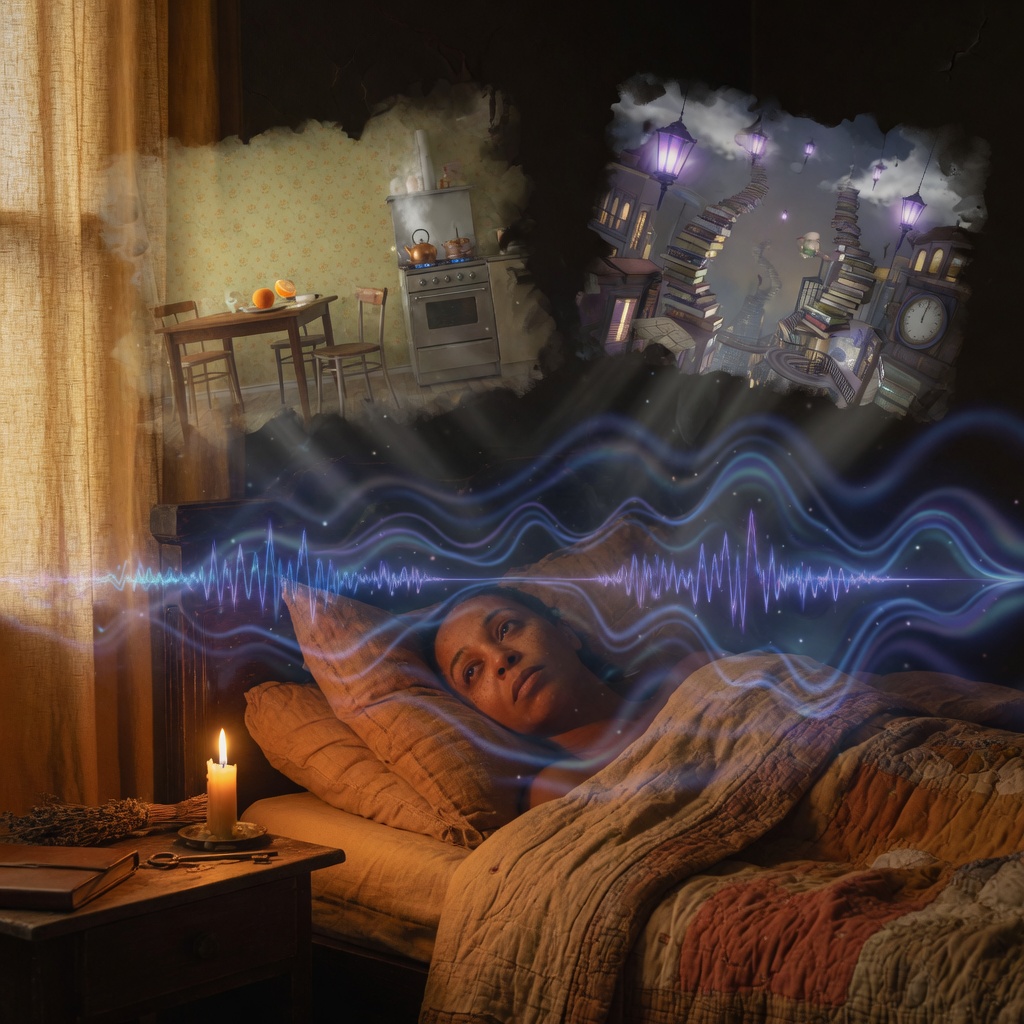
That moment when you wake up, heart still racing from some impossible scenario, and for a few seconds you’re not sure what’s real. Maybe you were flying over a city you’ve never visited. Maybe you were having an argument with someone who’s been dead for twenty years. Maybe you were just sitting in a kitchen that felt familiar but doesn’t exist.
Whatever the dream was, those first waking moments hold a strange power. You’re caught between two worlds – one made of pure mind, the other made of… well, also mind, if you ask the Hermeticists.
The Ancient Mirror
The old Hermetic teachers didn’t have EEG machines or sleep labs. They had something else: centuries of systematic inner observation. When Hermes Trismegistus wrote that “The All is Mind; the Universe is Mental,” he wasn’t being poetic. He was making a technical statement about the nature of consciousness.
And consciousness, they noticed, doesn’t come in just one flavor.
There’s the waking mind, busy with schedules and grocery lists and that weird noise the car is making. There’s the relaxed mind, maybe during a sunset or a long exhale. There’s the hypnagogic drift, that slippery space right before sleep takes hold. Then there’s the dream itself – vast, symbolic, operating by its own logic.
The Hermeticists mapped these states centuries before science had the vocabulary. They saw consciousness as a spectrum, a range of frequencies that the mind could tune into. Sound familiar? It should. Modern sleep researchers are saying the same thing, just with different language.
The Vibration Spectrum
Here’s where it gets interesting. The Principle of Vibration states that nothing rests, everything moves, everything vibrates. The Kybalion puts it plainly: “The differences between different manifestations of Matter, Energy, Mind, and even Spirit, are largely due to varying rates of Vibration.”
Your brain is literally vibrating. Not metaphorically – electrical impulses pulse through your neurons in rhythmic patterns, creating what scientists measure as brainwaves. And those brainwaves fall into distinct frequency bands that correspond to different states of consciousness.
Beta waves (13-30 Hz) are your daytime operating system. They’re active thinking, problem-solving, maybe a little anxiety if you’re not careful. Alpha waves (8-12 Hz) show up when you’re relaxed but still awake – staring at a sunset, meditating, zoning out in the shower.
Then the frequencies slow down. Theta waves (4-8 Hz) appear during light sleep and REM cycles, the stage where most vivid dreaming happens. Delta waves (0.5-4 Hz) are the slowest, dominating deep sleep when your body does its repair work and your mind is largely offline.
The Hermeticists would recognize this immediately. It’s the Principle of Vibration made measurable. Your consciousness isn’t switching between binary states of “awake” and “asleep.” It’s sliding along a frequency spectrum, tuning into different channels of experience.
The Rhythm of Sleep
The Principle of Rhythm says everything flows in and out, rises and falls. The pendulum swing shows up everywhere – in tides, in seasons, in your own emotional cycles. Sleep is one of the most obvious demonstrations of this principle at work.
You don’t just drift into deep sleep and stay there. You cycle. Through the night, you move through stages multiple times: light sleep, deeper sleep, deepest sleep, then back up to REM. Each cycle takes roughly ninety minutes, and as the night progresses, the deep sleep portions get shorter while the REM periods get longer.
This is why you often wake from vivid dreams in the early morning hours. Your brain has been doing the Rhythm dance all night, and by 5 or 6 AM, you’re spending more time in that theta-rich REM territory where dreams get strange and memorable.
Understanding this rhythm changes how you relate to sleep itself. It’s not a void you fall into. It’s an active process with its own patterns, its own intelligence. The Hermeticists saw sleep as a kind of journey – one that could be navigated with practice.
The Subconscious Stage
Here’s what makes the dream state so interesting from a Hermetic perspective. During waking hours, your conscious mind – the part that plans, judges, censors – runs the show. It filters experience, decides what’s relevant, keeps you on task.
In dreams, that filter largely shuts down.
What’s left is something rawer. Your subconscious assumptions, your unprocessed emotions, your symbolic associations – they all get to play without adult supervision. The dream is like a theater where the subconscious gets to stage its own productions.
This is why dreams often feel so personal and so strange at the same time. They’re speaking in the language of symbols and feelings rather than logic and narrative. The house in your dream isn’t just a house – it might represent your sense of self. The water might be emotion. The chase might be avoidance.
Modern neuroscience confirms something similar. During REM sleep, your prefrontal cortex – the brain region responsible for logic, planning, and self-awareness – shows reduced activity. Meanwhile, your limbic system, which handles emotions and memories, lights up. You’re literally experiencing consciousness with the logical filter turned down.
The Hermeticists would say this is where the subconscious mind does its work. And they had techniques for making that work more conscious.
The Lucid Laboratory
Lucid dreaming – the state where you become aware you’re dreaming while still in the dream – isn’t just a cool trick. Recent neuroscience, including a 2025 study published in the Journal of Neuroscience with the largest dataset of its kind, has confirmed that lucid dreaming is a distinct state of consciousness. It’s not simply REM sleep with some waking awareness mixed in. It’s its own thing, with unique neural signatures showing widespread communication across brain regions that don’t normally talk to each other during sleep.
The Hermetic tradition has been cultivating this state for centuries. They saw it as more than entertainment. It was a laboratory – a place where you could observe your own mind at work, interact with subconscious material directly, and even practice skills or explore ideas in a space unconstrained by physical reality.
How do you get there? The old methods are surprisingly practical.
First, start with what the Hermeticists called “the watchful mind.” Throughout your day, pause occasionally and ask yourself: “Am I dreaming right now?” Look at your hands. Read some text, look away, read it again. In dreams, text changes. Hands look wrong. These reality checks train your mind to question its assumptions, and eventually, you’ll ask the question while actually dreaming.
Second, keep a dream journal by your bed. Write down whatever you remember immediately upon waking – even fragments, even feelings without images. This trains your mind to take dreams seriously as information, which makes them more memorable over time.
Third, practice the Hermetic technique of “the observer.” As you’re falling asleep, try to maintain a thread of awareness while your body drifts off. Don’t cling to wakefulness – just watch the process. You might slip into the hypnagogic state, those swirling images and sounds that precede sleep. If you can stay aware through that transition, you’ve got a good chance of becoming lucid in the dream itself.
The Deeper Game
But here’s what separates the Hermetic approach from just “cool dream hacking.” The real point isn’t to control your dreams or have flying adventures. It’s to understand the nature of consciousness itself.
When you become lucid in a dream, you’re experiencing something remarkable: awareness observing its own projections. You’re watching the mind create a world, and recognizing that you’re the one creating it. That’s a direct encounter with the Principle of Mentalism – the recognition that mind is the foundation of experience.
This recognition doesn’t stay in the dream. It starts to leak into waking life. You begin to notice how much of your “reality” is constructed by your own assumptions, beliefs, and patterns. The dream becomes a mirror for the waking mind.
The Hermeticists called this kind of work “the Great Work” – the ongoing process of understanding yourself as a creative consciousness operating within a mental universe. The dream state is one of the most accessible laboratories for this investigation. You don’t need special equipment. You don’t need to go anywhere. You just need to pay attention to what your mind is already doing every night.
The Experiment Continues
Tonight, as you drift off, try this: notice the transition. Feel yourself moving from Beta alertness through Alpha relaxation, into that Theta drift. You’re not losing consciousness. You’re changing frequencies.
The Hermeticists knew this. Modern neuroscience confirms it. Your sleep isn’t a blank space between your days. It’s an active, intelligent process – a Rhythm of consciousness that’s been running since you were born.
What might you discover if you started paying attention?
Tonight, before you fall asleep, take thirty seconds to simply notice the moment your thoughts start getting weird. That’s the threshold. That’s where the laboratory begins.