The Whistleblower Who Broke the Silence
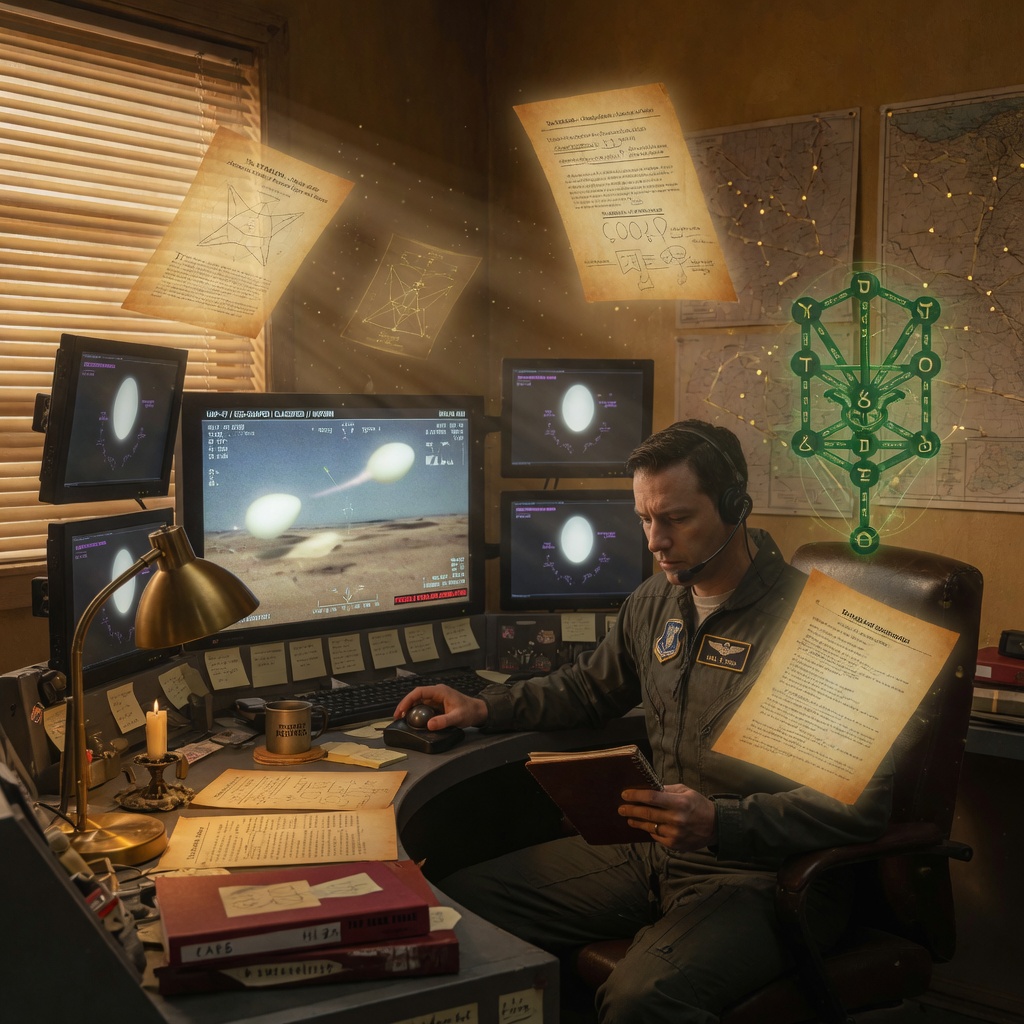
Imagine sitting in a classified briefing room, the kind with no windows and guards outside the door. You’re a military contractor, you’ve seen things most people never will. But nothing prepared you for what happened next – watching a so-called “psionic operator” attempt to mentally summon an unidentified craft while your team stood ready to retrieve it.
That’s essentially the story Air Force veteran Jake Barber began telling publicly in January 2025. Working with investigative journalist Ross Coulthart on NewsNation, Barber described his involvement in crash retrieval operations for downed UAPs. The twist wasn’t just the objects themselves – egg-shaped craft, anomalous debris, technology that didn’t match anything in known arsenals. The real shock was who else showed up on these missions.
Psionic operators. People with alleged psychic abilities. Individuals the military supposedly recruited to help locate, summon, and even communicate with these unidentified phenomena.
If your first reaction is disbelief, that’s fair. If your second reaction is curiosity, even better.
A Pattern Older Than You Think
Here’s the thing that makes Barber’s account less fringe than it first appears: the United States government has a documented, declassified history of exactly this kind of work.
From 1977 to 1995, the CIA and Defense Intelligence Agency ran what became known as the Stargate Project. Under various names – SCANATE, Grill Flame, Center Lane, Sun Streak – this program spent roughly $20 million investigating remote viewing. That’s the claimed ability to perceive distant locations, objects, or events using only the mind.
Remote viewers like Ingo Swann, Pat Price, and Joe McMoneagle were recruited, trained, and tasked with intelligence missions. They’d sit in a room, sometimes given only geographic coordinates, and attempt to describe what was there. Nuclear installations. Submarine bases. Hostage locations.
The program produced what the CIA’s own documents describe as mixed but occasionally striking results. It ran for nearly two decades before being officially shuttered in 1995. The declassified files are available on the CIA’s reading room website right now.
So when Barber says the military used psionic operators in UAP retrieval missions, he’s not describing something unprecedented. He’s describing a continuation.
The Hermetic Thread
The Kybalion, that compact little book of Hermetic philosophy published in 1908, lays out seven principles it attributes to Hermes Trismegistus. The very first one is Mentalism: “The All is Mind; The Universe is Mental.”
Read that again. The All is Mind.
The Hermetic tradition holds that consciousness isn’t some accidental byproduct of neurons firing. It’s the foundation. The substrate. The thing everything else emerges from. Matter, energy, space, time – they’re all expressions of a deeper mental reality.
Now consider what psionic operators are supposedly doing. They’re using consciousness as an operational tool. Not metaphorically. Not poetically. Literally deploying focused mental intention to interact with physical phenomena – to locate objects, to signal craft, to establish contact with something non-human.
Whether you believe every detail of Barber’s account or not, the premise aligns strikingly with what Hermeticists have taught for millennia: mind is not separate from reality. Mind shapes reality. Mind participates in reality at the most fundamental level.
The military apparently came to a similar conclusion. They just arrived there through classified programs instead of ancient scrolls.
As Above, So Below
The second Hermetic principle worth examining here is Correspondence: “As above, so below; as below, so above.”
This principle suggests that patterns repeat across scales. What happens at the macro level mirrors what happens at the micro level. The structure of an atom resembles the structure of a solar system. The rhythms of your body echo the rhythms of seasons. The dynamics of consciousness reflect the dynamics of the cosmos.
Applied to this conversation, Correspondence offers a provocative lens. If consciousness can interact with UAPs at the operational level – with individual craft, in specific moments, through trained practitioners – what does that imply about consciousness at larger scales?
Ancient Hermetic practitioners believed that trained individuals could access non-ordinary states of awareness to perceive things hidden from the physical senses. They called it theurgy – divine work through ritual and mental discipline. Medieval alchemists pursued similar aims, seeking not just to transform lead into gold but to transform their own consciousness into something capable of perceiving deeper truths.
The military’s psionic programs are, in a sense, a modern theurgy. Replace the robes and incense with flight suits and classified briefings, replace the temple with a secure facility, and the underlying assumption remains: focused human consciousness can reach beyond ordinary perception.
Why This Matters Beyond Conspiracy
It’s tempting to file this under “wild government secrets” and move on. But there’s something more interesting happening here, something that touches your everyday life.
If a government agency spent two decades and millions of dollars investigating remote viewing, that means serious people – scientists, military officers, intelligence analysts – considered consciousness worth studying as a real phenomenon. Not a philosophical curiosity. Not a religious belief. A potential operational asset.
And if current whistleblowers are to be believed, that investigation never really stopped. It just went deeper underground.
The Hermetic tradition has always insisted that consciousness is not passive. You are not merely a receiver of experience, a bag of chemicals responding to stimuli. You are an active participant in the creation of your reality. Your thoughts, your attention, your intention – they shape what you perceive and what you encounter.
This isn’t wishful thinking dressed up in mystical language. It’s a practical claim with practical implications.
Think about the last time you walked into a room already convinced something would go wrong. How did that turn out? Now think about a moment you approached a situation with genuine openness and curiosity. Different experience, right?
That’s Mentalism at the everyday level. Small-scale, sure. But the principle holds.
The Rhythm of Disclosure
The Hermetic Principle of Rhythm states that everything moves in cycles. Pendulums swing. Tides rise and fall. Seasons turn.
Look at the pattern of government engagement with parapsychology:
The 1970s saw a burst of interest and funding. The 1980s brought expansion and refinement. The 1990s brought official shutdown and public dismissal. The 2000s went quiet. The 2010s started stirring again with UAP disclosures. Now, in the 2020s, whistleblowers are openly describing psionic operators in military contexts.
The pendulum swung away from public acknowledgment. Now it’s swinging back.
This rhythm might frustrate those who want immediate answers, total transparency, neat conclusions. But Hermetic wisdom suggests that the swing itself is natural. Information emerges when conditions are right, recedes when they’re not, then returns transformed.
Barber’s willingness to speak publicly – stating he’d testify under oath to Congress – suggests the pendulum has reached a new inflection point. The Defense Department confirmed in February 2025 that it’s investigating his claims. That’s not nothing.
What Does the Government Actually Believe?
Here’s where things get speculative but worth sitting with.
Officially, the U.S. government’s position on psychic phenomena has been dismissive since Stargate was shut down. The CIA’s 1995 report concluded that remote viewing hadn’t proven useful enough to justify continued funding.
But unofficially? Actions speak louder than press releases.
If Barber and his colleagues are telling the truth, then the government didn’t abandon parapsychology research. It moved it into even more classified channels. It integrated psychic operators into retrieval operations. It treated consciousness not as a curiosity but as a tool.
The Kybalion’s Principle of Cause and Effect states that nothing happens by chance. Every event has a cause. Every action produces consequences. If the military invested resources in psionic programs, there was a reason. Not necessarily a good reason, not necessarily a wise one, but a reason rooted in observed results.
Someone, somewhere, saw enough to justify continuing. Enough to classify it. Enough to build programs around it.
The Gender Principle and Creation
One Hermetic concept that doesn’t get enough airtime in modern discussions is Gender – the idea that creation requires both projective and receptive forces. Not masculine and feminine in the cultural sense, but active and passive principles working together.
Consider this through the lens of psionic operations. The operator (receptive consciousness) opens to perceive. The military apparatus (projective force) acts on that perception. Neither works alone. The psychic without operational support can’t retrieve a craft. The operational team without psychic guidance can’t locate one.
Creation – whether it’s making art, building a relationship, or recovering anomalous technology – requires both forces in balance. The Hermetic tradition understood this. Modern military programs, it seems, stumbled into the same understanding through practical necessity.
Bringing It Home
You probably won’t be summoning UAPs this weekend. That’s not the point.
The point is that these revelations, whether every detail checks out or not, point toward something the Hermetic tradition has always maintained: consciousness is more powerful and more fundamental than modern materialism admits.
When a government spends decades secretly investigating psychic phenomena, when whistleblowers risk their reputations to describe psionic operators in classified programs, when ancient teachings and modern classified research converge on the same basic premise – that mind shapes reality – it might be worth paying attention.
Not because you need to believe every claim. But because the underlying principle deserves consideration.
You have a mind. You use it every day to navigate the world, solve problems, make decisions, create meaning. The Hermetic tradition suggests you’re using only a fraction of its capacity. The military apparently came to a similar conclusion.
Maybe the question isn’t whether psionic operators are real. Maybe the question is what you might be capable of if you took your own consciousness more seriously.
A Small Experiment
Here’s a gentle invitation, nothing dramatic.
Tomorrow morning, before you reach for your phone, sit for two minutes in quiet. Don’t meditate in any formal way. Just notice your own awareness. Notice that you’re aware of noticing.
That’s the Hermetic starting point. The recognition that consciousness exists, that it’s yours, and that it’s paying attention.
What you do with it from there is entirely up to you.