That Moment Before Sleep Takes You
There’s a peculiar space you drift through most nights without noticing. You’re not quite awake, not yet asleep. The room around you softens, and your thoughts start floating untethered from their usual anchors. Maybe a half-formed image flashes behind your eyelids – something you saw earlier, rearranged into something stranger. Your body feels heavy, but your mind is somewhere else entirely.
The ancient Hermetic practitioners knew this threshold intimately. They didn’t just stumble into it each night like most of us do. They sought it out deliberately, with ritual and preparation, because they believed that liminal space between waking and sleeping was one of the most powerful places a human mind could visit.
They built entire temples for it.
Sacred Chambers for Sacred Sleep
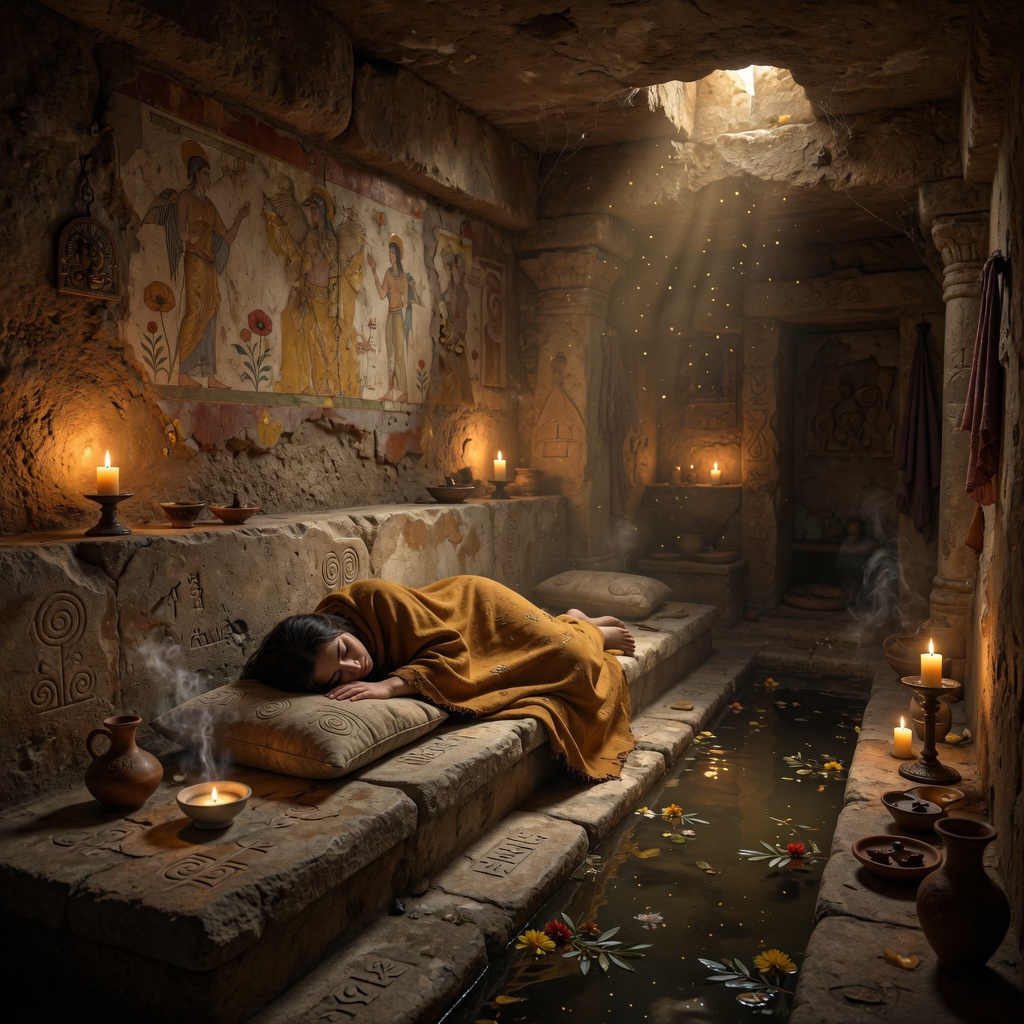
Walk through the ruins of an ancient Asclepieion – the healing temples scattered across Greece – and you’ll notice something odd about the architecture. There are long, covered porticoes with stone benches. Not for sitting. For sleeping. These were the abaton, the sleep chambers where sick people would spend the night hoping for a visit from the god Asclepius in their dreams.
The Serapeums of Egypt took this further. Dedicated to Serapis, a deliberately syncretic deity created to bridge Egyptian and Greek religious sensibilities, these temples functioned as something between a hospital and a mystery school. The most famous, the Serapeum of Alexandria, drew seekers from across the Mediterranean world. They came with illnesses, with questions, with longing for answers they couldn’t find in waking life.
And they slept. Under sacred conditions, with careful preparation, in rooms designed to alter the quality of their consciousness.
The archaeology tells us these weren’t just sleeping quarters. The chambers were often underground or partially enclosed, creating a sense of separation from the everyday world. Some had channels cut into the stone where water would flow, producing a constant low sound. Others burned specific incense blends. The space itself was engineered to shift the visitor’s mental state before they even closed their eyes.
Purification Before the Pillow
You couldn’t just show up and take a nap.
The rituals surrounding dream incubation were deliberate and multi-layered. Ablution came first – ritual washing, sometimes full immersion in sacred pools. This wasn’t hygiene in the modern sense. It was a symbolic shedding, a way of telling your body and mind that you were entering a different mode of being.
Then came dietary restrictions. Certain foods were forbidden for days before the incubation. Meat, wine, particular spices – all considered too heavy, too grounding for the kind of consciousness the seekers were trying to access. They ate simply. Light meals. Sometimes fasted entirely.
Prayers and invocations followed. In the Greek temples, hymns to Asclepius. In the Egyptian Serapeums, invocations to Serapis, and sometimes directly to Hermes Trismegistus himself. The seekers would speak their intentions aloud – what healing they needed, what question haunted them, what wisdom they lacked.
Then, and only then, they would lie down in the abaton.
Hermes in the Dream
Here’s where things get interesting from a Hermetic perspective.
The first historical reference to Hermes Trismegistus – this legendary figure who supposedly carried the wisdom of both the Greek Hermes and the Egyptian Thoth – comes from a dream record. Not a text. Not an inscription. A dream someone had and then wrote down.
Brian Copenhaver, the scholar who produced one of the standard modern translations of the Hermetica, mentions this in his introduction. The Saqqâra Necropolis, one of the most important cultic sites in ancient Egypt, contained incubation chambers where seekers hoped to receive visions from Hermes himself.
The Hermetic texts – the Corpus Hermeticum, the Asclepius, the various fragments collected under the name of the Thrice-Greatest Hermes – are themselves framed as dream-like revelations. Read the opening of the Poimandres, the first tractate of the Corpus Hermeticum. Hermes describes a state of contemplation that sounds remarkably like the hypnagogic state, that threshold before sleep: his mind was elevated, his bodily senses were suspended, and a vast, luminous being appeared to him and began to speak.
This wasn’t metaphor to the ancients. This was a description of an actual state of consciousness, one that could be deliberately accessed.
The Universe Is Mental
The first Hermetic principle – the one the Kybalion calls Mentalism – states that “The All is Mind; The Universe is Mental.”
This is the foundation everything else rests on. If reality itself is mental in nature, then altered states of consciousness aren’t escapes from reality. They’re different modes of accessing it.
Think about what that means for dream incubation. The seekers sleeping in those temple chambers weren’t engaging in wishful thinking or primitive superstition. According to Hermetic philosophy, they were navigating the mental substrate of reality itself. The dream state, with its loosened boundaries and fluid symbolism, was understood as a space where the mind could contact dimensions of the All that waking consciousness filtered out.
The principle of Correspondence – as above, so below – reinforces this. The patterns that govern the cosmos also govern the human mind. What happens in the temple of stone mirrors what happens in the temple of the body. What the stars do above, the dreaming mind does below. The macrocosm and microcosm are reflections of each other, and the dream state is one of the places where that reflection becomes visible.
Nothing Rests, Everything Moves
The Kybalion’s third principle – Vibration – tells us that nothing rests. Everything moves. Everything vibrates at different rates.
Modern neuroscience accidentally confirms this. Your brain doesn’t just switch off at night. It shifts through distinct frequency bands – beta waves when you’re alert, alpha as you relax, theta as you drift toward sleep, delta in deep sleep, and during REM, a wild mixture that sometimes produces frequencies associated with both waking alertness and deep meditation simultaneously.
The ancient Hermetic practitioners didn’t have EEG machines. But they understood vibration intuitively. They knew that different mental states had different qualities, different “speeds” if you will. And they knew that certain practices – purification, fasting, specific prayers, particular environments – could shift a person’s vibration from the gross frequencies of ordinary waking life toward the subtler frequencies needed for communion with divine intelligence.
The temple chambers were vibrational instruments. The water sounds, the incense, the stone construction, the darkness – all of it was calibrated to help the seeker’s consciousness slow down, become more receptive, vibrate at the rate needed to receive whatever Hermes might send.
The Inner Teacher Emerges
Something shifted in Hermetic thought over the centuries. The later texts – those medieval and Renaissance-era writings that carried the Hermetic tradition forward – developed a concept sometimes called the “inner teacher” or “perfect nature.”
In these texts, Hermes doesn’t appear as an external god visiting you in a dream. Instead, Hermes is understood as a principle within your own consciousness – the divine spark, the nous, the part of your mind that was always connected to the All and never forgot it.
This is the genius move. It takes the practice of dream incubation and internalizes it. You don’t need a physical temple anymore, because the temple is your own mind. You don’t need to invoke an external deity, because the teacher you’re seeking is already present in the depths of your own awareness.
The dream state, in this later Hermetic view, is where the noise of the everyday mind quiets down enough for you to hear what the inner teacher has been saying all along.
Modern Echoes
There’s a direct line from those ancient temple chambers to what modern lucid dreamers and dream interpreters are attempting.
Lucid dreaming – the practice of becoming aware that you’re dreaming while still inside the dream – shares the Hermetic aim of bringing conscious intention into the sleep state. The techniques overlap more than you might expect. Reality testing during the day. Setting intentions before sleep. Keeping dream journals to increase awareness of your dreaming patterns. These are modern versions of the same practices the temple seekers used.
Stephen LaBerge’s research at Stanford in the 1980s confirmed what the ancients knew intuitively: consciousness doesn’t shut off during sleep. It transforms. And with practice, you can maintain enough awareness during that transformation to interact with the dream state deliberately.
Modern dream interpretation, too, echoes the Hermetic understanding. When a therapist helps you explore your dreams, they’re operating on a version of the Correspondence principle – as above, so below. The patterns in your dreams reflect patterns in your waking life. The symbolic language of sleep mirrors the structure of your psyche.
The Rhythm of Seeking
The Hermetic principle of Rhythm tells us that everything has its tides. The pendulum swings. There are seasons for action and seasons for receptivity.
Sleep itself is the most obvious expression of this principle. Every day, you cycle between the projective state of waking and the receptive state of sleep. The ancient temple practices honored this rhythm rather than fighting it. They didn’t try to eliminate sleep or make it more productive in a modern capitalist sense. They recognized sleep as a sacred function, a natural doorway to dimensions of experience that waking consciousness couldn’t access.
The seekers who slept in those temple chambers understood something most modern people have forgotten: that the receptive states – sleep, meditation, contemplation, even boredom – are not empty time to be filled or optimized. They’re active states of a different kind. The mind is still working. It’s just working differently, attending to different signals, processing different frequencies.
What Those Walls Knew
Archaeological evidence from the Egyptian Serapeums reveals something fascinating about how seriously these practices were taken. The sleeping chambers weren’t afterthoughts. They were central to the temple’s design, often occupying the most protected, most sacred space within the complex.
The walls sometimes bore inscriptions – hymns, prayers, instructions for the dreamers. Some chambers had niches where statues of the deity would be placed, so the last thing a seeker saw before closing their eyes was the face of the god they hoped to meet in dreams.
At Epidaurus, one of the best-preserved Asclepieions, stone tablets called stelae were set up in the temple grounds. These recorded the dream healings that had occurred there – sometimes in astonishing detail. A man dreams that a god cuts open his belly and removes an illness. A woman dreams she’s told to drink a specific herbal preparation. A child dreams of being touched by a serpent and wakes healed.
These records weren’t just testimonials. They were data. The temples were collecting information about the relationship between consciousness, intention, and healing – information that modern science is only beginning to investigate under labels like psychoneuroimmunology and the placebo effect.
Trying It at Home
You probably can’t spend the night in an ancient temple. But the Hermetic approach to dream work is more accessible than you might think.
Start with the simplest version of purification. Before bed, wash your face and hands deliberately, not as routine hygiene but as a conscious transition. Tell yourself, even silently, that you’re entering a different mode of being.
Reduce the noise. The temple chambers were quiet for a reason. Put your phone in another room. Dim the lights an hour before sleep. Let your nervous system downshift naturally instead of slamming it with blue light and dopamine hits until the moment you close your eyes.
Set an intention, but keep it simple. Don’t demand a specific dream or answer. Just hold a question lightly in your mind. Something like: “Show me what I need to see” or “Let me remember what matters.” The ancient seekers understood that you can’t force revelation. You can only create conditions where it might occur.
Keep something by your bed to write with. Dreams evaporate fast. If you wake in the night with an image or feeling still vivid, jot it down immediately. Don’t wait until morning. The temple scribes recorded dreams as they happened, and there’s wisdom in that urgency.
And most importantly, take your sleep seriously. Not as wasted time. Not as something to minimize. As a practice. As a space your consciousness enters nightly that has its own rules, its own geography, its own kind of intelligence.
The Threshold Is Still There
Every night, you cross the same threshold those ancient seekers crossed. Your body relaxes. Your thoughts begin to loosen their grip. Images surface from somewhere deep. You drift toward a state where the ordinary rules of time and space don’t quite apply.
The Hermetic tradition suggests this isn’t something to be endured or ignored. It’s something to be approached with curiosity and respect. The temples may be ruins now, the rituals forgotten, the gods silent to most ears. But the doorway they pointed toward – that strange, luminous space between waking and sleep – is still there.
You walk through it every night.
The question is whether you’re willing to notice.
What would happen if you approached tonight’s sleep as a practice rather than an interruption? What might you discover if you held a quiet question as you crossed that threshold?