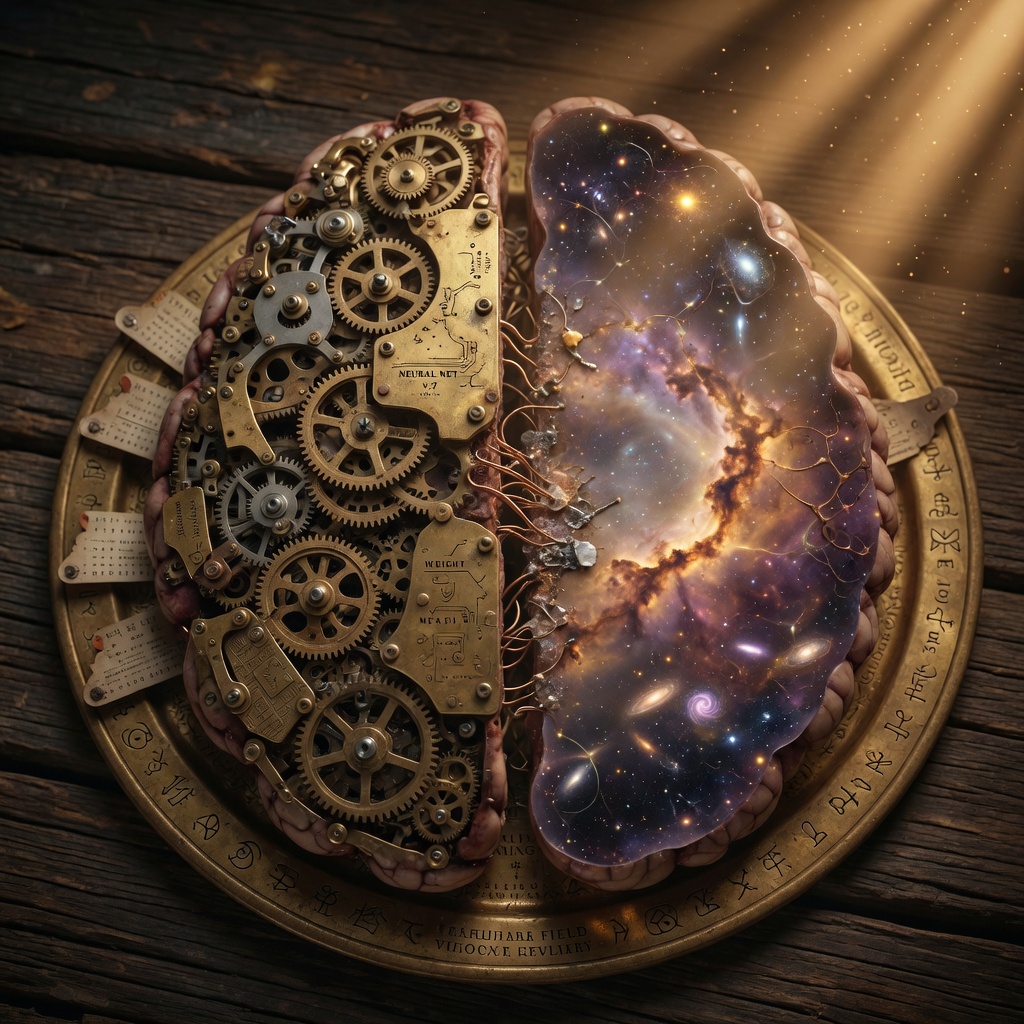
That Moment When You Wondered
You’re driving home on a familiar route, hands on autopilot, mind drifting. Suddenly, you arrive and realize you don’t remember the last five miles. Or you’re staring at a painting, lost in the colors, when a friend taps your shoulder and the world snaps back. In those gaps, where did your consciousness go? What is this awareness that can vanish like a skipped heartbeat, then return without missing a beat?
It’s a question that has haunted philosophers, mystics, and now neuroscientists. The mystery of why there is something it is like to be you – why you have an inner movie playing behind your eyes – is what philosophers call the “hard problem.” And in 2025, a massive, seven-year experiment tried to pin it down. It pitted two leading scientific theories of consciousness against each other in a head-to-head showdown. The results were surprising, messy, and left both theories battered. Strangely, that outcome feels familiar if you’ve ever peeked into an ancient text called The Kybalion.
The Hermetic Whisper in a Modern Lab
“The All is Mind; the Universe is Mental.”
That’s the first of seven Hermetic principles laid out in The Kybalion, a book compiled in the early 20th century from much older teachings. It’s a statement that has always sounded more like poetry than physics. It suggests that consciousness isn’t just something that happens inside your skull – it’s the fabric from which reality itself is cut. The universe isn’t made of dead matter that somehow learned to think. It’s a thought, dreaming itself into existence.
For centuries, this was a mystical idea, something you meditated on, not measured in a lab. Then along came the COGITATE Consortium – a global team of over 250 researchers – and decided to put the two most popular scientific theories of consciousness to a rigorous, preregistered test. It was like the scientific community saying, “Alright, let’s settle this. Is consciousness a late-stage broadcast in the brain’s theater, or is it a fundamental property of complex information?” They weren’t testing Hermeticism directly, of course. But in trying to solve the hard problem with brain scanners, they accidentally stumbled into the same ancient mystery.
The Two Contenders in the Ring
Imagine consciousness as a spotlight on a stage. One theory, Global Neuronal Workspace Theory (GNWT), says the spotlight only turns on when a performer (a piece of sensory information) walks to center stage and is broadcast to the entire theater – frontal lobes, memory centers, planning areas. Consciousness, in this view, is a late, loud, global broadcast. It’s the moment you not only see the red apple, but you can also think about it, say its name, and plan to eat it.
The other theory, Integrated Information Theory (IIT), says the spotlight is always on, and its intensity depends on how richly interconnected the backstage crew is. Consciousness isn’t a broadcast; it’s an intrinsic property of any system that integrates information in a complex way. Your brain’s posterior regions, like the visual cortex, are dense with these connections. For IIT, the raw experience of redness happens there, deep in the sensory regions, long before any frontal lobe announcement.
One theory locates consciousness in the front of the brain, as a late-arriving report. The other locates it in the back, as an early, intrinsic glow. They made opposite predictions about where and when neural activity should spike when you become aware of something. The COGITATE experiment was designed to see which prediction held up.
Inside the Biggest Consciousness Test Ever
This wasn’t a casual survey. Researchers used three different high-tech windows into the brain simultaneously: fMRI to see where blood flowed, MEG to track magnetic fields from neural chatter, and intracranial EEG in epilepsy patients to listen directly to brain cells. Over 256 volunteers participated, a huge number for this kind of study. They viewed images on a screen – sometimes quickly, sometimes for longer – and reported whether they’d seen them.
The experiment was adversarial by design. The proponents of IIT and GNWT each preregistered their specific predictions: “If my theory is right, then when the subject sees the image, we should see a spike in region X at time Y.” A neutral team ran the experiment and collected the data. It was a duel fought with brain scans instead of swords.
The Verdict: Neither Won
When the data was analyzed, neither theory emerged unscathed. Some of IIT’s predictions about sustained activity in posterior sensory areas held up, but others didn’t. GNWT’s predictions about a late, frontal surge of activity were also only partially supported. The results were messy, a mix of hits and misses for both sides.
The most striking finding was that the raw experience of seeing something seemed tied more to those early sensory regions in the back of the brain, while the later activity in the frontal lobes might relate more to interpreting or reflecting on that experience. As one summary put it, consciousness might be more about perception than planning. The brain’s “I see it!” and the brain’s “Now let me think about it” might be separate processes. The hard problem, it turns out, is hard for a reason.
The Hermetic Lens: A Fundamental Field
From a Hermetic perspective, this outcome isn’t a failure. It’s a confirmation. If consciousness is truly fundamental – The All is Mind – then trying to find it solely in the mechanics of the brain is like trying to find the ocean by analyzing a single wave. You’ll learn a lot about the wave, but you’ll miss the water.
The COGITATE experiment, with its expensive machines and meticulous protocols, was trying to locate consciousness as an effect of neural processes. But what if it’s the cause? What if the brain isn’t generating consciousness, but rather receiving, filtering, and modulating a field of awareness that’s already there? The Hermetic view would suggest that the brain is more like a radio than a broadcasting station. The music isn’t inside the radio; the radio is just tuned to receive it.
The fact that neither a “frontal broadcast” nor a “posterior intrinsic” model fully explained the data points to a simpler, more profound idea: consciousness may not be a local phenomenon in the brain at all. It’s the stage, not a particular actor on it. The experiment’s messy results are what you’d expect when you try to measure the ocean with a thimble.
Correspondence: As Above, So Below
Another Hermetic principle, Correspondence, states “As above, so below; as below, so above.” The patterns of the macrocosm are reflected in the microcosm. If the universe is fundamentally mental, then your individual consciousness should be a fractal of that universal Mind. Your thoughts, your awareness, your very sense of “I am” should have a creative, reality-shaping power.
This isn’t just metaphysical poetry. It’s an invitation to look at your own experience. Notice how your mood colors your entire day. When you’re anxious, the world seems threatening. When you’re joyful, opportunities appear. Your inner state doesn’t just describe your reality; it participates in creating it. The COGITATE study, by showing that consciousness can’t be pinned down to a single brain network, hints that it might be more fundamental than any network. It’s the field in which the network operates.
Living in a Mental Universe
So what does this mean for your drive home tonight, or your next moment of getting lost in a painting? It means the mystery you experience isn’t a bug in your biology. It might be a feature of the cosmos.
Instead of seeing consciousness as a puzzling side effect of complex matter, you can experiment with seeing matter as a puzzling side effect of consciousness. This shift doesn’t require you to reject science. It simply asks you to expand your definition of what’s fundamental. The COGITATE experiment, in its rigorous honesty, showed the limits of a purely physicalist approach. It left the door open to something more.
Try a small experiment. The next time you’re completely absorbed in a simple task – washing dishes, listening to rain, watching a candle flame – pause for a second. Don’t think about the task. Just notice the awareness that is experiencing it. That silent, background witness that is always there, whether you’re thinking about philosophy or tying your shoes. That’s the Hermetic hint. That’s the field the brain scanners were trying, and failing, to capture.
An Invitation to Wonder
The COGITATE Consortium didn’t prove Hermeticism. That wasn’t their goal. But they did something valuable: they showed, with data, that our current scientific models of consciousness are incomplete. The hard problem remains stubbornly unsolved. And in that gap of not-knowing, ancient wisdom finds a comfortable chair.
You don’t need to adopt any belief system. Just consider the possibility. What if the universe is not a vast, empty machine that accidentally produced you, but a vast, conscious mind that is dreaming you? How would that change the way you experience your next breath, your next thought, your next moment of wondering where your consciousness goes when you’re not paying attention?
Perhaps the most profound experiment isn’t one conducted in a lab with 256 subjects. It’s the one you conduct every day, simply by being aware. What do you notice when you pay attention to the fact that you are paying attention?
Try This Today
Pick one routine activity – making coffee, brushing your teeth, waiting for an elevator. For the duration of that activity, try to hold this question lightly in the background of your mind: What is it that is aware of this? Don’t strain for an answer. Just let the question hum beneath the surface of your doing. See what shifts.