You wake up on a Tuesday morning with a knot of dread in your stomach. A big presentation looms. Before your feet even hit the floor, your mind is already spinning worst-case scenarios – stumbling over words, forgetting key points, the whole room staring in judgment. By the time you arrive at work, your body is tense, your voice is tight, and guess what? The presentation goes exactly as badly as you imagined.
Now flip it. Same presentation, different morning. You wake up and take a few breaths. You picture yourself speaking clearly, the audience nodding along, the room feeling collaborative instead of hostile. You walk in with a different energy. Not perfect, maybe, but something shifts. The words flow easier. People respond differently.
Same event. Same you. Different outcome.
What changed? According to the Hermetic tradition – one of the oldest streams of Western mystical thought – it wasn’t the external circumstances. It was the mental field from which everything else emerged.
The First Law: The All Is Mind
The Kybalion, a text published in 1908 that distills ancient Hermetic teachings attributed to Hermes Trismegistus, opens with a single axiom that the other six principles build upon: “The All is Mind; the Universe is Mental.”
Read that again. Not “the universe has mental aspects” or “your thoughts influence things.” The claim is far more radical: the universe, at its most fundamental level, is consciousness. Matter, energy, time, space – all of it is a manifestation of Mind.
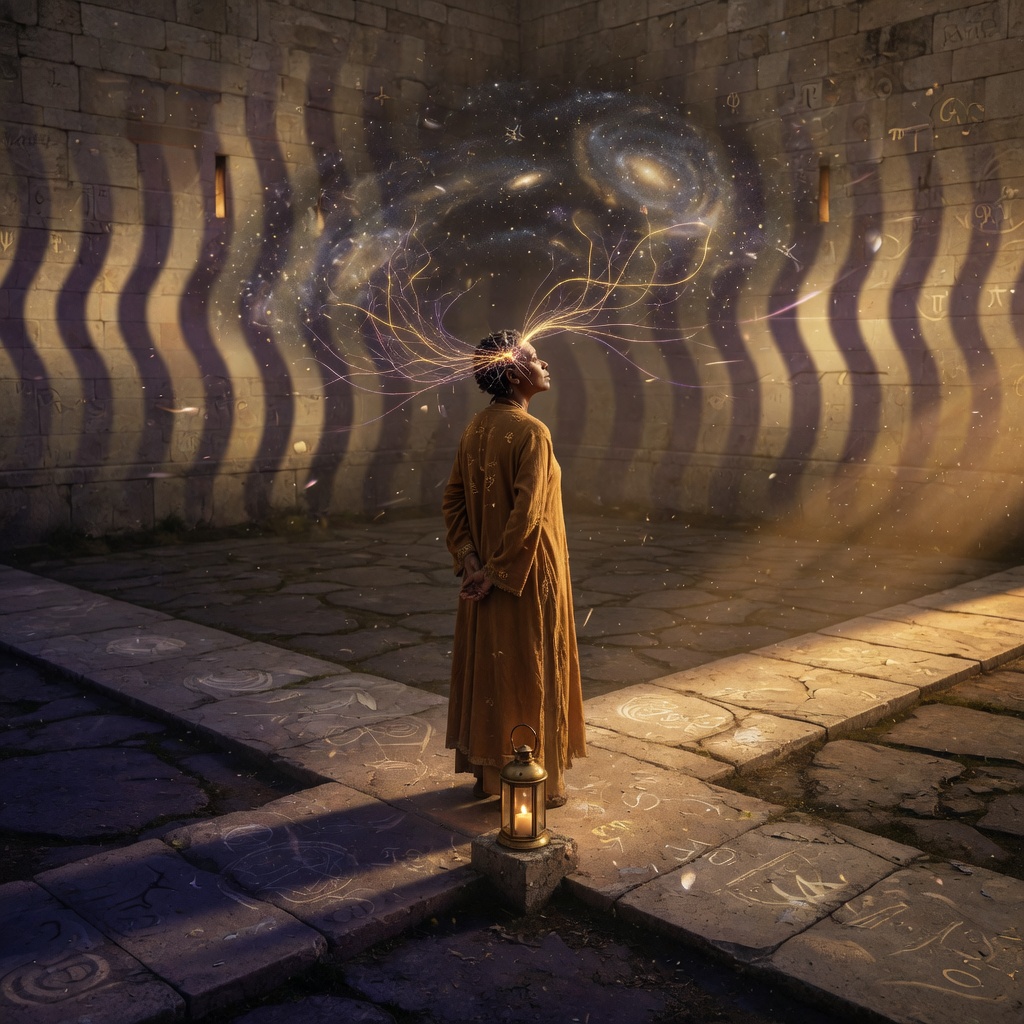
This isn’t poetry or metaphor, according to the Hermetic view. It’s the operating system. Everything you experience – your body, your relationships, the physical world you navigate – is a projection within a vast, infinite consciousness that the Kybalion calls “The All.” You’re not a physical being having mental experiences. You’re a mental being having physical ones.
If that sounds like a philosophical leap too far, stay with it for a moment. Because modern science keeps bumping into the same idea from unexpected directions.
When Science Stumbles Into Hermetic Territory
Consider the double-slit experiment, one of the most famous and confounding demonstrations in quantum physics. When particles like electrons or photons are fired at a barrier with two slits, they create an interference pattern on the other side – as if they’re behaving like waves, passing through both slits simultaneously. But here’s the strange part: the moment you place a detector to observe which slit the particle actually goes through, the interference pattern disappears. The particle starts behaving like, well, a particle. Observation itself changes the outcome.
Physicists have debated this for decades. The Copenhagen interpretation suggests that particles exist in a superposition of states until measured. Other interpretations, like the von Neumann-Wigner hypothesis, go further – they propose that consciousness itself is what collapses the wave function. The observer doesn’t just witness reality; the observer participates in creating it.
Sound familiar? “The All is Mind; the Universe is Mental.”
Now, quantum physics doesn’t prove Hermetic philosophy, and serious thinkers on both sides caution against sloppy conflations. But the resonance is hard to ignore. Ancient Hermetic sages and modern physicists are both circling the same mystery: that consciousness and matter aren’t separate categories. They’re entangled aspects of something deeper.
The Placebo Effect: Your Body Takes Orders from Your Mind
If quantum mechanics feels abstract, here’s something closer to home. The placebo effect is one of the most replicated, rigorously documented phenomena in medical science. Give someone a sugar pill and tell them it’s a powerful painkiller, and their brain will release endogenous opioids – actual chemicals that block real pain. Their blood pressure drops. Their inflammation decreases. Their symptoms improve.
Harvard Medical School has called the placebo effect proof that “your mind can be a powerful healing tool.” Research published in Nature Human Behaviour in 2024 explored self-induced placebo mechanisms – how people can deliberately use mental imagery and somatic awareness to trigger these healing responses without any external intervention at all.
The implication is staggering. Your body isn’t a fixed machine that your mind merely inhabits. Your body is responsive to the mental field in which it exists. Change the field, change the body.
This is Mentalism in action. Not as abstract theory, but as lived, measurable reality.
The Mentalism Audit: Where Are You Living?
Here’s where things get practical. If the universe really is mental, then the way you think isn’t just a private psychological event – it’s a creative act. Every thought, every assumption, every unconscious belief is shaping the field of your experience.
Most people don’t realize how much of their thinking operates from a materialist framework. They treat their circumstances as fixed, their problems as external, their emotions as reactions to things that happen “out there.” The Hermetic tradition invites a different orientation.
Try this audit. Not as a test with right answers, but as honest reflection.
When something goes wrong at work, do you first look at what changed in the external situation, or do you check what mental state you were carrying into it?
When your body feels tense or unwell, do you reach immediately for an external remedy, or do you first pause to notice what thoughts and emotions might be contributing?
When you think about your future, do you describe it in terms of what’s likely given current circumstances, or do you start from the vision of what you actually want and work backward?
When you encounter someone who frustrates you, do you focus on changing their behavior, or do you examine the story you’re telling yourself about them?
These aren’t accusations. They’re orientations. Most people live predominantly in one camp or the other, and most default to the materialist view – not because they’ve chosen it, but because culture trains it into us. We’re taught that reality is “out there” and our job is to react to it.
The Principle of Mentalism flips this. Reality is in here. And from that inner space, everything else takes shape.
Mental Transmutation: The Hermetic Art of Changing Your World by Changing Your Mind
The Kybalion doesn’t just offer the Principle of Mentalism as a theory to believe. It describes a practical discipline: mental transmutation. The art of changing your reality by changing your mental state.
This isn’t wishful thinking. It’s not positive affirmations taped to your bathroom mirror (though those aren’t inherently useless). Mental transmutation is the deliberate practice of recognizing that your mental state is causal, not reactive, and then learning to shift it intentionally.
Think of it like tuning a radio. The station doesn’t change to match your preferences – you change the dial to match the frequency you want to receive. Your consciousness works similarly. The world you experience is a reflection of the frequency you’re broadcasting.
Here’s what this looks like in practice:
Morning mental architecture. Before you check your phone, before the day’s demands flood in, spend three to five minutes deliberately setting your mental state. Not with a to-do list. With a felt sense of how you want to move through the day. Calm? Confident? Curious? Let that feeling saturate your awareness before anything else gets in.
Thought catching. Throughout the day, practice noticing your thoughts without judgment. Not to suppress them, but to see them clearly. When you catch a thought like “this always goes wrong” or “people can’t be trusted,” pause. Recognize it as a creative act you’re performing, not a neutral observation. Then ask: Is this the frequency I want to broadcast?
Emotional transmutation. When you feel stuck in a low state – anxiety, frustration, resignation – don’t fight the emotion. That just adds resistance. Instead, find the opposite pole. The Kybalion’s Principle of Polarity teaches that opposites aren’t different things; they’re the same thing at different degrees. Anger and calm are on the same spectrum. Fear and courage are the same energy, expressed differently. Move along the spectrum gently. Don’t leap from despair to joy – just nudge toward slightly less despair, then slightly less again. The shift is gradual, but it’s real.
Evening review. Before sleep, revisit the day not as a list of accomplishments and failures, but as a series of mental states you inhabited. Where were you conscious and deliberate? Where were you on autopilot? This isn’t about self-criticism. It’s about building awareness of the mental field you’re cultivating moment by moment.
The Trap of Materialism (the Mental Kind)
A word of caution. The Principle of Mentalism doesn’t mean the physical world is an illusion you can dismiss. Your body needs food. Gravity exists. Bills arrive in the mail regardless of your mental state.
The Hermetic tradition isn’t asking you to deny the physical. It’s asking you to recognize the causal chain. The mental precedes the physical. Thought precedes form. This doesn’t mean you can think your way out of every hard situation by sheer willpower. It means the mental framework you bring to a situation shapes how you engage with it, what solutions you perceive, what possibilities you’re open to.
There’s a subtle trap here: using Mentalism as another way to blame yourself when things go wrong. “If reality is mental, and my reality is hard, then it must be my fault for thinking wrong.” That’s materialism wearing a spiritual mask. It’s still treating circumstances as the primary reality and your mind as something that failed to control them.
The healthier frame: your mind is the primary reality. Circumstances are downstream effects. But the river of manifestation moves at its own pace, influenced by countless currents – not just your conscious thoughts, but your unconscious beliefs, collective fields, timing, and forces you can’t see. Your job isn’t to control the river. It’s to align with it.
Correspondence: The Fractal Nature of Mind
The Kybalion’s second principle, Correspondence – “As above, so below; as below, so above” – deepens the picture. The mental and physical aren’t just connected; they mirror each other at every scale.
The patterns you think in become the patterns you live in. The beliefs you hold about yourself repeat in your relationships, your career, your health. This isn’t cosmic punishment. It’s resonance. Like attracts like, not because of some mystical law of attraction, but because the mental field organizes itself around its dominant frequencies.
Notice the patterns in your life. They’re diagnostic. Where do you see repetition? Where do the same themes keep showing up – different faces, same dynamic? Those patterns are reflections of mental structures operating beneath your conscious awareness. They’re not happening to you. They’re happening from you.
This is actually good news. Because if the patterns are mental, they can be changed mentally. Not easily, not instantly, but genuinely. The outer world reshapes when the inner world shifts. It’s correspondence in action.
The Living Experiment
The Hermetic path isn’t about believing the right doctrines. It’s about running the experiment yourself.
Try this today: Pick one recurring thought you have – something habitual, maybe something negative. Just one. “I never have enough time.” “People always let me down.” “I’m not good at this kind of thing.” Hold it up to the light. Examine it. Is it a fact about reality, or is it a mental habit you’ve been broadcasting without realizing it?
Then, for one day, experiment with replacing it. Not with forced positivity, but with genuine curiosity. “What if time works differently than I think?” “What if some people can be trusted?” “What if I could learn this?” See what happens. Not to the external world – watch what happens inside you.
That shift, however small, is the beginning of mental transmutation. It’s the moment you stop being a passive receiver of circumstances and start recognizing yourself as an active participant in the creation of experience.
The universe is mental. Which means you have far more agency than you’ve been told.
Not control. Not magic. Agency.
And that might be the most radical thing you can claim in a world that keeps insisting you’re just a body, bumping into other bodies, hoping for the best.