When Pipes Burst, Truth Leaks Out
Imagine you’re a caretaker at a small village church in the Austrian Alps. It’s 2025. You notice water pooling on the stone floor of the crypt – some aging pipe has finally given out. You call a plumber, maybe grumble about repair costs. Nobody expects that a burst pipe is about to crack open a 280-year-old mystery.
But that’s exactly what happened at St. Thomas am Blasenstein, a quiet parish tucked into the hills of Upper Austria. The water leak forced a proper examination of the crypt’s most famous resident: a mummified body that locals had nicknamed the “Air-Dried Chaplain.” And what researchers found wasn’t just a name for the body. It was a forgotten embalming technique that nobody had ever documented before.
Sometimes the universe delivers its answers through the most unglamorous door.
The Body in the Crypt
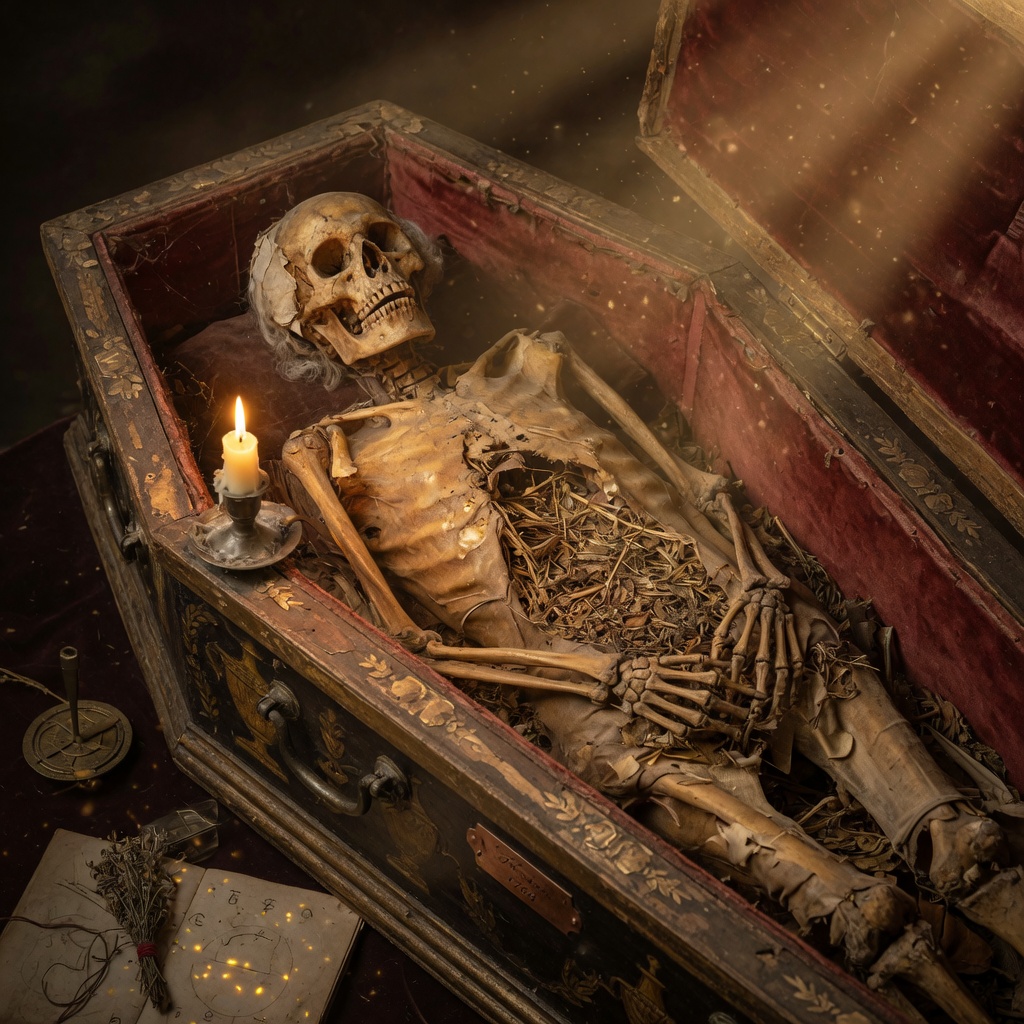
For generations, the mummy had been a local curiosity. The story passed around the village was that the remains belonged to an 18th-century clergyman who died of an infectious disease – probably tuberculosis. According to the tale, his body had been dug up from its original grave a few years after burial and moved to the church crypt. Nobody knew exactly why. Nobody knew for certain who he was.
What people did know was that the body was strange. The torso was remarkably intact – skin still stretched over ribs, organs still recognizable after nearly three centuries. But the head and legs? Those looked like what you’d expect from a body that old. Decomposed. Skeletal in places. The mismatch was baffling.
And so the mummy sat in its coffin, half-preserved, fully mysterious, earning his nickname. The Air-Dried Chaplain. As if someone had just left him out on a clothesline and forgotten about him.
A Pipe, A Flood, and Permission to Look
The water leak changed everything. When repair crews descended into the crypt, it created an opportunity – one that researchers at Ludwig-Maximilians-Universität in Munich had apparently been waiting for. Dr. Andreas Nerlich, a pathologist, led a team that finally got to examine the mummy properly. CT scans. Toxicology tests. Radiocarbon dating. The full investigative treatment.
What they found overturned the local legend entirely.
The body hadn’t been naturally “air-dried.” It had been deliberately, carefully, and rather ingeniously preserved using a method that no one in the scientific community had ever seen before.
Stuffed with Twigs and Treated with Chemicals
Here’s where it gets strange.
The researchers discovered that someone – most likely in 1746, shortly after the man’s death – had packed his abdominal and pelvic cavities full of wood chips, fragmented twigs, and fabric. But not through any incision. Through the rectum.
The stuffing material was pushed into the body’s interior through the rectal canal, filling the abdominal cavity like someone packing a suitcase. Then the whole works was treated with zinc chloride – a potent drying agent that also kills bacteria. Toxicology also turned up traces of copper and small amounts of arsenic.
The result was a kind of internal mummification focused on the torso. The drying agents and the physical stuffing worked together to pull moisture out of the body’s core, halt bacterial decay, and create conditions that preserved skin, tissue, and even some organ structures in remarkable detail.
But nobody had bothered with the head or the extremities. Those were left to decompose naturally, which is why the mummy looked so bizarrely inconsistent – pristine trunk, deteriorated skull and limbs.
This technique had never been documented in any historical embalming manual. No medical text from the 18th century described it. No other mummy showed signs of it. It was, as far as anyone could tell, a one-off. A local solution to a local problem, lost to history until a plumber’s visit brought it back into the light.
Unmasking the Man
The scientific investigation also settled the question of identity.
Radiocarbon dating placed the body in the period between 1730 and 1780. Skeletal analysis showed a man between 35 and 45 years old. And the tuberculosis? That part of the local legend turned out to be true – researchers found evidence of the disease in the preserved tissue.
Cross-referencing all of this with parish records and monastery archives from the region, the team identified the mummy as Franz Xaver Sidler von Rosenegg. He was born in 1709 into an aristocratic family, took religious orders at the Waldhausen im Strudengau monastery, and was delegated to serve as parish vicar at St. Thomas am Blasenstein for roughly six years. He died in 1746, at the age of 37.
The local legend had been partly right – he was a clergyman who died of an infectious disease. But the story about being dug up and moved? That part appears to be wrong. The evidence suggests he was embalmed and placed in the crypt shortly after death, not exhumed years later.
Why This Matters Beyond the Grave
There’s something disarming about how this discovery happened. No grand expedition. No carefully planned archaeological dig. Just a water leak in a basement, forcing people to actually look at what they’d been walking over for centuries.
It raises an uncomfortable question: how much knowledge is sitting right beneath our feet, waiting for a mundane accident to reveal it?
The Air-Dried Chaplain’s embalming technique wasn’t recorded anywhere because it didn’t need to be. It was a practical solution, probably devised by someone local – maybe the vicar’s colleagues at the monastery, maybe a village healer with knowledge of drying agents. Whoever did it knew enough about chemistry and anatomy to preserve a body in a way that would survive nearly three centuries. They just never wrote it down. Or if they did, the document hasn’t survived.
This is how so much human knowledge disappears. Not in fires or floods or wars, but in the quiet accumulation of generations who assume someone else is keeping notes. The technique dies with the practitioner. The memory fades. The body sits in its crypt, waiting.
The Layers We Don’t See
There’s a resonance here that goes beyond archaeology.
Think about the stories you carry about your own life. The explanations you’ve accepted for years – about why you are the way you are, about what happened and why. How many of those stories are like the local legend about the Air-Dried Chaplain? Partly true, partly embellished, partly just the version that made sense to people who didn’t have all the information.
Sometimes it takes a disruption – a leak in the basement of your assumptions – to force a proper examination. And what you find underneath the familiar story can be surprising. More intricate. More intentional than you expected.
The vicar’s body wasn’t just naturally preserved by accident. Someone made choices. Someone packed that body with wood chips and treated it with chemicals, and those choices echoed forward through three centuries. The intention outlasted the intention-maker by a factor of ten.
What intentions are you setting that might echo that far?
What the Crypt Keeps
The church at St. Thomas am Blasenstein is still there. The crypt is still there. Franz Xaver Sidler von Rosenegg is still there, resting in his coffin, his torso preserved by the strange ingenuity of people who loved him enough to figure out how to keep him intact.
And now the story is complete. Not just the scientific facts – those were always there, locked in the wood chips and zinc chloride – but the human story. An aristocratic monk. A parish priest in a small village. A man who died young from a disease that ravaged Europe for centuries. Someone who cared enough about him to try something new, something nobody had thought to write down.
The water leak has been repaired. The crypt is dry again. But the knowledge that leaked out with that water isn’t going back underground.
Try This Today
The next time something inconvenient happens – a disruption to your routine, a problem that forces you to stop and deal with it – pay attention to what gets revealed in the process. What assumptions get shaken loose? What hidden things come to light?
The best discoveries rarely announce themselves. They show up wearing the disguise of a plumbing emergency.
What old stories in your own life might benefit from a closer look? And what preservation methods – what intentional practices – are you using to keep what matters most intact?


