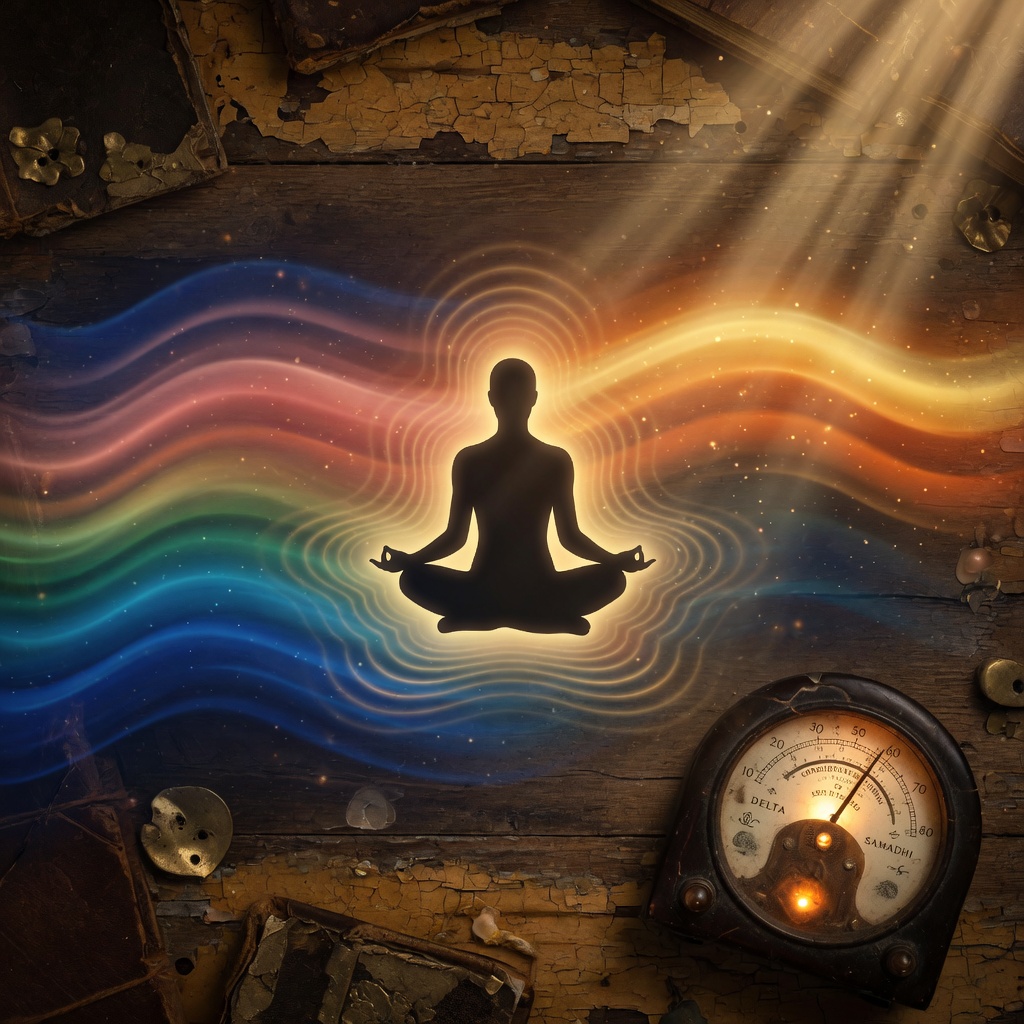
There’s a fleeting instant, maybe just before your alarm shrieks, where you’re neither fully asleep nor truly awake. You’re floating. Thoughts drift like clouds, unattached to the urgent “you” that needs to get up and make coffee. For a few seconds, you exist in a liminal space – a different frequency of awareness entirely.
That space isn’t empty. It’s a different station on the dial.
Modern neuroscience is finally catching up to what mystics have whispered for millennia: consciousness isn’t a light switch. It’s a dimmer. And the ancient Hermetic Principle of Vibration – “Nothing rests; everything moves; everything vibrates” – might be the most practical map you’ll ever find for navigating the spectrum of your own awareness.
The Kybalion’s big claim
Over a century ago, a text called The Kybalion laid out seven Hermetic principles distilled from ancient Egyptian and Greek wisdom. The third principle is Vibration: the idea that everything in the universe – from the densest rock to the most ephemeral thought – is in constant motion. The difference between matter and energy, between thought and thing, is simply the rate of vibration.
Think about that for a second. Your anxious mind and your calm mind aren’t different in kind. They’re different in frequency. Same you, different speed.
For centuries, this was metaphor. Poetic philosophy. Beautiful, maybe, but not exactly testable. Then came the EEG.
What brainwaves actually show
In the 1920s, Hans Berger recorded the first human electroencephalogram and discovered that the brain produces rhythmic electrical pulses. Fast-forward a hundred years, and we’ve mapped these rhythms into distinct bands:
- Delta (0.5–4 Hz): Deep, dreamless sleep. The brain’s slowest oscillation. Where repair happens.
- Theta (4–8 Hz): The twilight zone. Hypnagogia, deep meditation, REM sleep. Where memories consolidate and intuition whispers.
- Alpha (8–13 Hz): Relaxed wakefulness. That calm-but-alert feeling after a walk in nature or a few deep breaths.
- Beta (13–30 Hz): Ordinary waking consciousness. Focused attention, conversation, problem-solving.
- Gamma (30–100+ Hz): Heightened perception. Peak focus, moments of insight, advanced meditators in states of bliss.
Here’s what’s wild: these aren’t separate states. They’re a continuum. A 2024 MIT study confirmed what neuroscientists have suspected – brainwave patterns aren’t random noise. They’re organized in a universal hierarchy, with faster gamma waves dominating the brain’s outer layers and slower alpha/beta waves deeper inside. It’s a layered orchestra, not a single note.
And a Scientific American article from recent years put it plainly: “Consciousness is not simply a binary – on or off, conscious or unconscious – but instead something that can encompass a continuum of different states.”
The Hermeticists were right. It’s all vibration. You’re just tuning into different frequencies.
Why this changes everything
If consciousness is a spectrum, then you’re not stuck. You’re not “an anxious person” or “a calm person.” You’re a person currently tuned to beta-gamma with a lot of mental static, or a person who’s learned to drop into alpha-theta with ease. The station isn’t who you are. The radio is.
This is the Principle of Correspondence in action – as above, so below. The patterns in your brain mirror the patterns in your life. A mind constantly buzzing at high beta is a life constantly reacting. A mind that can fluidly move between states is a life with more range, more creativity, more choice.
And here’s where it gets practical.
You already shift states all the time
You do this every day without thinking about it. When you’re stressed, your brainwaves speed up. When you take a few slow breaths, they begin to settle. When you’re engrossed in a task and lose track of time, you’ve slipped into alpha-theta territory – that’s flow. When you wake from a vivid dream, you were just in theta, weaving reality from pure consciousness.
The problem isn’t that you can’t shift states. It’s that you do it unconsciously, blown around by external triggers and old habits. The Hermetic invitation is to do it on purpose.
This is inner alchemy. Not lead into gold, but reactivity into presence. Beta into alpha. Mental chatter into creative stillness. The raw material is your attention, and the furnace is your daily practice.
Three doorways into the spectrum
You don’t need to understand the neuroscience to walk through these doors. But knowing why they work makes the practice feel less like mysticism and more like skill.
1. Breath as frequency tuner
Slow, deep breathing – especially with longer exhales – activates the parasympathetic nervous system. Your heart rate drops. Your brainwaves slow. You’re literally downshifting your vibration. Try inhaling for four counts, holding for four, exhaling for six. Two minutes of this and you’ll feel the shift from beta to alpha. It’s not woo. It’s biology.
2. Meditation as conscious state-shifting
Every meditation tradition is, at its core, teaching you to move deliberately along the consciousness spectrum. Focused attention practices (like watching the breath) train beta-alpha transitions. Open awareness practices drop you into theta. Advanced practitioners – monks with tens of thousands of hours – show sustained gamma coherence that scientists once thought was impossible.
You’re not “clearing your mind.” You’re changing the channel.
3. Assumption as vibrational alignment
Neville Goddard taught that the feeling of the wish fulfilled is the key to manifestation. Joe Dispenza teaches heart-brain coherence – aligning your emotional state with a future possibility until your body can’t tell the difference. Both are describing the same Hermetic truth: to change your reality, change your vibration.
When you sit in the feeling state of already having what you want, you’re not just daydreaming. You’re shifting your brainwave patterns, your hormonal balance, your electromagnetic field. You’re tuning to a different station – and the universe, being consciousness itself, responds.
The spectrum isn’t linear, it’s nested
Here’s a nuance the Hermeticists understood that modern science is still unpacking: these states aren’t a ladder you climb. They’re nested. You can be in beta (focused task) while theta hums underneath (creative intuition). You can be in deep delta sleep while gamma flashes spike (lucid dreaming).
This is the Principle of Polarity – opposites are the same thing at different degrees. Sleep and waking aren’t opposites. They’re two ends of the same dial. Deep meditation and heightened alertness aren’t enemies. They’re dance partners.
The goal isn’t to live in alpha all day (though that would be lovely). It’s to become fluid. To have range. To know where you are on the spectrum and have tools to move when you want to.
The dream within the dream
There’s a deeper layer here, one that might bend your mind a bit.
If consciousness is fundamental – not produced by the brain but filtered through it – then brainwaves aren’t generating your awareness. They’re modulating it. Like a prism splitting white light into colors, the brain takes infinite consciousness and narrows it into the specific bandwidth you call “my life.”
This is the Hermetic Principle of Mentalism: the All is Mind. The universe is a thought in the mind of the infinite, and you are that infinite mind, dreaming itself into form. Your brainwaves are the rhythm section of the dream.
Alan Watts put it simply: “You are the universe experiencing itself.” The spectrum of consciousness isn’t something you move through. It’s something you are. Every state – deep sleep, anxious beta, blissful gamma – is a face you wear, a note you play in the symphony of being.
Waking up, then, isn’t about reaching some special state. It’s about realizing you’re the one who chooses the station.
Making it real in your Tuesday afternoon
All this is fascinating, but how does it help when you’re stuck in traffic, spiraling about a deadline, or lying awake at 2 AM?
Start with noticing. The next time you feel stressed, pause and ask: what frequency am I on right now? Not judging, just noticing. High beta? Racing thoughts? That’s data, not destiny.
Then choose one micro-shift:
- Three slow breaths (downshift to alpha)
- Name five things you can see (ground into sensory beta, away from anxious beta)
- Place a hand on your chest and feel your heartbeat for ten seconds (theta doorway)
- Recall a moment of genuine gratitude and let it warm your body (gamma coherence)
These aren’t hacks. They’re acts of conscious vibration. Small ones, sure. But small shifts accumulate. A daily practice of five minutes of intentional state-shifting rewires your baseline over time. That’s inner alchemy in action – transmuting the lead of unconscious reaction into the gold of aware presence.
The invitation
The Hermeticists didn’t have EEG machines. They had direct experience, disciplined practice, and a trust that the inner world was the real world. Modern neuroscience has given us the maps – the frequencies, the brain regions, the chemical cascades. But the territory remains the same: your consciousness, your vibration, your choice.
You are not at the mercy of your brainwaves. You are the awareness in which they arise. And the more you practice moving consciously along the spectrum, the more you realize that the spectrum itself is a gift – an infinite instrument, waiting for you to play it.
The Kybalion says nothing rests. Everything moves. Everything vibrates.
The question isn’t whether you’re vibrating. It’s whether you’re doing it on purpose.
Try this today: Set a timer for three minutes. Close your eyes. Breathe slowly, extending your exhales. Notice what shifts – not in your thoughts, but in the texture of your awareness. Does the world get softer? Quieter? More spacious? That’s you, changing the dial.
Reflection question: If consciousness is a spectrum you can navigate, what frequency do you spend most of your day on – and what would shift if you learned to move more freely?


