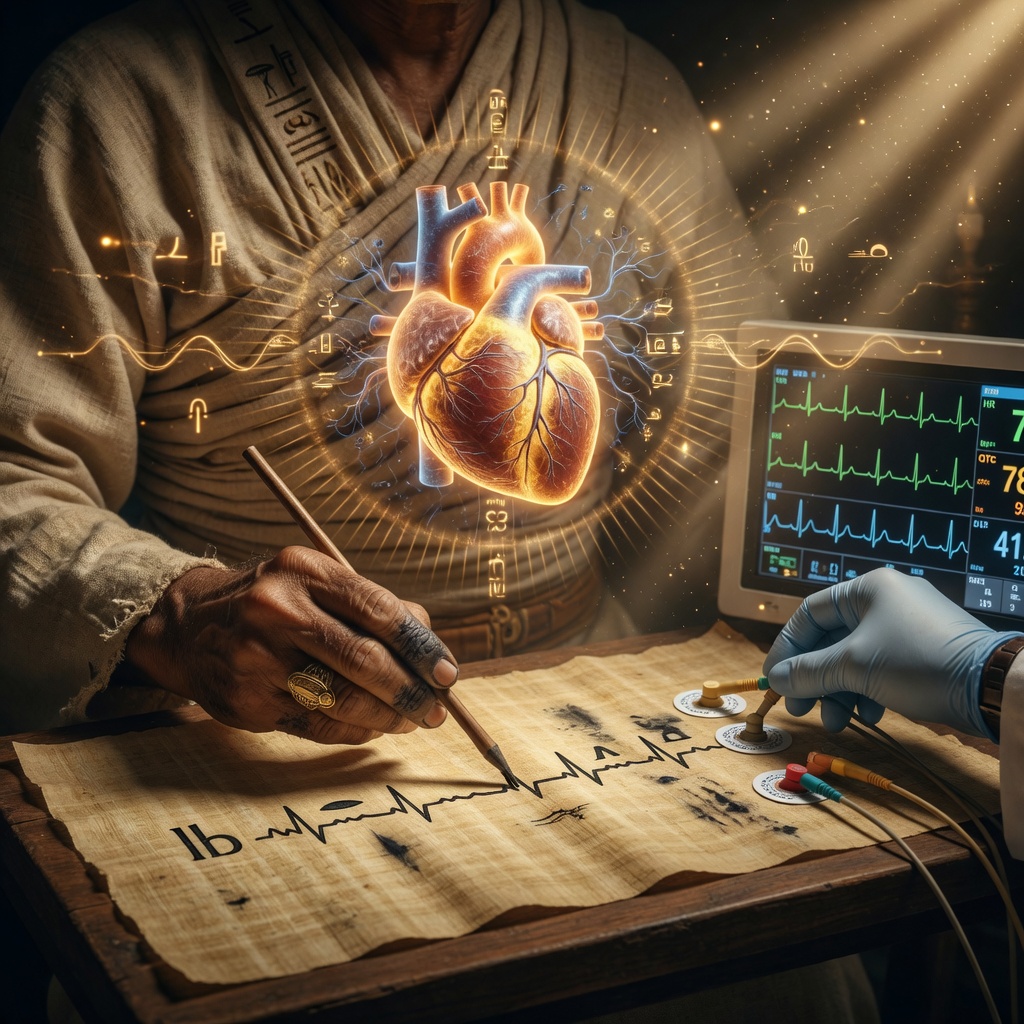
Somewhere around 1500 BCE, an Egyptian scribe pressed a reed stylus into papyrus and wrote instructions for the afterlife. When you die, he explained, your heart will be weighed against the feather of Ma’at – truth. Not your brain. Not your résumé. Your heart. The Egyptians didn’t see the heart as a pump. They saw it as the seat of your intelligence, your emotions, your memories, your very soul. They called it “ib,” and they believed it was the organ that told the truth about who you really were.
Fast forward thirty-five hundred years. A cardiologist in a lab coats wires electrodes to a research participant’s chest and monitors their heart’s electrical activity on a screen. What the data shows would have made that ancient scribe nod in quiet recognition.
The heart is not what you were told it was.
The Muscle We Got Wrong
For centuries, Western medicine reduced the heart to a mechanical pump – a fist-sized muscle whose only job was to push blood through your veins. William Harvey formalized this view in 1628 with his treatise on blood circulation, and the model stuck. The brain was king. The heart was plumbing.
But the ancient world never bought it. The Chinese character for heart, “xin,” didn’t just mean the organ – it meant heart-mind. The Huangdi Neijing, China’s foundational medical text from roughly 2600 BCE, described the heart as the “sovereign” of all organs, responsible for intelligence, wisdom, and what they called shen – the spirit or consciousness that animates a person. In the Vedic traditions of India, the heart chakra, Anahata, was considered the bridge between earthly and divine consciousness. Not a metaphor. A location.
Three civilizations, separated by thousands of miles and centuries, arriving at the same conclusion: the heart thinks. The heart knows. The heart is where consciousness lives.
Then came the Enlightenment, and we “grew up” and decided those were quaint superstitions.
Except they weren’t.
A Brain Sitting in Your Chest
In the 1990s, a neurocardiologist named J. Andrew Armour at the University of Montreal began mapping something unexpected. Embedded within the tissue of the heart was a complex, independent nervous system – a network of approximately 40,000 neurons, complete with their own ganglia, axons, and sensory neurites. Armour called it the “little brain in the heart.” The scientific term is the intrinsic cardiac nervous system, or ICNS.
This is not a metaphor. Your heart contains a real neural network that can process information, make decisions, and store memories – all independently of the brain in your skull. It can sense, feel, learn, and remember. A 2026 study published in Cell confirmed that the ICNS is not just a relay station for the brain’s commands. It is “essential for cardiac performance and survival across conditions,” managing the heart’s function on its own terms.
Think about that for a moment. When someone tells you to “follow your heart,” they are speaking more literally than they probably realize.
The Electromagnetic Giant
Here is where it gets stranger. The HeartMath Institute, based in Boulder Creek, California, has spent over three decades studying heart-brain communication. Their research has documented something that sounds almost impossible: the heart’s electromagnetic field is approximately 100 times stronger electrically and up to 5,000 times stronger magnetically than the brain’s field.
Five. Thousand. Times.
The magnetic component of the heart’s field is not blocked by tissues. It extends several feet beyond the body in every direction, and it can be measured by sensitive magnetometers. Your heart is broadcasting a signal right now – and not just to your own brain and body. Other people’s hearts are picking it up.
This is not poetry. This is physics.
And it changes the way you should think about every room you walk into. Every conversation you have. Every moment of genuine compassion or sharp resentment you feel radiating from your chest.
The Heart That Knows Before You Do
One of HeartMath’s most unsettling findings involves what they call “nonlocal intuition.” In a series of experiments, researchers Rollin McCraty and colleagues had participants sit in front of a computer screen while electrodes monitored their heart activity, brain waves, and skin conductance. Images were then displayed randomly – some calm, some emotionally provocative. The catch? The images hadn’t been selected yet when the participant’s body began responding.
On average, the heart showed a significant physiological response approximately 18 seconds before the participant consciously knew what image was coming. The heart was responding to future events before they happened. Before the brain knew. Before the participant could have known.
The researchers published their findings under the title “Electrophysiology of Intuition” in the journal Global Advances in Health and Medicine. Their conclusion: “It appears that the heart is involved in the processing and decoding of intuitive information.”
The Egyptians called the heart the seat of the soul. HeartMath calls it a nonlocal intuitive organ. The overlap is uncomfortable for anyone who thinks ancient people were simply guessing.
When the Heart Speaks, the Brain Listens
The communication between heart and brain is not a one-way street. But it is heavily weighted in one direction. Research from the HeartMath Institute shows that the heart sends far more information to the brain than the brain sends to the heart. The signals travel through multiple pathways: neurological (via the vagus nerve and spinal cord), biochemical (through hormones), biophysical (through pulse waves), and electromagnetic (through the heart’s field).
And here is where the endocrine function of the heart matters. The heart is not just a muscle – it is a gland. It synthesizes and secretes hormones, including atrial natriuretic peptide (ANP) and B-type natriuretic peptide (BNP). These hormones influence blood pressure, fluid balance, and – critically – brain function. ANP, in particular, crosses the blood-brain barrier and affects areas of the brain involved in emotional processing and decision-making.
Your heart is literally bathing your brain in chemicals that shape how you think and what you feel.
This is why, when researchers measure heart rate variability (HRV) – the subtle, beat-to-beat variation in the time between heartbeats – they are not just measuring cardiac health. They are measuring a window into your autonomic nervous system, your emotional regulation, your cognitive performance, and your capacity for what the ancients simply called “knowing.”
Coherence: The Rhythm That Changes Everything
When the heart beats in a smooth, sine-wave-like rhythm – what HeartMath researchers call “coherence” – something remarkable happens. Brain waves begin to synchronize with the heart’s rhythm. The prefrontal cortex, the area associated with higher-order thinking, pattern recognition, and what we might call executive wisdom, lights up. The entire nervous system shifts from reactive to responsive.
Coherence is not a mystical state. It is a measurable, physiological one. And it can be induced deliberately.
The simplest way? Slow, deep breathing focused on the heart area, paired with the genuine activation of a regenerative emotion – gratitude, compassion, appreciation, care. Not “thinking about” gratitude. Actually feeling it. Dropping the awareness into the center of the chest and letting warmth build there.
HeartMath’s research shows that when people practice this consistently, they experience measurable improvements in cognitive function, emotional resilience, intuitive accuracy, and even their ability to influence the emotional states of people around them through their electromagnetic field.
The Hermetic Principle of Correspondence says “As above, so below. As within, so without.” The microcosm of your heart rhythms mirrors and shapes the macrocosm of your life. When your inner world is ordered, your outer world begins to reflect that order back to you. This is not a belief. It is a repeating pattern that shows up in data.
The Alchemy in Your Chest
The ancient traditions of inner alchemy were never primarily about turning lead into gold in a physical laboratory. They were about transmutation – refining the raw, reactive, confused energies of ordinary human experience into something luminous and coherent. The heart was always at the center of that work.
When you feel anger tightening your chest, that is lead. When you breathe slowly into that space and consciously shift to a feeling of genuine appreciation for something simple – the light through a window, the weight of a blanket, the fact that your lungs work without you asking them to – that is the beginning of gold. Not metaphorically. Physiologically. Your HRV pattern shifts. Your brain waves reorganize. Your electromagnetic field changes its broadcast.
You are not just “feeling better.” You are changing the signal you send into the world. And the world responds.
Try This Today
Here is HeartMath’s Quick Coherence technique, distilled into its core:
Step one: Place your attention in the center of your chest. Not your head. Your chest. Feel the area around your heart as if your awareness lived there instead of behind your eyes.
Step two: Breathe slowly through that space. Imagine the air flowing in and out of your heart. Aim for roughly five seconds in, five seconds out. Find a rhythm that feels gentle and sustainable.
Step three: While breathing this way, activate a genuine feeling of appreciation or gratitude. Not a thought about it – the actual feeling. Recall a moment with someone you love. The warmth of a pet. A time someone showed you unexpected kindness. Let that warmth expand in your chest.
Hold this for sixty seconds. That is all. One minute.
If you do nothing else today, do this. Before a difficult conversation. Before you check your email. Before you scroll. Before bed. Notice what shifts – in your body, in your clarity, in the quality of the next few minutes that follow.
The ancients were not naive. They were paying attention to something most of us forgot how to feel. The instruments are now catching up to what the sages always knew.
Your heart is not a pump. It is a portal.
Something to Think About
If your heart is broadcasting an electromagnetic signal that extends several feet beyond your body, and other people’s nervous systems are unconsciously receiving it – what signal are you sending right now?
And what might change if you spent sixty seconds, once a day, learning to tune that signal with intention?