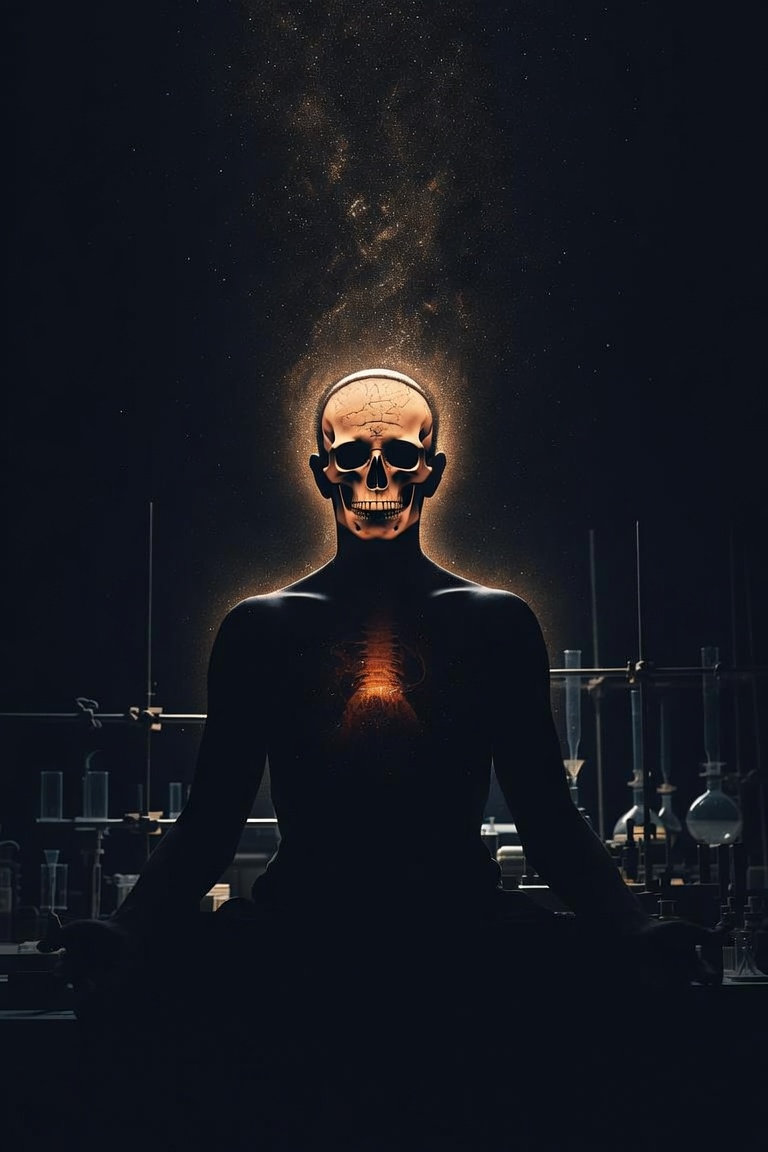
The Glow Nobody Expected to See
Four mice, anesthetized and placed inside a sealed dark chamber at the University of Calgary. Around them, ultra-sensitive single-photon detectors cooled to nearly absolute zero stood ready to capture something so faint it makes starlight look like a floodlamp. What the researchers recorded was not surprising to anyone who has ever sat still enough to notice the strange phosphene swirls behind closed eyelids – but it was surprising to physics. The mice were glowing.
Not from heat. Not from some fluorescent dye injected into their veins. The glow came from inside them, strongest around their heads, chests, and abdominal cavities – wherever metabolic activity hummed at its highest. And then the researchers did something that turned a laboratory curiosity into a headline: they let the mice die. The light vanished. Not slowly. Not ambiguously. It dropped off a cliff, like someone flipped a switch. Even rewarming the dead bodies didn’t bring it back. Whatever had been radiating was gone.
Published in The Journal of Physical Chemistry Letters in April 2025, the paper by physicist Vahid Salari, Daniel Oblak, and their colleagues documented ultraweak photon emission (UPE) from living organisms with a level of clarity and imaging precision that previous researchers could only dream of. These biophotons, as they are called, are real, measurable light – photons in the visible spectrum, roughly 380 to 750 nanometers – emitted at intensities about ten to one thousand photons per square centimeter per second. That is billions of times dimmer than what the human eye can detect. You would never see it with your naked eyes. But it is there.
The paper went viral within weeks. Over two hundred news stories. Nature covered it. Science Alert covered it. BBC covered it. And maybe the reason it captured so many imaginations is that somewhere beneath the clinical language of photon detectors and metabolic processes, people recognized something. Something the mystics have been saying for a very long time.
What the Mystics Already Knew
Here is where the story gets strange, because the Calgary team’s finding did not arrive into an empty cultural space. It landed right in the middle of a conversation that has been running, uninterrupted, for at least three thousand years.
In the Pali Canon, the earliest Buddhist texts, the Buddha describes the mind as prabhāsvara – a Pali and Sanskrit term that translates as “luminous,” “radiant,” or “clear light.” Not metaphorically luminous. Not poetically radiant. The term points to the fundamental nature of consciousness itself, which is said to shine but is obscured by the dust of mental affliction. Tibetan Buddhist practice takes this further. The ‘od gsal – the clear light mind – is considered the deepest layer of awareness, the ground of consciousness that surfaces in moments of profound stillness or at the moment of death.
Cross the Himalayas into the Indian subcontinent and you find the Vedic seers describing jyoti, a word that means both “light” and “consciousness” and was never meant as a metaphor. The Chandogya Upanishad teaches that the light within the heart is the light of the cosmos. The Katha Upanishad places the self-luminous Being (Atman) within the lotus of the heart, radiant and eternal. The Rigveda – possibly the oldest religious text in existence – frames light as a state of consciousness, not an external phenomenon.
Move west and the pattern holds. In the Christian mystical tradition, the Transfiguration describes Jesus on Mount Tabor radiating light so intense his disciples could barely look at him. Early Desert Fathers spoke of the Tabor light as a real, perceptible phenomenon accessible through contemplative prayer. Meister Eckhart, the 14th-century Christian mystic, wrote of a “spark” (Fünklein) at the center of the soul that is nothing other than the divine light itself. In Sufism, God is described as “the Light of the heavens and the earth,” and the human being is understood as a mirror reflecting that divine radiance.
Taoist internal alchemists spent centuries refining shen – spirit-light – through specific meditation and breathing practices that were understood not as symbolic exercises but as real energetic transformations. The Hermetic tradition, through the Kybalion and related texts, teaches that “The All is Mind” and that reality operates through vibration – with light as the highest expression of vibrational frequency.
Different cultures. Different centuries. Different continents. Different languages. And they all arrived at the same conclusion: consciousness is light. Not a metaphor. Not a poetic flourish. A description of direct experience, validated across traditions by practitioners who spent decades looking inward with the same kind of rigor that the Calgary team brought to their photon detectors.
The Popp Connection
The Calgary study did not appear in a vacuum. It stands on the shoulders of a German biophysicist named Fritz-Albert Popp, who spent the 1970s and 1980s arguing, against considerable skepticism, that living cells emit coherent photons. Not as metabolic waste. Not as random thermal noise. As organized light, produced by DNA and cellular processes in ways that suggest communication, coordination, and perhaps something more.
Popp called them biophotons. He proposed that this coherent photon field served as a regulatory system – a kind of light-based information network running alongside the electrical and chemical signals that conventional biology recognizes. His ideas were largely dismissed during his lifetime. The mainstream scientific establishment considered them fringe, if they considered them at all.
The Calgary team’s 2025 paper effectively vindicates Popp’s core claim. Living organisms do emit light. It is organized. It is tied to metabolic processes. And it dies when the organism dies. The researchers used imaging systems that Popp could only have imagined, and what they found matches what he predicted decades ago.
Alongside Popp, the Hungarian researcher Istvan Bokkon has proposed something even more provocative: that biophotons might function as a third signaling system within the brain itself, operating alongside electrical impulses and neurotransmitter chemistry. Brain neurons, it turns out, express photoreceptor proteins called opsins – the same class of proteins that detect light in your retinas. Your neurons can both emit and detect photons. The hardware for a photonic communication network already exists inside your skull.
If Bokkon is right, then consciousness is not just electrochemical. It is also photonic. Your brain may be generating light, detecting light, and using light as part of how it integrates information and produces the seamless experience of being alive.
The Hard Problem Gets a Little Softer
Neuroscience has a famous headache called the “hard problem of consciousness.” The question is straightforward: how does electrochemical activity in neurons produce subjective experience? How does a voltage spike become the taste of coffee, the ache of grief, the feeling of being alive?
Nobody has answered it. Not convincingly. The materialist framework can map correlations between brain states and experiences with increasing precision, but it has never explained the leap from objective mechanism to subjective quality. The gap remains.
Biophotons do not close that gap entirely. But they crack it open in a new direction. If the brain’s primary activities include photon emission and detection – if light is part of how neurons talk to each other – then the medium of consciousness might be more luminous than anyone assumed. The “hard problem” might partly be a problem of looking for consciousness in the wrong part of the spectrum.
Think about the Calgary team’s specific finding: the biophoton glow was strongest in the head, in the region where the brain sits. And it vanished at death. If photon emission is tied to consciousness – if it is part of what the brain does when it is conscious and stops doing when it is not – then the light going out at the moment of death is not just a chemical event. It is a consciousness event. The inner light extinguishes. Whatever was radiating departs.
That is precisely what the Tibetan Book of the Dead describes at the moment of death. It is what Christian mystics mean when they speak of the soul’s departure. It is what the Hindu tradition describes when Atman, the self-luminous self, releases its identification with the body.
The scientists and the mystics are describing the same moment from different sides of the same wall.
Your Brain Is Already Doing This
Here is the part that changes everything from abstract to personal: you are not reading about something that happens in a laboratory to anesthetized mice. Your brain is emitting photons right now. Your neurons are producing biophotons as part of their normal activity. The light is flowing through the photonic network that runs alongside your electrical and chemical signaling. It is happening whether you know about it or not, whether you believe it or not, whether you pay attention to it or not.
And there may be a way to notice it.
Sit somewhere quiet. Close your eyes. Wait a few minutes for the visual noise to settle. Then pay attention to what is happening behind your eyelids. Not the afterimages of whatever you were looking at. Not the random flicker of retinal noise. Look deeper. There is often a quality of luminosity there – dim, subtle, sometimes appearing as faint colors, sometimes as a kind of diffuse brightness without source.
Meditators across traditions report this. Zen practitioners describe kensho as a kind of inner illumination. Vipassana teachers instruct students to cultivate āloka-saññā, the perception of light, to sharpen concentration and access deeper states. Christian contemplatives in the Centering Prayer tradition describe a subtle inner radiance that surfaces when the mind becomes still. Sufi practitioners speak of the heart becoming luminous through dhikr.
Maybe you have noticed something like this yourself. Maybe during meditation, or in the moments before sleep, or in a moment of sudden peace, you caught a flash of something luminous – not an external light, but something that seemed to come from inside awareness itself. The perennial traditions would say you caught a glimpse of your own nature. The Calgary team would say your brain was doing what brains do – emitting photons, and perhaps, in moments of unusual coherence, emitting them in ways that your own opsins could detect.
The Correspondence Principle
The Hermetic tradition teaches As above, so below – the principle of correspondence. Patterns repeat across scales. What happens at the cosmic level mirrors what happens at the human level. What happens in the inner world shapes what happens in the outer world.
The biophoton discovery gives this principle a strange new empirical dimension. The light that mystics describe as the nature of consciousness at the most fundamental level – the clear light, the Tabor light, the jyoti, the shen – appears to have a physical correlate at the cellular level. The cosmos, according to modern physics, began with light. The universe’s first atoms were forged in light. The stars burn with light. And now it turns out that every cell in your body – every neuron in your brain – is quietly radiating light of its own.
The macrocosm and the microcosm, both made of the same stuff. Light all the way up. Light all the way down. Light all the way in.
What Changes When You Take This Seriously
This is not an invitation to add a new belief to your collection. It is an invitation to notice something that is already happening.
The perennial traditions are unanimous on one point: the light they describe is not something you need to acquire. It is not a state you need to reach. It is what you already are, underneath the noise, underneath the identification with thought, underneath the assumption that you are a solid, separate, material thing bumping around in a solid, material world.
The Calgary team measured what the body emits when it is alive and stops emitting when it is dead. The mystics measured something similar through direct experience – the luminosity of awareness itself, which shines in deep sleep, shines in waking, shines in meditation, shines in suffering, and shines at the moment when the body releases its grip.
The shift, if there is one, is subtle. It is the difference between thinking of yourself as a chemical machine that occasionally has spiritual experiences and thinking of yourself as awareness – luminous, radiant awareness – that is currently operating through a chemical machine. The machine has light running through it. The light is not the machine’s product. The machine is the light’s instrument.
Neville Goddard taught that imagination is the creative power of God operating through the human form. Joe Dispenza teaches that sustained coherent feeling states reshape physical reality. Both are describing, in different language, the principle that consciousness is primary and matter is its expression. Biophotons give this principle a body. They give it wavelengths. They give it photons you can count.
Try This
Tonight, before sleep, try something small. Close your eyes. Take a few slow breaths. Then pay attention to the light behind your eyelids. Not searching for anything. Not trying to make something happen. Just noticing. The mystics say it is always there, always shining, always what you are.
What do you find when you stop looking outward?
What happens to that inner light when you feel genuinely peaceful?