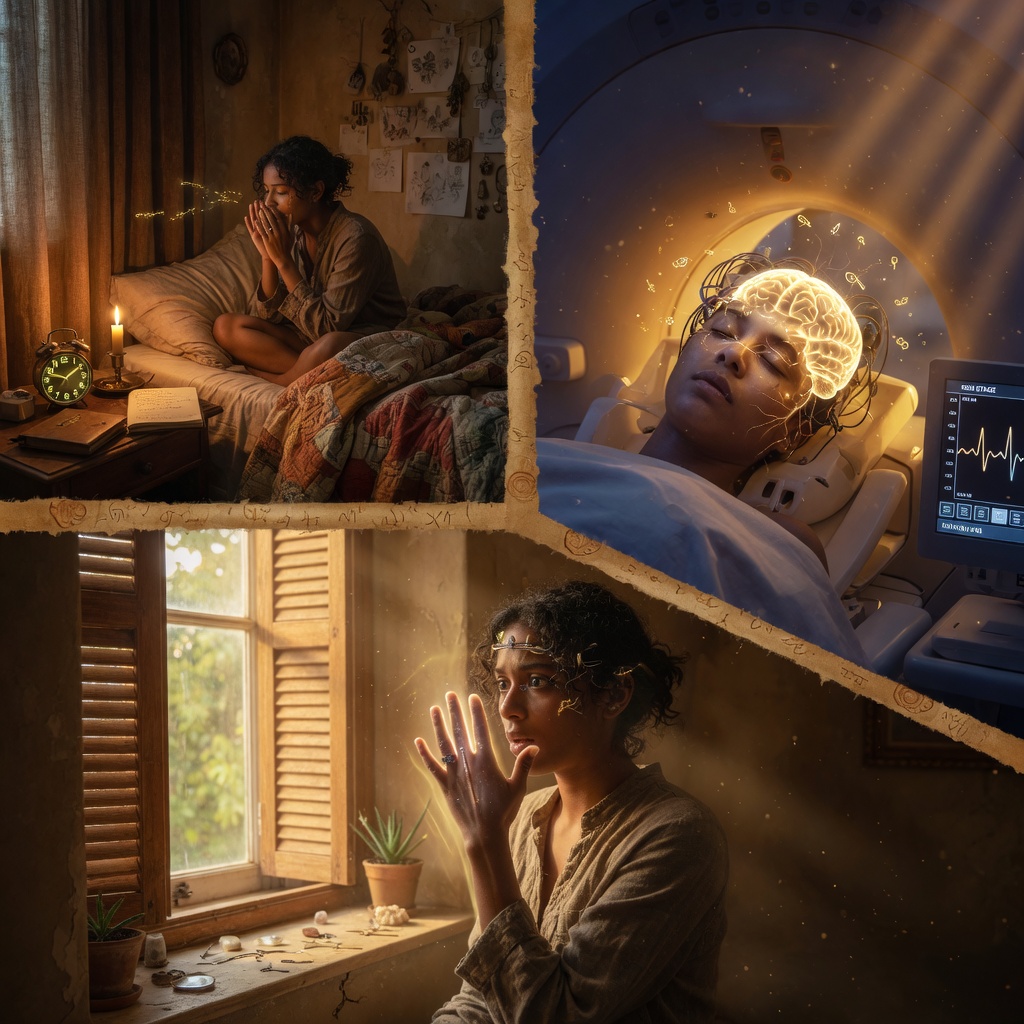
The alarm goes off at 3 AM, and instead of groaning, you sit on the edge of your bed and whisper to yourself: “The next time I’m dreaming, I will realize I’m dreaming.” You repeat it. You feel the words. You visualize yourself inside a dream, recognizing it for what it is. Then you lie back down and slip into sleep with that intention burning quietly behind your eyelids.
This is the MILD technique – Mnemonic Induction of Lucid Dreams – developed by Stanford psychophysiologist Stephen LaBerge in the 1980s. It sounds almost absurdly simple. But it works. And the reason it works has implications that go far beyond having cool dreams.
The Nightly Rehearsal
Every night, your consciousness generates an entire world. It fills it with people, places, physics, and plotlines. It manufactures emotions that feel completely real. It builds a “you” inside that world who accepts the whole thing without question. You chase things. You run from things. You feel shame and triumph and longing.
Then you wake up and call it “just a dream.”
But here’s the thing that should bother you: you didn’t question any of it while it was happening. The walls could shift. The dead could walk around. Gravity could reverse. And the character you were playing just… went along with it. Accepted the rules. Lived inside the story.
Sound familiar?
The ancient Hermeticists had a phrase for ordinary waking consciousness: “the sleep of the body.” They weren’t being poetic. They were being precise. The Kybalion’s first principle – Mentalism, the idea that “The All is Mind” – suggests that what we call physical reality is itself a kind of dream, a projection of consciousness that we collectively accept as solid and fixed. Not because it is, but because we’ve never seriously questioned it.
Lucid dreaming, then, isn’t just a cool trick for flying over mountains in your sleep. It’s dress rehearsal for something much bigger.
What Happens When You Wake Up Inside
In 2025, a landmark study published in the Journal of Neuroscience mapped the brains of lucid dreamers at an unprecedented scale. The researchers found something that surprised even them: lucid dreaming isn’t just REM sleep with a little wakefulness sprinkled in. It’s a distinct, hybrid state of consciousness. The brain shows patterns that are genuinely unique – not fully awake, not fully dreaming, but occupying a third territory that doesn’t fit neatly into either category.
During lucid dreams, the prefrontal cortex – the part of you that says “wait a minute, this doesn’t make sense” – comes online in a way it normally doesn’t during sleep. Metacognition activates. The dreamer suddenly has the capacity to observe the dream while still being inside it. To watch the movie and realize you’re in the theater at the same time.
This is exactly what the mystical traditions have been pointing at for thousands of years.
The Hindu concept of maya doesn’t say the world is fake. It says the world is real in the way a dream is real – vivid, consequential, emotionally true – but constructed. Projected. Not what it appears to be on the surface. The Buddhist traditions speak of awakening not as escaping this world, but as recognizing its nature while still being in it. Not leaving the dream. Waking up inside it.
And here’s where it gets practical: the skills that make someone a good lucid dreamer are the same skills that make someone an effective navigator of consciousness-based reality.
Reality Checks and the Art of Questioning
Lucid dreamers use something called “reality checks” – small, habitual tests they perform throughout the day. They push a finger through their palm. They read a line of text, look away, then read it again. They ask themselves, “Am I dreaming right now?” and actually mean it.
The point isn’t the test itself. The point is the habit of questioning. Of not assuming that what seems real is necessarily what it appears to be.
When you practice reality checks consistently during waking hours, something interesting happens: you start doing them in your dreams too. And when the finger pushes through the palm, or the text changes the second time you read it, the spell breaks. You realize. You’re dreaming. And suddenly, everything shifts. You’re no longer at the mercy of the narrative. You’re aware inside it.
Now apply this to waking life.
How often do you move through your day on autopilot? Reacting to the same triggers, running the same mental scripts, accepting the same assumptions about who you are and what’s possible? The career you think you have to have. The limitations you think are permanent. The story about yourself that you’ve been telling so long it feels like bedrock.
What if some of that is just… dream logic? What if you accepted it without question the same way you accept a talking giraffe in a dream?
The Hermetic principle of Correspondence – “As above, so below” – suggests that patterns repeat across scales. The way you relate to your nightly dreams mirrors how you relate to your waking dream. If you sleepwalk through one, you probably sleepwalk through the other. And if you can learn to wake up in one, the muscle transfers.
The Laboratory Between Your Ears
Here’s what makes lucid dreaming genuinely useful for inner work, beyond the novelty: it’s a controlled environment for practicing awareness.
In a lucid dream, you can test things. You can change the scenario by changing your expectation. You can face a nightmare and, instead of running, turn toward it and ask it what it wants. You can practice sustaining awareness when everything around you is trying to pull you back into unconsciousness. The dream constantly tempts you to forget, to fall back into the story, to lose yourself in the spectacle.
Sound like anything you know?
The waking world does the same thing. It gives you crises and distractions and emotional hooks that pull you out of presence and into reactivity. News cycles. Relationship drama. Financial anxiety. The whole thing is designed, in a sense, to keep you asleep. To keep you identified with the character rather than aware of the consciousness generating the character.
Neville Goddard spoke about this constantly. Your assumptions shape your reality. The feeling state you carry is the mold that the world fills in. But you can only work with this if you’re awake enough to notice what you’re assuming. If you’re sleepwalking through your assumptions, they run you. If you become lucid to them, you can revise them.
Joe Dispenza’s research on heart-brain coherence points to the same thing from a different angle. When you can sustain a feeling state that doesn’t depend on external conditions – when you can generate the feeling of the wish fulfilled before the evidence arrives – you’re doing during waking hours exactly what a lucid dreamer does during sleep. You’re authoring the experience from the inside out rather than reacting to it from the outside in.
The dream is the laboratory. Every night, you get a fresh chance to practice.
The Stability Problem
Anyone who’s had a lucid dream knows the hardest part isn’t getting lucid. It’s staying lucid.
The excitement of realization often wakes you up, or the dream destabilizes and collapses. Experienced lucid dreamers learn techniques for maintaining the state: rubbing their hands together to generate physical sensation, spinning in place, focusing on details of the dream environment rather than getting swept up in the implications of what’s happening.
This mirrors a real challenge in waking spiritual practice. You have a moment of clarity. You see through the illusion, even briefly. The constructed nature of your problems becomes obvious. The separation between you and the world thins. And then… you lose it. The old patterns reassert themselves. The identification with the character snaps back into place.
Alan Watts described this as the oscillation between what he called “the ceramic model” and “the fully automatic model” of the universe – between thinking something outside is in control and thinking nothing is in control. The awakened perspective is neither. It’s recognizing that consciousness itself is the ground, and everything else is what consciousness is doing.
But holding that recognition? That’s the practice. And lucid dreaming gives you a nightly training ground for exactly this kind of stability work.
What the Anomalies Are Trying to Tell You
In dreams, anomalies are everywhere. Clocks don’t work right. Text changes. People behave in impossible ways. Dead relatives show up alive. The physics are wrong.
A lucid dreamer learns to see these anomalies not as problems but as invitations. Each glitch in the dream is a doorway to recognition. “Wait – that clock has no hands. I’m dreaming.”
In waking life, the anomalies are subtler but they’re there. Synchronicities that don’t fit the materialist model. Intuitions that turn out to be accurate. Moments where time seems to stretch or compress. The feeling that you’ve done this before, been here before, know something you shouldn’t know.
The Hermetic tradition would call these moments of correspondence breaking through – hints that the surface reality isn’t the whole story. Robert Monroe, who spent decades exploring out-of-body states, documented experiences that suggested consciousness doesn’t need a body at all, that the physical world is one frequency among many that awareness can tune into.
Most people dismiss these anomalies the same way a non-lucid dreamer dismisses the impossible things in a dream. They rationalize. They explain away. They go back to sleep.
But a lucid dreamer pays attention to the glitches. Uses them. Follows them down the rabbit hole.
Debugging the Simulation
Here’s the reframe that might change how you approach your next dream: lucid dreaming is debugging practice.
When a programmer tests software, they’re looking for where the code breaks. Where the expected behavior doesn’t match the actual behavior. Where the assumptions baked into the code produce errors.
Your consciousness does the same thing every night. It generates a simulation – the dream – and if you can learn to observe the simulation while it’s running, you start to see the code. You notice how expectation generates experience. How belief shapes the environment. How the dream character (you) is being operated by something larger than itself.
Then you wake up. And if you’ve been paying attention, you start to notice the same patterns in the waking simulation. The way your assumptions generate your experience. The way belief shapes your environment. The way the waking character (also you) is being operated by something larger than itself.
The Kybalion’s Principle of Cause and Effect says that nothing happens by chance. Everything has a cause. In dreams, the cause is transparent: your mind is generating the whole thing. In waking life, the cause is less obvious but no less real. Your consciousness, your assumptions, your sustained feeling states – these are the causes. The 3D world is the effect.
Lucid dreaming makes this relationship visible in a way that’s hard to argue with. When you change your expectation in a dream and the dream changes, you’ve just run a direct experiment in mental causation. You’ve watched consciousness create in real time.
That’s not mysticism. That’s empirical data from your own laboratory.
Starting Tonight
The beautiful thing about this practice is that it requires nothing special. No equipment. No retreat. No teacher. Just a little intention and a willingness to take your dreams seriously.
Start simple. Before you fall asleep tonight, set the intention to recognize when you’re dreaming. Say it to yourself, feel it, believe it’s possible. Keep a notebook by your bed – when you wake up, write down whatever you remember, even fragments. During the day, pause occasionally and genuinely ask yourself: “Could I be dreaming right now?” Not as a joke. As a real question.
Notice what happens over time. The dreams get clearer. The moments of recognition start to appear. And slowly, something shifts – not just in your dreams, but in how you relate to waking life. The boundary between “real” and “dream” gets thinner. The sense of being a passive character inside someone else’s story starts to dissolve.
You start to wake up. Not all at once. Not permanently. But enough to taste what the mystics have been pointing at all along.
The dream is the training ground. The waking world is the final exam. And both of them are yours to navigate with open eyes.
What if tonight, instead of just falling asleep, you set an intention to wake up inside the dream? And what would change if you brought that same questioning awareness into your morning?