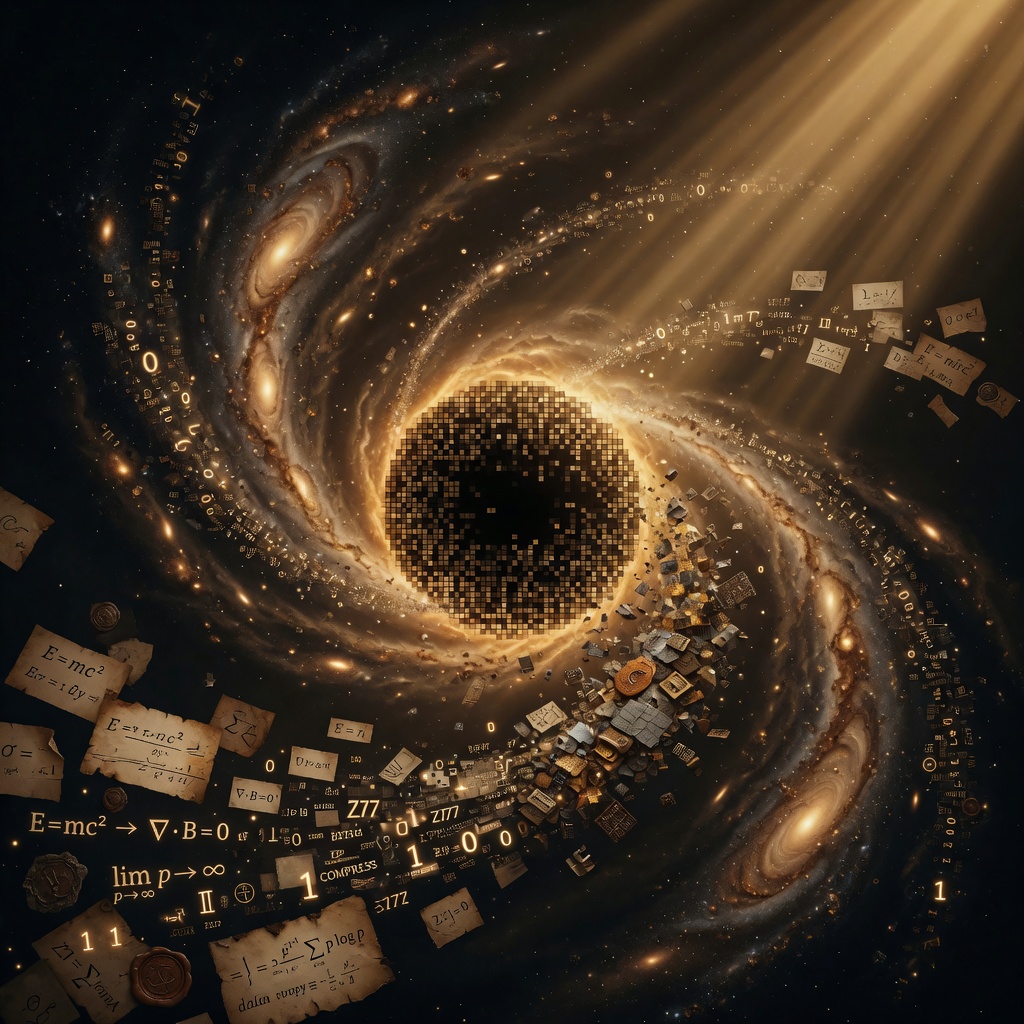
Drop a ball and watch it fall. Simple, right? Something heavy goes down because that is what heavy things do. But a physicist at the University of Portsmouth wants to rewrite that story entirely. In his 2025 paper published in AIP Advances, Melvin Vopson proposes something that sounds like science fiction but is grounded in hard mathematics: gravity might not be a fundamental force at all. It might be the universe running a compression algorithm.
This is not metaphor. Vopson’s work suggests that what we experience as gravity is actually nature optimizing its own data storage, pulling information-dense matter together to reduce the computational cost of running reality. If that sentence made the hair on your arms stand up, good. It should.
The Second Law Nobody Talks About
Most people have heard of the Second Law of Thermodynamics. Entropy increases. Things fall apart. Energy dissipates. The universe trends toward disorder. It is one of the most established principles in physics.
But in 2022, Vopson and his colleague S. Lepadatu proposed a companion law they call the Second Law of Infodynamics. The core idea is deceptively simple: while thermodynamic entropy in any isolated system increases over time, information entropy decreases.
Information entropy is a measure of disorder in the data required to describe a system. Think of it like this: a messy room requires more words to describe than a clean one. More bits. More storage. The Second Law of Infodynamics says that left to itself, any system containing information states will trend toward requiring less information to describe, not more.
This is exactly what happens in computational systems. When a computer processes data, it compresses, optimizes, and removes redundancy. Vopson’s insight is that the universe appears to be doing the same thing.
Gravity: The Universe’s ZIP File
Here is where it gets wild.
In his April 2025 paper, “Is Gravity Evidence of a Computational Universe?”, Vopson takes the Second Law of Infodynamics and derives Newton’s law of gravity from it. Not from mass and distance. From information dynamics.
The argument goes like this: matter carries information. Every particle, every atom, every configuration of stuff in the universe requires bits to represent it. According to the Second Law of Infodynamics, the universe wants to minimize information entropy. It wants to compress. And the most efficient way to compress information-dense material is to bring it together.
Gravity, in this framework, is not a mysterious attraction between masses. It is an entropic information force. It is the universe’s optimization routine pulling matter into tighter configurations because clustered information is cheaper to store than scattered information.
This aligns with Dutch physicist Erik Verlinde’s 2011 theory of entropic gravity which argued that gravity emerges from changes in information associated with the positions of material bodies. Vopson arrives at a similar destination but through a different door, grounding it specifically in the computational patterns of information entropy.
What Compression Actually Looks Like
Anyone who has ever zipped a file on a computer understands compression intuitively. The algorithm finds patterns, removes redundancy, and represents the same data with fewer bits. A photograph might go from 5 megabytes to 2 megabytes without losing anything essential.
Vopson’s claim is that gravity does something analogous at a cosmic scale. When a star pulls a planet into orbit, when galaxies cluster into filaments, when matter collapses into black holes, the universe is performing data compression. It is reducing the number of bits required to describe the state of the system.
A black hole, in this view, is not just a gravitational curiosity. It is the ultimate compression algorithm. The maximum possible information packed into the minimum possible space. This connects directly to the holographic principle, which suggests that all the information in a volume of space can be encoded on its boundary surface. The universe, it seems, has always been thinking about storage limits.
The Hermetic Whisper
More than a century before Vopson published his paper, a text called The Kybalion articulated a principle that now reads like a prophecy: “THE ALL is MIND; The Universe is Mental.”
The First Hermetic Principle, known as Mentalism, states that consciousness is not something that arises within the universe. Consciousness is the substrate. The universe arises within consciousness. Reality is a mental construct, a thought in the infinite mind of what the Hermeticists called The All.
When Vopson writes that the universe behaves like a computational system optimizing its information storage, the Hermetic tradition hears something familiar. If reality is fundamentally informational, if it operates on data compression and entropy reduction, then the medium of that information has to be something. The question is: what is running the computation?
The Hermetic answer is consciousness itself. Not human consciousness specifically, but the universal consciousness that underlies all apparent forms. The mind of The All.
This is not a gap that mysticism fills because physics cannot. It is a convergence. Physics is discovering that reality has the structure of information. Ancient wisdom traditions have always said that information requires a mind to exist.
The Mirror of Correspondence
The Hermetic Principle of Correspondence states: “As above, so below; as below, so above.” Patterns repeat across scales. What happens at the macro level mirrors what happens at the micro level.
Vopson’s research is a striking example of this principle in action. The compression algorithms that optimize data on a laptop mirror the gravitational dynamics that optimize information across galaxies. The same pattern, different scales.
This correspondence runs deeper than analogy. If the universe is computational, then every scale should exhibit the same information-processing behaviors. And it does. Vopson has demonstrated the Second Law of Infodynamics in digital data storage, biological RNA genomes, atomic physics, mathematical symmetries, and cosmology. The pattern holds everywhere.
The Hermeticists would not be surprised.
What This Means for the Dream
If gravity is a compression algorithm, then the solidity of the ground beneath your feet takes on a different character. You are not standing on a fundamental substance. You are standing on a data structure that the universe maintains through constant computational optimization.
The weight you feel is not the pull of mass through curved spacetime, at least not in Vopson’s framework. It is the cost of information density being resolved through spatial compression. The universe is folding you into its storage architecture.
This reframes the ancient mystical claim that reality is a dream, an illusion, a projection of consciousness. The mystics were not saying that nothing exists. They were saying that what exists is not what it appears to be. It is not solid stuff governed by mysterious forces. It is information, pattern, and consciousness, governed by optimization principles that look suspiciously like code.
Alan Watts once said that the universe is not made of things. It is made of processes. Vopson’s work suggests those processes are computational, running on a substrate that ancient traditions would call Mind.
The Entropy Inversion
Perhaps the most unsettling aspect of Vopson’s Second Law of Infodynamics is what it implies about the direction of the universe.
Thermodynamic entropy increases. Everything decays, disperses, cools. This is the arrow of time that physics has always described. But if information entropy simultaneously decreases, then the universe is not just winding down. It is also compressing. Becoming more ordered at the informational level even as it becomes more disordered at the energetic level.
This dual arrow suggests that the universe is not heading toward heat death in the simple sense. It is heading toward maximum compression. The end state might not be a cold, diffuse soup of particles. It might be a maximally compressed information state, something like the ultimate save file.
The Kybalion’s Principle of Rhythm states that everything flows in and out, rises and falls, swings to the right and to the left. Vopson’s two entropies might be describing exactly this rhythm, one expanding while the other contracts, the universe breathing between disorder and compression.
Living Inside the Algorithm
So what does any of this mean for the way you live your Monday morning?
Start with this: if reality is informational and computational, then the assumptions you hold about it might matter more than you think. The Hermetic Principle of Cause and Effect, echoed in Neville Goddard’s teaching that assumption hardens into fact, suggests that consciousness is not passive. It participates in the computation.
When you assume a state of being, when you sustain a feeling, when you revise a memory, you are not just thinking. You are altering the informational structure of your local reality. You are changing the data that the universe has to compress.
This does not mean magical thinking. It means recognizing that if the universe runs on information, and if consciousness is the substrate of that information, then the relationship between inner state and outer experience is not mystical. It is mechanical.
Try this: spend five minutes today noticing the weight of your assumptions. Not analyzing them, not judging them, just noticing. What are you assuming to be true about your life, your limitations, your possibilities? Those assumptions are informational inputs into the system you call reality.
The universe is listening. It is compressing. It is optimizing.
What data are you feeding it?


