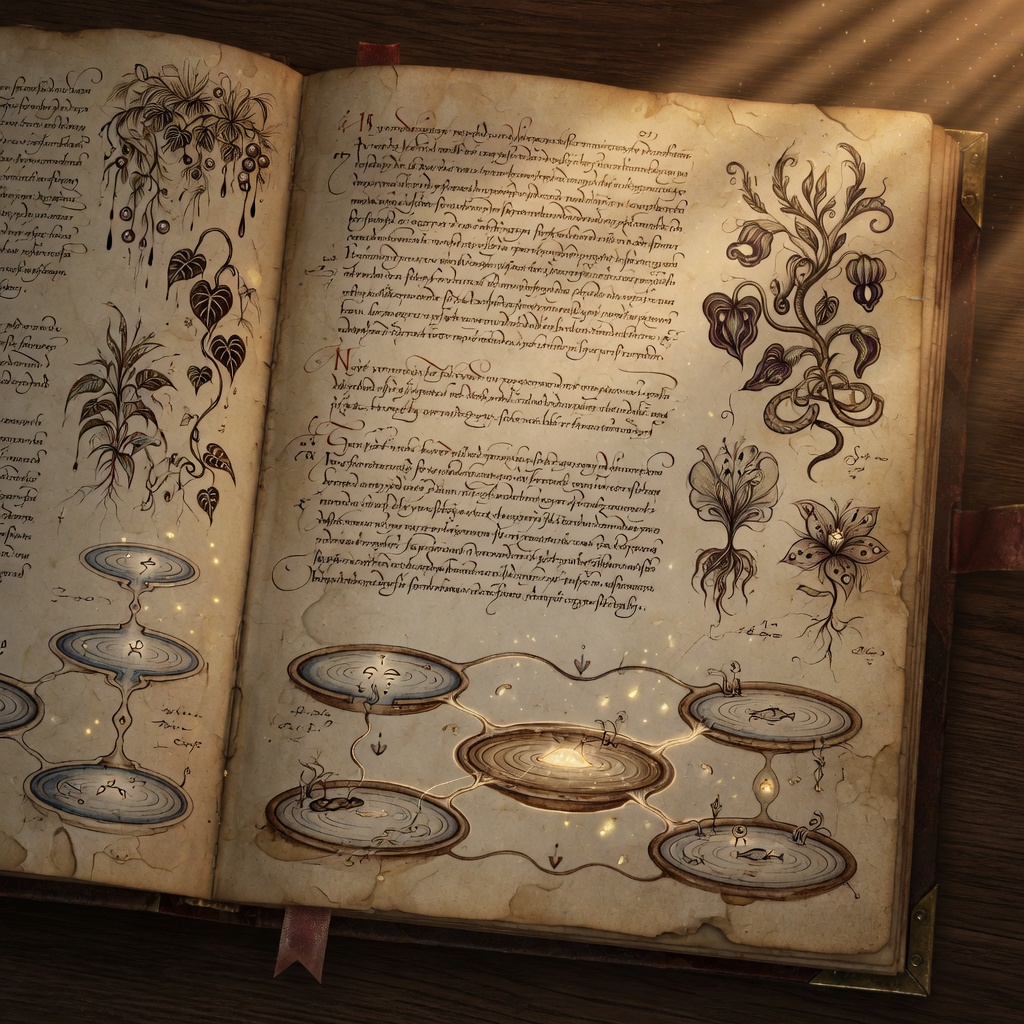
Somewhere in a climate-controlled vault at Yale University, a 600-year-old book sits in quiet defiance of every mind that has tried to read it. The Voynich Manuscript, catalogued as MS 408 in the Beinecke Rare Book and Manuscript Library, is roughly 240 pages of vellum covered in looping, flowing script that matches no known language. Its margins are filled with drawings of plants that botanists cannot identify, celestial diagrams that follow no recognizable astronomical system, and strange scenes of women bathing in interconnected green pools. No one knows who wrote it. No one knows what it says. And despite the best efforts of Renaissance scholars, World War II military codebreakers, modern computational linguists, and thousands of dedicated amateurs, no one has cracked it.
That is either deeply frustrating or deeply fascinating, depending on how you sit with mystery.
A Book Without a Country or a Author
The manuscript gets its modern name from Wilfrid Voynich, a Polish-born book dealer who acquired it in 1912 from a collection of manuscripts held by the Jesuits in Italy. But the book itself is much older. Radiocarbon dating performed in 2009 placed the vellum between 1404 and 1438, firmly in the early Renaissance. Stylistic analysis of the illustrations suggests a European origin, possibly Central European, though some scholars have argued for connections to Mesoamerica, the Islamic world, or even East Asia based on certain botanical and astronomical motifs.
The trail of ownership before Voynich is spotty but real. A letter found with the manuscript, dated 1665 or 1666, was sent from Johannes Marcus Marci of Prague to the Jesuit scholar Athanasius Kircher in Rome. Marci claimed the manuscript had once belonged to Emperor Rudolf II of the Holy Roman Empire, who allegedly purchased it for 600 gold ducats and believed it to be the work of the 13th-century English friar Roger Bacon. That attribution has never been proven and is now considered unlikely by most scholars, but it tells a story: people have been trying to claim this book and pin it to a known genius for centuries.
What makes the Voynich Manuscript so stubbornly resistant to identification is not just the unknown script. It is the total package. The plants do not match any known species, living or extinct. The astronomical charts do not align with any standard system of the period. The human figures are anatomically vague, often female, depicted in what look like alchemical or medical contexts but without any accompanying text that makes sense. The manuscript appears to be a coherent work with internal logic, but that logic remains locked away.
Codebreakers, Algorithms, and the Shape of Meaning
The list of people who have tried to read the Voynich Manuscript reads like a roll call of the 20th century’s finest minds in cryptography and linguistics. William Friedman, the American cryptologist who broke Japan’s PURPLE cipher before World War II, became obsessed with the manuscript in the 1940s and assembled a team of codebreakers to work on it. They failed. Decades later, the NSA reportedly took a crack at it. They also failed.
The pattern has repeated with depressing regularity. Someone announces a breakthrough, the academic world gets briefly excited, and then closer scrutiny reveals the “decipherment” was based on selective reading, confirmation bias, or outright self-deception. In 2014, a history researcher named Stephen Bax claimed to have identified ten plant names and one proper name in the manuscript. His methodology was criticized, and his partial decipherment has not been replicated or expanded. In 2017, Gerard Cheshire published a paper in the journal Romance Studies claiming the manuscript was written in a proto-Romance language. The paper was retracted after scholars pointed out serious methodological problems.
But here is where it gets interesting. Computational analyses of the text have revealed statistical patterns that are remarkably consistent with natural language. The text follows Zipf’s law, a mathematical relationship observed in virtually all human languages where the frequency of a word is inversely proportional to its rank in the frequency table. The entropy of the text, a measure of its information density, falls within the range of known languages, not random gibberish. The script shows evidence of internal structure: certain character combinations appear only at the beginnings of words, others only at the ends, and there are clear patterns of repetition and variation that look like grammar.
This does not prove the manuscript contains meaningful content. A sufficiently clever hoaxer in the 15th century could have produced text that mimics these statistical properties without encoding any real information. But it does make the “pure nonsense” theory harder to defend. Someone sat down and produced this text with care and consistency. Whether they were encoding real knowledge or performing an elaborate act of deception, they knew what they were doing.
Theories That Almost Work
The leading theories about the Voynich Manuscript tend to cluster around a few poles.
The cipher theory holds that the manuscript is written in a known European language, probably Latin or a vernacular like Middle High German or Czech, encrypted through some form of substitution cipher or more complex system. The problem is that no cipher system from the period, or any period, has been found that produces the specific statistical signature of the Voynich text. Simple substitution ciphers preserve the word-length distribution and character frequency patterns of the underlying language. The Voynich script does not match any known language well enough for this to work straightforwardly.
The constructed language theory suggests the author invented a new language, possibly for esoteric or alchemical purposes. This is not as far-fetched as it sounds. The Renaissance was a period of intense interest in “perfect” or “angelic” languages, and several constructed scripts and languages from the period survive. The problem is that a constructed language still needs a key, a grammar, a lexicon, something to anchor interpretation. Without that, the text is no more readable than if it were random.
The hoax theory, most forcefully argued by computer scientist Gordon Rugg, proposes that the manuscript was produced using a device called a Cardan grille, a kind of mechanical cipher tool that could generate text that looks structured but contains no meaning. Rugg demonstrated that a 16th-century grille could produce text with statistical properties similar to the Voynich script. Critics have pointed out that Rugg’s method does not perfectly replicate all features of the manuscript, and that the illustrations, the careful layout, and the sheer effort involved in producing 240 pages of consistent nonsense seem disproportionate for a hoax.
Then there is the herbal-pharmaceutical theory, which takes the illustrations seriously as representations of real plants, possibly ones that were known locally but never entered the broader botanical record, or ones that are stylized to the point of unrecognizability. Some researchers have proposed that the manuscript is a women’s health manual, given the prominence of female figures and what appear to be bathing or therapeutic scenes. Others have suggested it is an alchemical text, with the plants and astronomical diagrams serving as symbolic representations of chemical and spiritual processes.
None of these theories fully accounts for all the evidence. Each one explains some features of the manuscript while leaving others unexplained. The honest answer is that no one knows.
What the Manuscript Mirrors Back
There is something worth sitting with in the fact that this book exists at all. Someone in the early 1400s spent months, possibly years, producing a detailed, illustrated, carefully organized manuscript. They used high-quality materials. They maintained consistent handwriting and drawing style throughout. They created what appears to be a reference work of some kind, with sections devoted to different subjects. And they did all of this in a script that no one else could read.
Why?
If it is a cipher, the author never shared the key, or the key was lost almost immediately. If it is a constructed language, the author never taught it to anyone, or the community that used it vanished without a trace. If it is a hoax, it is the most elaborate, labor-intensive, and purposeless hoax in the history of written communication. If it is a genuine record of real knowledge, that knowledge was encoded so thoroughly that it has been inaccessible for six centuries.
The Voynich Manuscript sits in that uncomfortable space between meaning and meaninglessness. It looks like it should mean something. It has the structure, the care, the internal consistency of a meaningful text. But meaning requires a reader, and no reader has been found.
This is not just a problem for cryptographers. It is a mirror for anyone who has ever felt that there is something important just beyond the edge of understanding, something that wants to be known but cannot quite be reached. The perennial traditions speak of knowledge that is hidden in plain sight, encoded not in strange scripts but in the structure of experience itself. The Tao that can be spoken is not the eternal Tao. The Kingdom of Heaven is within. The All is Mind.
What if some knowledge is not meant to be decoded by the same mind that encoded it? What if the act of trying to crack the code is itself the teaching?
The Gift of Not Knowing
Modern culture has a complicated relationship with mystery. On one hand, we celebrate discovery, breakthrough, the moment of cracking the code. On the other hand, we are increasingly comfortable with the idea that some things may be fundamentally unknowable, that the universe contains more than human cognition can process, that consciousness itself may be the kind of mystery that does not resolve into neat answers.
The Voynich Manuscript is a physical artifact of that tension. It is a real, tangible object that you can visit in New Haven, Connecticut, and look at through glass. It has pages you can count, illustrations you can study, text you can copy. And yet it remains, after all this time, a closed door.
There is a teaching in that. Not everything that presents itself as knowledge is meant to be consumed and filed away. Some things exist to keep the question alive. The manuscript has generated more scholarship, more creative thinking, more genuine wonder than most texts that have been fully translated and understood. Its resistance to interpretation is not a failure. It is a function.
Think about the last time you encountered something in your own life that refused to make sense. A pattern that kept repeating but never resolved. A dream that felt deeply significant but dissolved the moment you tried to explain it. A relationship that defied every framework you tried to apply to it. The impulse is to decode, to translate, to make the unknown known. But what if the mystery itself is the message?
The alchemists spoke of the prima materia, the raw, undifferentiated substance from which all transformation begins. It cannot be grasped directly. It can only be approached through patience, through willingness to sit with confusion, through the slow work of refining perception until what was invisible becomes visible. The Voynich Manuscript may be a kind of prima materia for the mind, a puzzle that exists not to be solved but to be inhabited.
Six hundred years of brilliant people have failed to read this book. That is not a defeat. It is an invitation to wonder.
What mystery in your own life might be asking you to stop decoding and start listening? And is there something you have been trying to force into understanding that might reveal more if you simply let it remain open?


