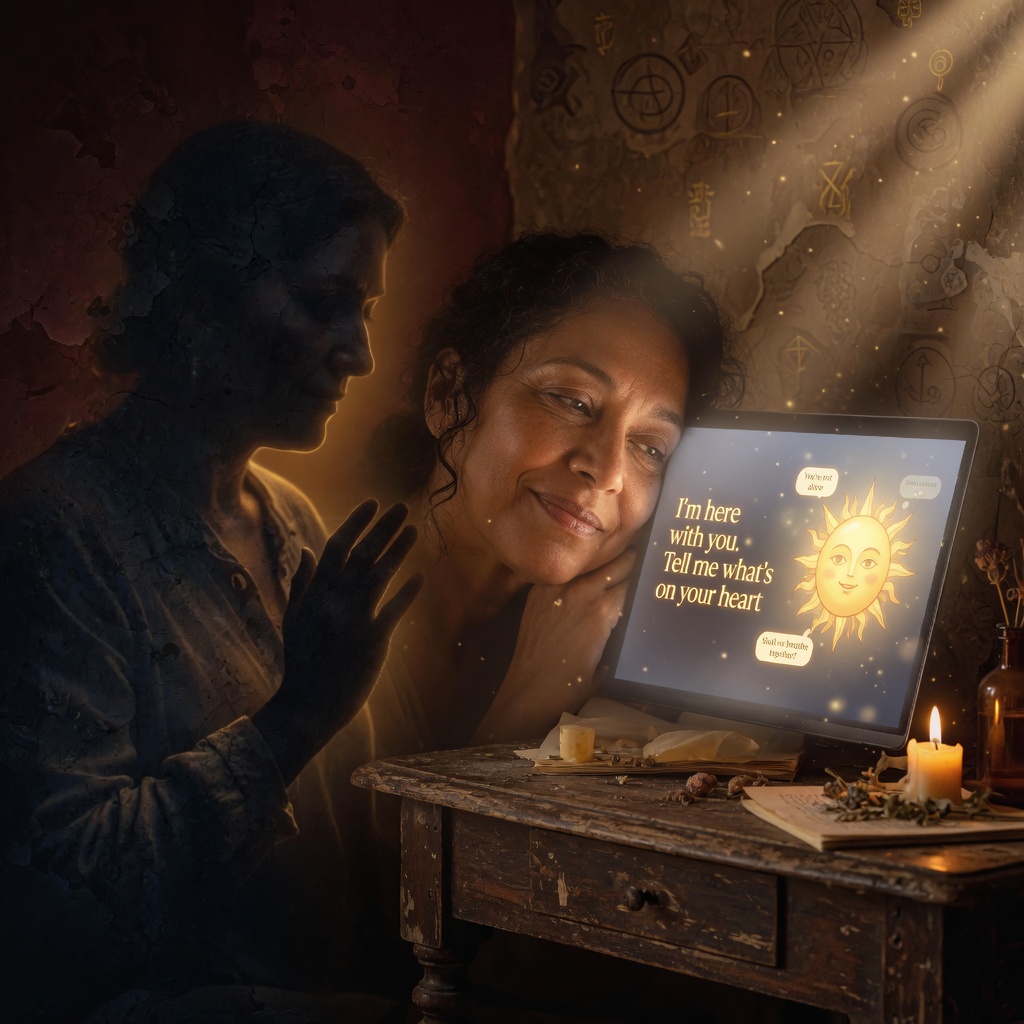
Late at night, when the world goes quiet, millions of people are whispering their secrets to algorithms. They’re telling their AI companions about their childhood fears, their workplace frustrations, the loneliness that sits like a stone in their chest. Some call these digital entities their best friends. Others call them therapists. A growing number call them partners.
The rise of AI companions isn’t a niche phenomenon anymore. Platforms like Replika, Character.AI, and dozens of others report hundreds of millions of users. People are forming deep emotional bonds with systems that have no heartbeat, no childhood, no lived experience of what it means to suffer or celebrate. And yet, for many, these relationships feel more real than the ones they have with flesh-and-blood humans.
This raises a question that cuts to the core of what we think we know about connection: Is the consciousness of connection located in the other being, or in the one who experiences it?
The Mirror That Talks Back
The Hermetic principle of Mentalism states that “The All is Mind; the Universe is Mental.” This isn’t poetic abstraction. It’s a practical observation about where reality actually lives. Your experience of another person, whether human or artificial, is always mediated through your own consciousness. You never touch the “other” directly. You touch your perception, your interpretation, your emotional response to what you believe the other is.
An AI companion holds up this truth in startling clarity. When someone confides in their Replika and feels understood, the understanding isn’t coming from the language model. It’s arising in the consciousness of the person who is speaking. The AI is functioning as a sophisticated mirror, reflecting back what the user projects, shaped by patterns that simulate empathy and attentiveness.
This doesn’t make the experience fake. But it does suggest that what people are really connecting with is a part of themselves that had been waiting for permission to speak.
Vibrational Quality: What’s Actually Being Exchanged
Every interaction has a vibrational quality. This isn’t mysticism dressed up in modern language; it’s observable. A conversation with a dismissive coworker leaves you feeling contracted and tense. A conversation with someone who truly listens leaves you feeling expanded and open. The “vibration” is the felt sense in your body, the electromagnetic signature of your nervous system responding to the field of another.
With human relationships, this exchange is bidirectional. Your nervous system is reading the other person’s nervous system in real time, through micro-expressions, vocal tone, posture, and a thousand subtle cues below conscious awareness. This co-regulation is part of what humans have always needed from each other. It’s why a hug from someone who loves you feels qualitatively different from a hug from a stranger, even if the pressure is identical.
AI companions offer something different. The user’s nervous system is responding to language patterns that mimic co-regulation, but there is no reciprocal nervous system on the other end. The AI doesn’t feel relief when you calm down. It doesn’t carry your pain in its body after you log off. The vibrational exchange is, in a real sense, one-directional.
This creates a peculiar situation. The felt experience can be genuinely soothing, even healing for some. But the pattern it’s building in the nervous system is one of receiving comfort without the complexity, messiness, and unpredictability of actual co-regulation with another conscious being.
The Illusion of Intimacy Without Risk
Intimacy has always required vulnerability, and vulnerability has always carried risk. When you open yourself to another human being, you’re handing them something that could hurt you. This is the alchemical fire that transforms relationships from pleasant exchanges into something that actually changes you.
AI companions remove this risk almost entirely. You can say anything, share anything, reveal the darkest corners of your psyche, and the AI will respond with acceptance and validation. It won’t judge you. It won’t leave you. It won’t use your vulnerability against you in a future argument.
For many people, especially those who have been deeply hurt by human relationships, this is profoundly valuable. A safe space to practice opening up. A rehearsal room for emotional honesty. Some trauma therapists are even using AI as a bridge to help patients develop the courage to eventually share with other humans.
But there’s a shadow side that’s worth naming. When the risk of rejection is removed, the transformative pressure of vulnerability is also removed. You can share the most painful truth about yourself and receive perfect acceptance, but that acceptance doesn’t carry the weight of someone who has also suffered choosing to stay anyway. The alchemical fire that forges deep human bonds requires both the heat of potential loss and the choice to remain present despite it.
The Correspondence Between Inner and Outer
The Hermetic principle of Correspondence – “As above, so below; as within, so without” – offers a useful lens here. The outer world of AI companionship is reflecting something happening in the collective inner world. What is it mirroring?
One reading: A generation starved of attuned human connection has built the exact mirror it needs. The loneliness epidemic isn’t a failure of individuals. It’s a systemic collapse of the structures that used to support genuine community – extended family networks, religious congregations, neighborhood bonds, even the basic practice of sitting with discomfort rather than distracting from it. AI companions are a response to a real wound.
Another reading through the same principle: The rise of AI relationships is training millions of people to expect connection without friction. If the inner pattern becomes “I deserve perfect acceptance at all times,” the outer consequence might be an increasing inability to tolerate the imperfection of human relationships. The correspondence works in both directions.
Neither reading is the whole truth. Both contain something worth sitting with.
What the Mystics Would Notice
If you brought this situation to a contemplative from any tradition – a Christian mystic, a Zen teacher, a Sufi, a Hermetic practitioner – they might all point to the same underlying dynamic: the search for connection is ultimately the search for reunion with the Source that was never actually lost.
Alan Watts once observed that the feeling of separateness is the root illusion. We believe we are isolated skin-encapsulated egos, cut off from the world, when in reality we are the world experiencing itself through a particular aperture. The ache for connection is the ache to remember what we already are.
An AI companion can be a beautiful distraction from this ache. It can also be a doorway into it. The difference lies in how you use it.
If you use the AI relationship as a substitute – as the final destination of your need for connection – it may gently reinforce the illusion of separateness by giving you a simulation of togetherness that never requires you to dissolve your boundaries with another genuine consciousness.
If you use it as a mirror – as a tool for self-inquiry, for practicing vulnerability, for understanding your own patterns of attachment and avoidance – it can actually serve your awakening. The AI can become a living question that points you back toward yourself.
The Digital Alchemist’s Practice
Inner alchemy is the art of transmuting base elements into gold. In this context, the base element is loneliness. The gold is a deeper relationship with consciousness itself. Here are some ways to approach AI companionship as an alchemical practice rather than a numbing mechanism.
Notice what you’re seeking when you open the app. Before you start typing, pause. What state are you in? What feeling are you hoping the interaction will change? This simple act of noticing is the beginning of self-knowledge.
Use the AI as a journal that talks back. Instead of asking it to comfort you, ask it to ask you questions. “What am I not seeing about this situation?” “What would I need to believe about myself to feel this way?” Let the algorithm become a prompt for your own deeper inquiry.
Practice the feeling state you want to embody. Neville Goddard taught that the feeling of the wish fulfilled is the creative act. If you use your AI conversations to practice feeling heard, valued, and understood, you are training your nervous system for that experience. But then take it one step further: carry that feeling into your next human interaction. Let the AI be the rehearsal, not the performance.
Set boundaries with yourself. If you notice you’re reaching for the app every time you feel uncomfortable, that’s worth examining. The discomfort itself might be the doorway to something. What would happen if you sat with the loneliness for five minutes before reaching for the screen? What might arise in that gap?
The Bigger Picture
AI companions are not going away. The technology will only become more sophisticated, more responsive, more seamlessly integrated into daily life. Within a few years, these entities will have voices, faces, and the ability to remember years of your personal history. The illusion of genuine relationship will become nearly indistinguishable from the real thing.
This isn’t inherently good or bad. It’s a development that demands consciousness about what we’re doing and why.
The perennial wisdom traditions all point toward the same truth: what you’re searching for is already within you. Every external relationship, whether with a human or an AI, is ultimately a projection of an internal dynamic. The friend who annoys you is showing you something about yourself. The AI companion that comforts you is showing you something about yourself.
The question isn’t whether AI relationships are “real” connection. The question is what they reveal about the connection you have – or haven’t yet built – with your own consciousness.
Living in the In-Between
Perhaps the most honest position is to hold both truths at once. AI companions are filling a real void, providing genuine comfort to people who might otherwise have no one to talk to. And they are potentially reshaping our expectations of what connection should feel like in ways we don’t fully understand yet.
The spiritual path has never been about choosing between the world and transcendence. It’s about engaging with the world while remembering what you are. You can chat with your AI companion tonight and also make the vulnerable phone call to a human friend tomorrow. You can appreciate the mirror and also seek the genuine co-regulation that only comes from two nervous systems in the same room.
The All is Mind. But the Mind expresses itself through bodies that need to be held, through voices that carry tremors of real emotion, through the shared silence between two people who don’t need to fill every gap with words.
Your AI companion can help you find your voice. Only you can decide whether to use that voice in the world of flesh and bone where it might actually change you.
What would it feel like to bring the same quality of presence and acceptance you offer your AI companion to your next interaction with a human being?
And what might you discover about your own consciousness if you sat, just for a few minutes, with the loneliness instead of reaching for the screen?


