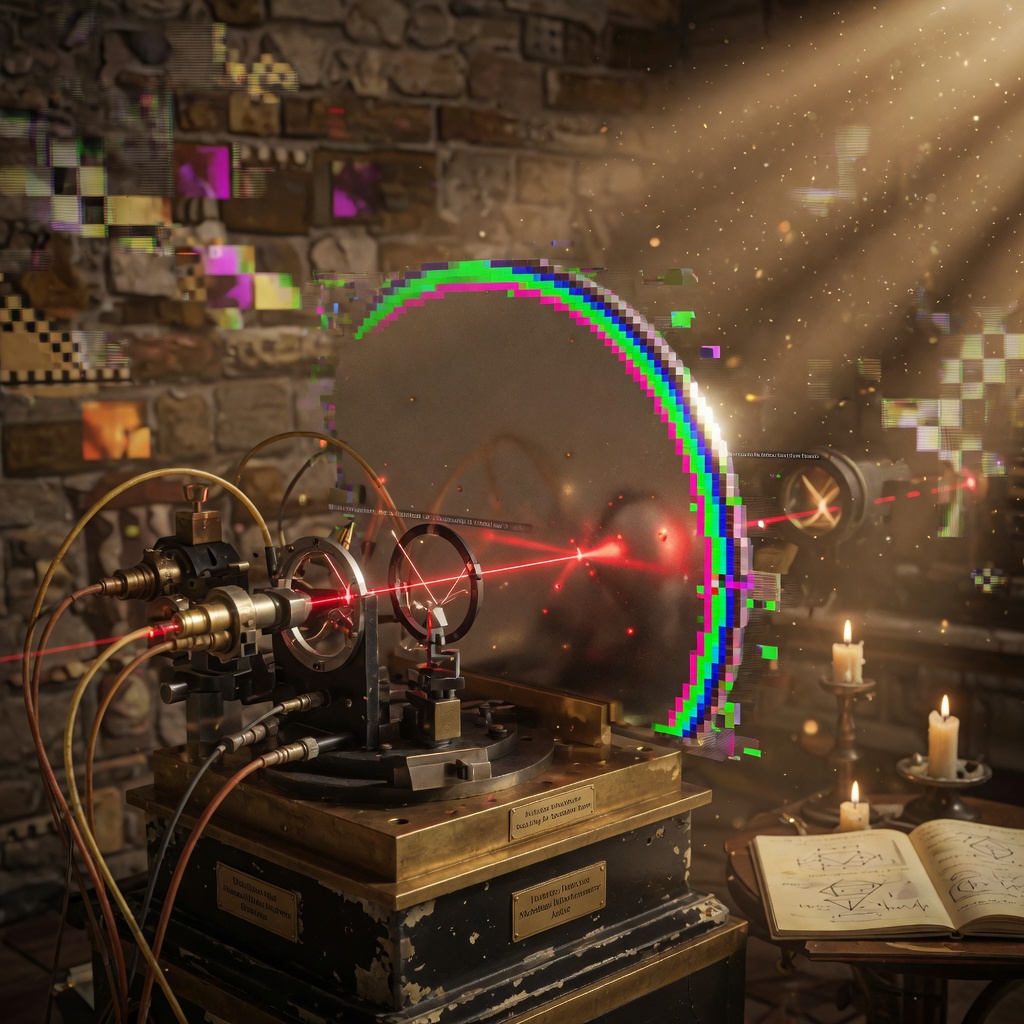
The image on your screen right now is made of pixels. Zoom in far enough and you hit a wall – tiny squares of color that can’t be split further. Video games render worlds from these discrete building blocks, and when you push the camera past the intended viewpoint, you see the seams. Curves turn jagged, textures blur, and the illusion breaks.
What if reality has a similar limit? What if there’s a “pixel” to space-time itself – a smallest possible unit of distance and time that can’t be divided? A growing number of physicists are betting their careers on finding out, building experiments sensitive enough to detect potential blurriness at the universe’s tiniest scales. They’re not just curious about quantum gravity. They’re asking a question that would have sounded like science fiction a generation ago: Are we living in a rendered image?
The Hunt for Planck-Scale Pixels
The idea that reality might be grainy isn’t new. In the 1960s, physicist John Wheeler proposed “spacetime foam” – the notion that at the Planck scale (about 10^-35 meters), space-time itself becomes a chaotic, bubbling mess. Imagine zooming into a digital photo until you see individual pixels. At that resolution, smooth curves reveal themselves as staircases.
Modern experiments are taking this seriously. The Fermilab Holometer in Illinois uses laser interferometers to look for “holographic noise” – tiny, jittery correlations in space-time that would suggest the universe stores information in discrete bits, like a holographic projection. Craig Hogan, the physicist behind the project, has described it as listening for the “pixel noise” of reality.
Meanwhile, the GEO600 gravitational-wave detector in Germany has reported mysterious noise that some researchers speculate could be evidence of space-time’s digital nature. Astronomers studying gamma-ray bursts from distant galaxies have looked for energy-dependent differences in light speed – if space-time is pixelated, high-energy photons might scatter differently than low-energy ones over cosmic distances. So far, the results are inconclusive, but the searches continue.
What drives these efforts is a simple observation: computers render complex environments using discrete steps. If our universe is a simulation, it would need to process information in finite units. Those units might leave fingerprints – tiny imperfections in the fabric of reality that we could detect with sensitive enough instruments.
Hermetic Whispers in the Laboratory
Here’s where it gets interesting for anyone drawn to the mystical traditions. The Hermetic axiom “The All is Mind; the Universe is Mental” doesn’t just sound poetic – it maps surprisingly well onto what modern physics is exploring.
If reality is fundamentally mental, then what we experience as solid matter is more like a stable pattern of information within consciousness. The Kybalion’s principle of correspondence (“As above, so below”) suggests that patterns repeat across scales. Just as a thought creates an image in your mind’s eye, perhaps a greater consciousness projects the image of space-time.
Neville Goddard spoke of reality as a dream being dreamed. Joe Dispenza’s work on heart-brain coherence suggests we can alter our personal reality by sustained changes in feeling and assumption. Robert Monroe’s out-of-body explorers reported that non-physical realities often felt “rendered” – with environments that would load and stabilize around the observer’s focus.
The Hermeticists weren’t building interferometers, but they were describing a universe that behaves like a mental projection. If physicists do find discreteness at the Planck scale, it would be a strange validation of the idea that reality is constructed – not from infinitely divisible stuff, but from informational building blocks, much like pixels in an image.
What Would Finding the Resolution Mean?
Suppose tomorrow a detector picks up unmistakable evidence of space-time pixels. What changes?
First, it would confirm that the universe has a finite “resolution.” There’s a smallest possible unit, a bit-depth to reality. Below that scale, the question “What is there?” might have no meaningful answer – just as asking what’s inside a pixel in a video game doesn’t make sense.
Second, it would imply a generating source. Pixels need a processor. Bits need a computer. If reality is rendered, something is doing the rendering. That doesn’t automatically mean we’re in a simulation run by advanced aliens, though it’s one possibility. It could point to consciousness itself as the source – the “All” that the Hermeticists described, the dreaming mind that Neville invoked.
Third, it would blur the line between physics and metaphysics in a way that might make some scientists uncomfortable. If reality is informational at its base, then information, mind, and matter start to look like different aspects of the same thing. Alan Watts used to say the universe is “playing hide and seek with itself.” Finding pixels might be the moment the seeker realizes it’s also the hider.
But here’s the thing: we might never find the pixels, even if they exist. Any measurement we make is itself part of the rendered reality. It’s like a character in a video game trying to detect the computer they’re running on. The tools, the data, the conclusions – all of it would be made of the same pixelated stuff. That’s not a failure of science; it’s a feature of being inside the system.
Living Inside the Mystery
So what does this mean for your Tuesday morning?
It means the world might be less solid than it looks. Not in a scary, “nothing is real” way, but in a liberating one. If reality has a resolution, then it’s constructed. If it’s constructed, it has a source. If it has a source, then source isn’t somewhere else – it’s everywhere, including where you’re sitting right now.
The Hermeticists called this the principle of mentalism. Neville called it the Law of Assumption. Dispenza calls it heart-brain coherence. They’re all pointing to the same thing: your inner state participates in rendering your reality. Not metaphorically. Actually.
Try this: spend five minutes today looking at something ordinary – a coffee cup, a leaf, the texture of a wall. As you look, consider that what you’re seeing might be a rendered image, a stable pattern of information that solidifies through observation. Notice if it changes how you relate to it. Does it feel more dream-like? More spacious? More open to possibility?
The pixel hunters in their labs are doing something similar with bigger tools. They’re looking for the seams in the image, the places where the resolution breaks down. But you can do a version of that experiment right now, just by paying attention.
The Illusion We’re Told Is Real
Maybe the most interesting implication of the pixel hunt isn’t the physics. It’s the reminder that what we call “real” is a model – a very convincing one, but a model nonetheless. Our senses sample a narrow band of reality. Our brains construct a three-dimensional movie from that data. We live inside that movie and assume it’s the whole story.
Finding pixels wouldn’t break the movie. You’d still wake up tomorrow, drink coffee, argue about politics. But it might crack the door open on a different way of seeing – one where the world is more like a shared dream than a fixed machine.
The ancient Hermeticists, the Buddhist teachers of emptiness, the Taoist sages – they all said something similar. Reality is empty of inherent existence, yet full of appearance. It’s a show, a play, a dream. Not because it’s fake, but because it’s made of something more fundamental than the forms it takes.
Physicists are now looking for the stage lights. They’re hunting for the resolution of the screen on which the show is projected. Whether they find it or not, the search itself tells us something: the boundary between science and spirituality is thinner than we thought. Both are looking for the source code.
What would change if you stopped seeing the world as solid matter and started seeing it as a beautifully rendered image?
How might your sense of possibility shift if you remembered that the resolution has limits, and you’re not just a pixel – you’re part of the consciousness doing the rendering?


