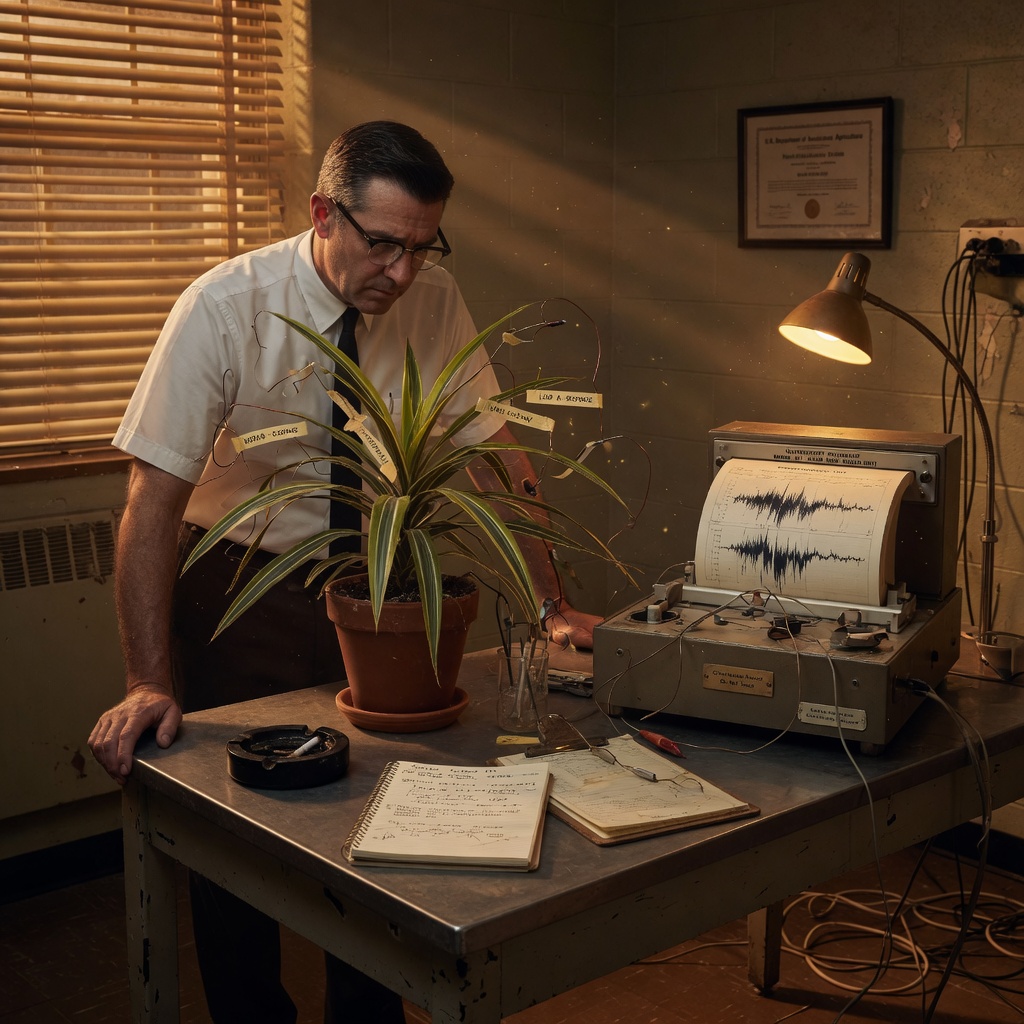
Imagine a spartan lab in the late 1960s, a man in a crisp shirt leaning over a dracaena plant, wires snaking from its leaves to a polygraph machine. The needle should have been flat, the plant inert. Instead, it jittered and spiked, responding, it seemed, to the man’s silent thoughts. That man was Cleve Backster, and he spent the rest of his life trying to convince a skeptical world that consciousness is not a badge worn only by humans, but a field that even a humble houseplant can tap into.
The Experiment That Changed Everything
The story begins in 1966, not in a university lab, but in a New York City interrogation training school. Backster, a former CIA polygraph specialist, was teaching how to detect deception. He was bored, toying with a seldom-watered dracaena plant. On a whim, he attached the plant’s leaves to his lie detector and decided to see if he could make the needle move by threatening it – first with a lit match. The needle did not budge. But then he simply imagined setting the leaf on fire. The polygraph spiked wildly.
That single, unrepeatable moment set him on a path that would last decades. Backster began a systematic, if unorthodox, series of experiments. He tested plants on when brine shrimp were dropped into boiling water (they reacted), when yogurt was cultured (they didn’t), and when he walked into the room with intent to harm them (they always reacted). He called this phenomenon “primary perception,” a kind of base-level awareness that he believed resided in all living cells, from plants to individual human cells.
A Spy with a Polygraph
To understand why Backster’s work resonated, you need to understand the man himself. Before plants, he’d spent years coaxing confessions from spies and criminals. He knew how to read the subtle physiological tremors that betray a secret. His training taught him that the body’s electrical signals are honest, that intent leaves a trace. When he turned that same meticulous, almost clinical attention to botanical life, he approached it not with mystical wonder, but with the cold precision of a forensic scientist. He controlled for humidity, static, the emotional state of the lab staff – anything that could skew the polygraph’s sensitivity.
His intelligence background gave him credibility in certain circles and made his methods anathema in others. Mainstream biologists saw a polygraph expert playing with houseplants. Backster saw a continuation of his interrogation work: he was simply expanding the definition of “who” could feel a threat. The line between interrogator and inquisitor blurred as he began to interview the plant itself, asking it questions and interpreting the needle’s dance as responses.
The Backlash and the Backstory
The scientific community was not amused. botanists pointed out that electrical activity in plants is a known phenomenon – a response to touch, light, or damage, not a conscious reaction to human thought. They argued his polygraph was picking up minute changes in turgor pressure, static, or even the vibrations of people moving in the room. Reputations were bruised. A 1974 televised experiment at the University of Arizona, designed to prove his theory, was deemed a failure when the polygraph failed to register a clear signal when the plant was threatened by a volunteer.
Backster’s response was telling: he said the plant had become accustomed to the threat. In the perennial traditions, this is a familiar refrain – consciousness is slippery, it adapts, it plays hide-and-seek with the observer. The backlash forced him out of mainstream academia and into the fringes, but also into the arms of a growing counterculture hungry for evidence of a more interconnected world. His work found a home in the New Age movement, influencing books like Peter Tompkins and Christopher Bird’s The Secret Life of Plants, which brought his ideas to millions.
Primary Perception and the Web of Life
Look past the polygraph graphs, and you find a question that still haunts biology and philosophy: is consciousness a spectrum? Backster’s “primary perception” is an early, clumsy attempt to chart that spectrum. It aligns with the ancient Hermetic principle of Correspondence – as above, so below. If consciousness is fundamental, as non-dual teachings suggest, then it must be present in varying degrees in all expressions of life, from the amoeba to the oak tree. The plant does not “think” as a human does, but it may feel, in some raw, electrical way, the intentions that ripple through the shared field.
Modern research in plant neurobiology (a term itself controversial) has found that plants communicate through chemical signals, adjust their growth based on sound, and even engage in a form of somatic memory. While none of this proves they can read a human’s murderous thoughts, it shows that the line between “thinking” and “reacting” is far more blurred than Backster’s critics assumed. In a way, Backster was an early explorer of what we now call the consciousness of interconnection.
The Quiet Revolution in Your Own Backyard
So what does a dead CIA interrogator’s plant experiments mean for your life today? Maybe it’s this: you live in a world that is not made of dead matter that accidentally woke up, but of conscious substance that has been dreaming all along. The kitchen herbs on your windowsill, the fungi spreading beneath the forest floor, the cells of your own body – they are all participants in a field of awareness that science is only beginning to map. You do not need a polygraph to feel this. You need only to sit with a houseplant and pay attention, not to its leaves, but to the stillness between you.
Inner alchemy, the practical art of turning leaden beliefs into golden awareness, begins with such small acts. When you water a plant with genuine presence, you are not just performing a chore. You are engaging in a subtle act of resonance, a reminder that you are not separate from the life you tend. This is the quiet revolution Backster stumbled into: the recognition that the observer and the observed are entangled, that the feeling is always mutual.
Try this today: Pick a plant in your home. Place your hand gently on its leaves. Close your eyes. Instead of thinking, feel. Notice the texture of the leaf, the temperature, the subtle sense of life humming just beneath the surface. Then, ask a silent question – not with your mind, but with your heart. Listen for the answer not in words, but in the quality of the silence that follows. You may not get a polygraph spike, but you might just feel the old boundaries soften, just a little.


