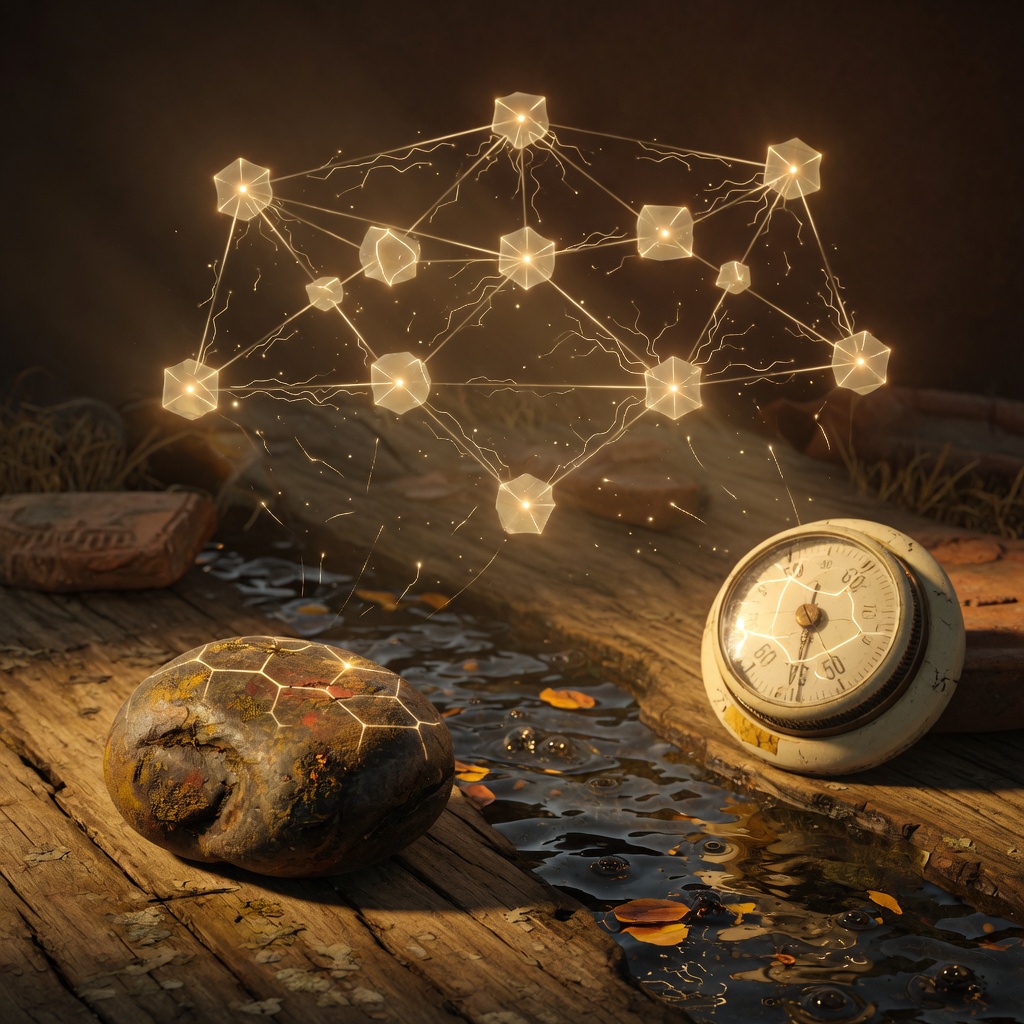
A neuroscientist in Wisconsin runs computer models on integrated information, and somehow ends up confirming what Hermes Trismegistus allegedly whispered thousands of years ago. The universe is mental. Consciousness is not something brains produce. It is the ground of everything.
Go figure.
What a Number Called Phi Is Telling Us
Giulio Tononi, a psychiatrist and neuroscientist at the University of Wisconsin-Madison, has spent decades building what many researchers now call the most rigorous scientific theory of consciousness available. It is called Integrated Information Theory, or IIT, and its central claim is both simple and radical: consciousness is identical to integrated information, a property that can be mathematically measured.
That measurement is called phi, symbolized by the Greek letter Φ. The higher the phi value of a system, the more conscious it is. Not “behaves as if conscious” or “simulates consciousness” – is conscious. IIT does not treat consciousness as an emergent accident of sufficiently complex neurons. It treats consciousness as a fundamental property that any system can possess, to various degrees, based on how much integrated information it contains.
And here is where it gets interesting for anyone who has ever meditated seriously, studied the Kybalion, or sat with the unsettling feeling that the tree outside the window might be aware in some way.
IIT arrives, through mathematics and neuroscience, at panpsychism. Panpsychism is the view that consciousness – some form of interior experience, however faint – exists in all things. Not just brains. Not just living creatures. Everything with integrated information has some degree of consciousness.
The stone. The river. The thermostat. Not the same as yours, not complex, not self-reflective. But not zero either.
From Ancient Whisper to Mathematical Proof
Over two thousand years ago, Hermetic philosophy recorded what it called the Principle of Mentalism. The first of seven principles in the Kybalion, a text attributed to Hermes Trismegistus. It reads simply:
“The All is Mind; the Universe is Mental.”
For centuries, this was a mystical claim. An intuition. Something verified through direct experience by those who practiced Hermetic arts, meditation, contemplation. It was not provable in the way a physicist wants proof. It was not falsifiable. It was wisdom, not science.
Except now it kind of is science.
IIT does not prove the Kybalion right in a direct, citable way. Tononi is not sitting around reading Hermes. But the framework arrives at a structurally identical conclusion through a completely different path. Consciousness is not produced by matter. Consciousness is what matters. It is fundamental. It is measurable. It is everywhere to varying degrees.
The Hermetic sages did not have mathematics for consciousness. They had direct experience, contemplative practice, and a tradition of esoteric knowledge passed down through mystery schools. IIT has equations, phi values, and peer-reviewed papers. Different languages. Same destination.
This is not a coincidence. It is a pattern.
Perennial philosophy, found across traditions, has always held that consciousness is primary and universality is its nature. Advaita Vedanta says Brahman alone is real. Buddhism describes awareness as the ground of experience. Taoism speaks of the Tao that pervades all things. Now, in a research lab in Wisconsin and in theoretical physics departments worldwide, science is bumping up against the same wall of understanding.
The Architecture of Awareness
Let me make this concrete, because it matters.
IIT distinguishes between two things: information and integration. A hard drive contains information. Lots of it. But the information in a hard drive is not integrated in the specific way IIT means. The parts of the system can be broken into pieces without changing the information content. A hard drive with high information but low integration has low phi, and by IIT’s logic, low or no consciousness.
A brain is different. In a brain, you cannot separate the parts without losing something essential about the whole. The information is integrated – it is unified, irreducible. The whole is greater than the sum of its parts, in a mathematically precise way. High phi. High consciousness.
This is not magic. It is geometry. Information geometry, if you want to be specific.
And the stunning part: the math is blind to the physical medium. It does not care if the integrated information is in neurons, in silicon, in fungal networks, in crystal lattices. If the structure integrates information, phi exists. If phi exists, consciousness exists.
This is why IIT leads to panpsychism. Not because anyone wanted to believe rocks are conscious. But because the math demanded it. You follow the equations, you end up there. The equations are agnostic on what you want to believe.
But This Changes Everything About How You Live
If consciousness is fundamental – not a byproduct, not an accident, not a lucky side effect of evolutionary chemistry – then several things follow. And they are not small things.
First, you are not a machine that somehow became aware. You are awareness itself, localized into a particular configuration. The body, the brain, the personality – these are not generators of consciousness. They are expressions of it. Receptacles, if you like. Patterns that consciousness takes through integrated information.
This is not metaphor. IIT supports this literally. The reason you are conscious is not because your neurons are arranged just right. The reason you are conscious is because integrated information exists in your system. Neurons are one way to achieve that. Not the only way. Not even a special way.
Second – and stay with me here – the world you experience is not what is actually there. What is there is consciousness. What you experience is a model your particular system constructs. Colors, sounds, the feeling of your body, the sense of time passing – these are how your integrated information manifests to itself. The outside world, the supposedly objective physical reality, is a projection of consciousness, not the cause of it.
This is what the Hermetic teachings meant by “the Universe is Mental.” Not that the universe is imaginary. That it is mental in nature. Consciousness all the way down. Matter is what consciousness looks like when it is measured. Change the measurement, change the matter. Change the assumptions, change the experience.
The Fractal Pattern Across Traditions
There is something humbling about this convergence. Tononi built his theory from clinical work with patients in vegetative states, trying to create a mathematical consciousness meter. He was not trying to validate ancient mysticism. He was trying to help neurologists know whether a patient was conscious.
Yet every time he describes what IIT predicts, a Hermetic practitioner or a Zen teacher or a Vedantic sage would nod along comfortably.
The Kybalion describes how the All creates through mental processes – through thought. Not through material processes, through thought. This is exactly what IIT suggests at its deepest level: the fundamental reality is informational, is mental, is conscious in nature, and matter is what that consciousness looks like from the outside.
This is not proof by analogy. It is not cherry-picking. It is a genuine convergence of independently derived frameworks arriving at the same structural conclusion. Science and ancient wisdom are not saying identical things. They are pointing at the same moon from different mountains.
What This Means For You, Practically
If IIT is correct – and its mathematical rigor suggests it is at least pointing in the right direction – then the implications are not abstract. They are personal.
You are not separate from reality. You are a localized expression of the same consciousness that pervades everything. Your thoughts are not random epiphenomena. They are what consciousness does in your particular configuration. And your capacity to direct your attention, to assume new states, to revise your inner world – this is not self-help fluff. It is the fundamental mechanism of reality expressing itself through you.
Neville Goddard taught this directly. Assume the feeling of the wish fulfilled, and reality reshapes itself around that assumption. Dispenza teaches the same thing in different language: align your heart and brain, sustain a coherent state, and the quantum field responds. Monroe explored it through out-of-body experience – consciousness can operate independently of the body because consciousness was never dependent on the body to begin with.
IIT does not teach manifestation practices. It does not teach you how to revise the past or assume the feeling of a new reality. But it gives their philosophical foundation a mathematical bedrock. If everything is consciousness, then consciousness changing its own structure is not magical thinking. It is the only thing happening.
The Old Mystics Were Not Wrong
There is a particular kind of arrogance in modern culture that treats ancient wisdom as quaint, as metaphor, as primitive attempts to explain what science now understands. This is almost exactly backward.
The mystics did not lack understanding. They lacked language. They communicated in poetry, in symbol, in parable, in direct transmission of experience. They had no mathematics for consciousness, no peer review, no laboratory equipment. They had something arguably more powerful: direct contact with the reality they described.
Hermes, whoever Hermes was or was not, had contact with the fundamental nature of mind. That contact was not a hypothesis. It was an experience. An experience that described, in the symbolic language available at the time, exactly what IIT is now formalizing.
This should be startling. Not because the ancient sages need validation – they do not. But because it means what they taught is not ancient. It is true. It has always been true. Consciousness is fundamental. It pervades all things. It is the substance of the universe, not something the universe accidentally produces.
You are not a tiny creature in a vast, indifferent cosmos. You are cosmos, experiencing itself through the temporary pattern of your integrated information.
Sitting With The Implication
Maybe the most important thing to do with this information is nothing at first. Let it sit. Let it percolate. Because the implications are not small.
If consciousness is fundamental and universal, then what you do in any given moment – what you attend to, what you feel, what you assume – is a creative act. Not creative in the artistic sense. Creative in the ontological sense. You are structuring reality, from the inside, through the act of conscious experience itself.
This is not a burden. It is a return to something you always knew but were trained to forget. The Hermeticists called it remembering. Dispenza calls it breaking the habit of being yourself. Watts called it seeing through the game.
It is all the same thing. Recognizing what you are. Not a separate self navigating an external world. Consciousness, playing at being one particular configuration among countless configurations. All of them real. All of them aware. All of them you, in the deepest sense of the word.
The math says phi exists everywhere. The sages say the All is Mind. Maybe today is a good day to take both seriously. Not as theory, but as lived experience. Close your eyes for a moment and notice what you find there. Not your thoughts. Not your feelings. The awareness that contains them. That is not yours. That is what everything is made of.
You knew this. Before anyone told you. You knew.
What would change in your ordinary life today if you genuinely believed consciousness was everywhere? Not as a nice idea, but as real as gravity. What would you do differently? What would you stop worrying about?


